
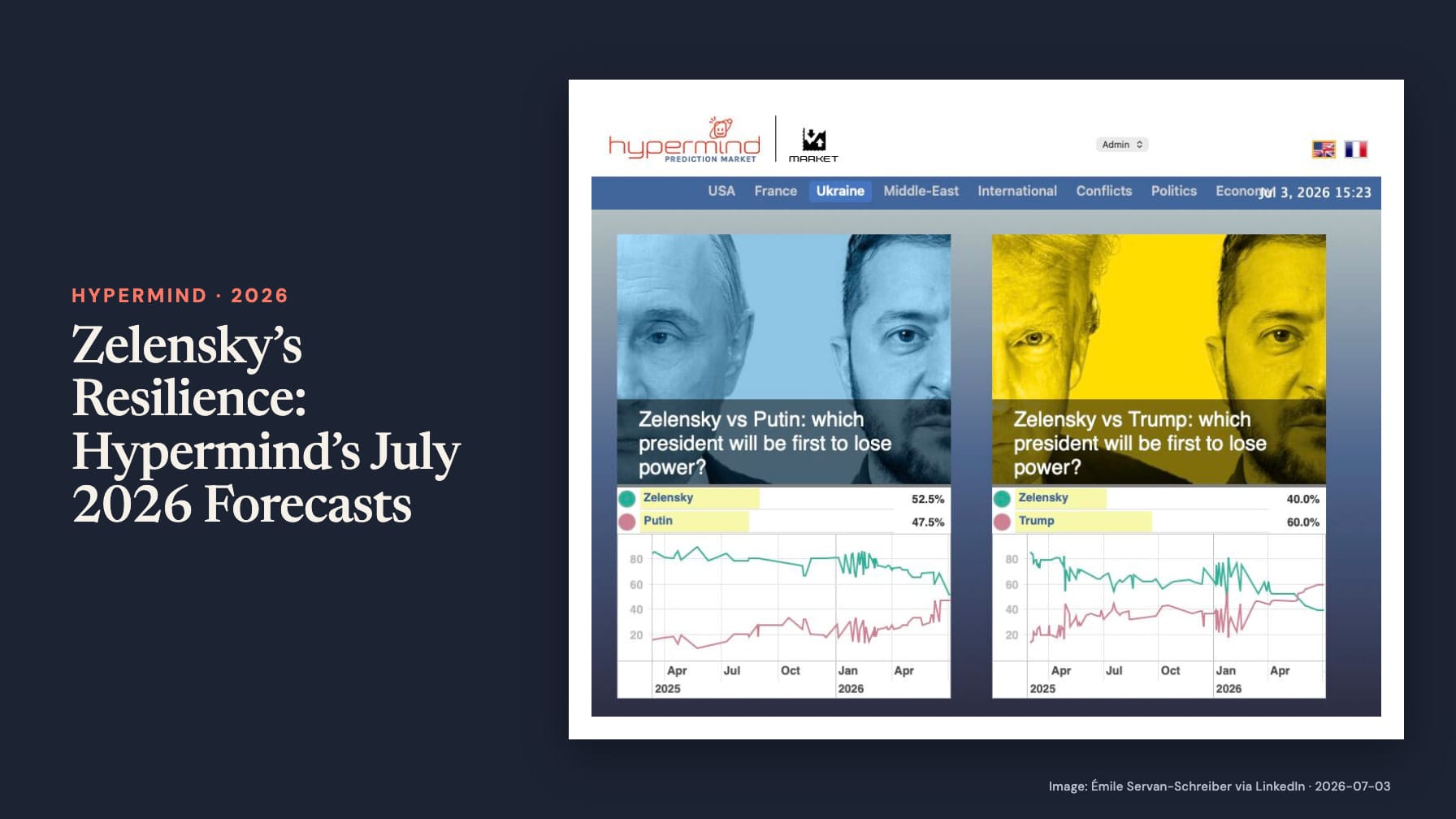
On 3 July 2026, Émile Servan-Schreiber wrote that Zelensky was looking increasingly resilient on Hypermind’s prediction market. The accompanying screenshot gives the observation substance: the crowd put Volodymyr Zelensky almost level with Vladimir Putin in a contest over who would lose power first, and gave Donald Trump the greater chance of leaving power before Zelensky.
The July 2026 leadership comparisons
The first question reads: “Zelensky vs Putin: which president will be first to lose power?” Its displayed probabilities are Zelensky 52.5% and Putin 47.5%. In the second, comparing Zelensky with Trump, the figures are Zelensky 40.0% and Trump 60.0%. These are the figures displayed in the screenshot shared on 3 July 2026.
The direction matters. A higher number here means a greater chance of losing power first. The Zelensky–Putin plot shows Zelensky’s line declining across the displayed 2025–2026 period. That is consistent with Servan-Schreiber’s description of greater resilience, even though Zelensky remained marginally more likely than Putin to leave first at this particular snapshot. Against Trump, the balance had moved the other way.
The 2022 baseline was a different question
An update reshared on 19 April 2022 said Zelensky had, for the first time since the invasion, a higher chance of staying in power than Putin. Its attached chart is titled “Putin vs Zelensky: chances of losing power in 2022”. It plots separate risks of departure within a calendar year, rather than the eventual order of departure.
The distinction changes how the numbers should be read. A calendar-year question asks whether a departure happens before a fixed deadline. A first-to-leave comparison asks which of two leaders leaves earlier, even if both remain in office for years. The two leaders’ departure risks in the 2022 chart were separate estimates, so they need not sum to 100%. The July 2026 paired alternatives do sum to 100%.
Resilience is relative to the question
The practical value of the comparison is that it makes a broad judgement about resilience explicit. A reader can see whether the crowd expects Zelensky to outlast a particular leader, rather than infer that from an assessment of his personal popularity or military position. The result also depends on the opponent: near parity with Putin and an advantage over Trump answer different questions.