
On 24 June 2023, as Wagner’s rebellion unfolded, Émile Servan-Schreiber pointed readers to Hypermind’s prediction market. He described the prices as a real-time measure of the effect on Putin’s position and warned that they would evolve rapidly over the following hours. The attached graphic fixes the observation more precisely: 09:20 GMT that Saturday.
Two questions during the rebellion
The left-hand panel asked whether Vladimir Putin would remain president of Russia until 31 December 2023. At the stated observation time, it showed yes at 60.0% and no at 40.0%. The line chart shows a sharp disturbance near the end of the series. The printed 60.0% is the dated observation to compare with later events, rather than a value inferred from the line’s height.
The second panel asked what percentage of Ukraine’s territory Russia would occupy by the end of November 2023. Its displayed distribution was 1.8% for at least 18% occupied; 48.6% for 12% to 17%, labelled as the March 2023 range; 35.1% for 6% to 11%, with 6% marked as the pre-war level; and 14.4% for 5% or less. These are probabilities assigned to territorial bands, not estimates of casualties or battlefield success.
The EU’s Foreign Affairs Council discussed the Wagner insurrection on 26 June. Its official account said ministers considered the Russian state and Putin’s personal credibility weakened. That corroborates the crisis context. It does not establish that the market measured the rebellion’s causal effect, or supply the territorial definitions needed to resolve the second contract.
December asked which leader would leave first
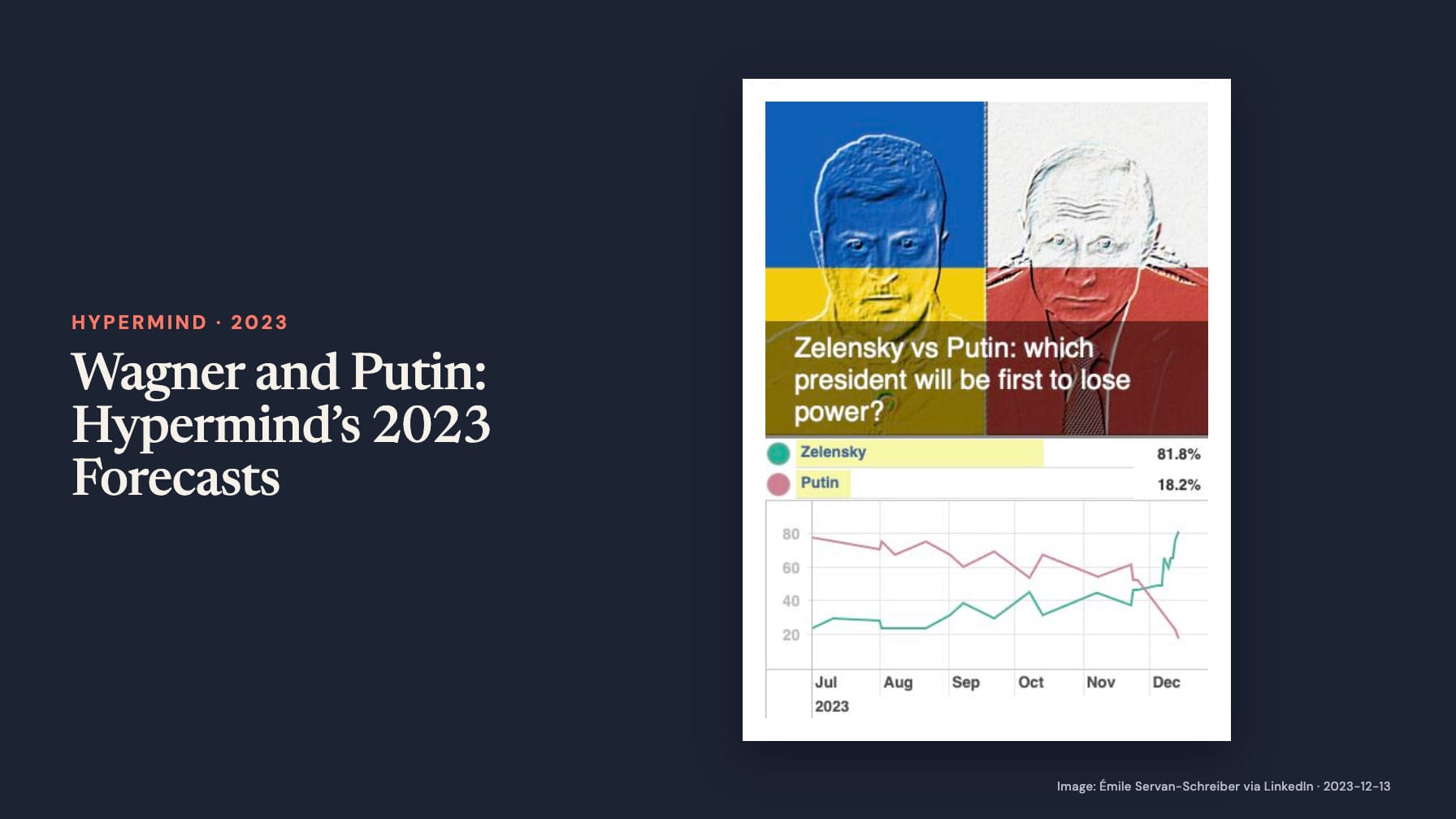
On 13 December, Servan-Schreiber posted that Putin was winning on Hypermind, adding an unhappy emoticon. The accompanying image shows the question behind his comment: the question was which president, Zelensky or Putin, would be first to lose power. It displayed Zelensky at 81.8% and Putin at 18.2%.
The December observation therefore expressed a relative expectation about the order of two leaders’ departures. It was neither an 81.8% estimate of a Russian military victory nor an updated price for Putin’s survival to the end of 2023. The question compares the order of departures rather than their dates.
What can be checked
China’s Ministry of Foreign Affairs records Putin exchanging New Year greetings as Russian president on 31 December 2023. That supports the ordinary reading of the June survival outcome; full settlement rules, territorial definitions and the December contract’s horizon remain unspecified. The December figure answers a separate question: even a forecast that one leader would leave first would not say when that departure would happen.
The earlier Hypermind Ukraine-war retrospective covers the forecasts before this shock. These later cards illustrate a practical distinction: a leader-survival probability, a territorial distribution and a relative-tenure forecast answer different questions. Keeping their definitions and dates attached to their numbers prevents an apparently continuous story from becoming a misleading time series.