
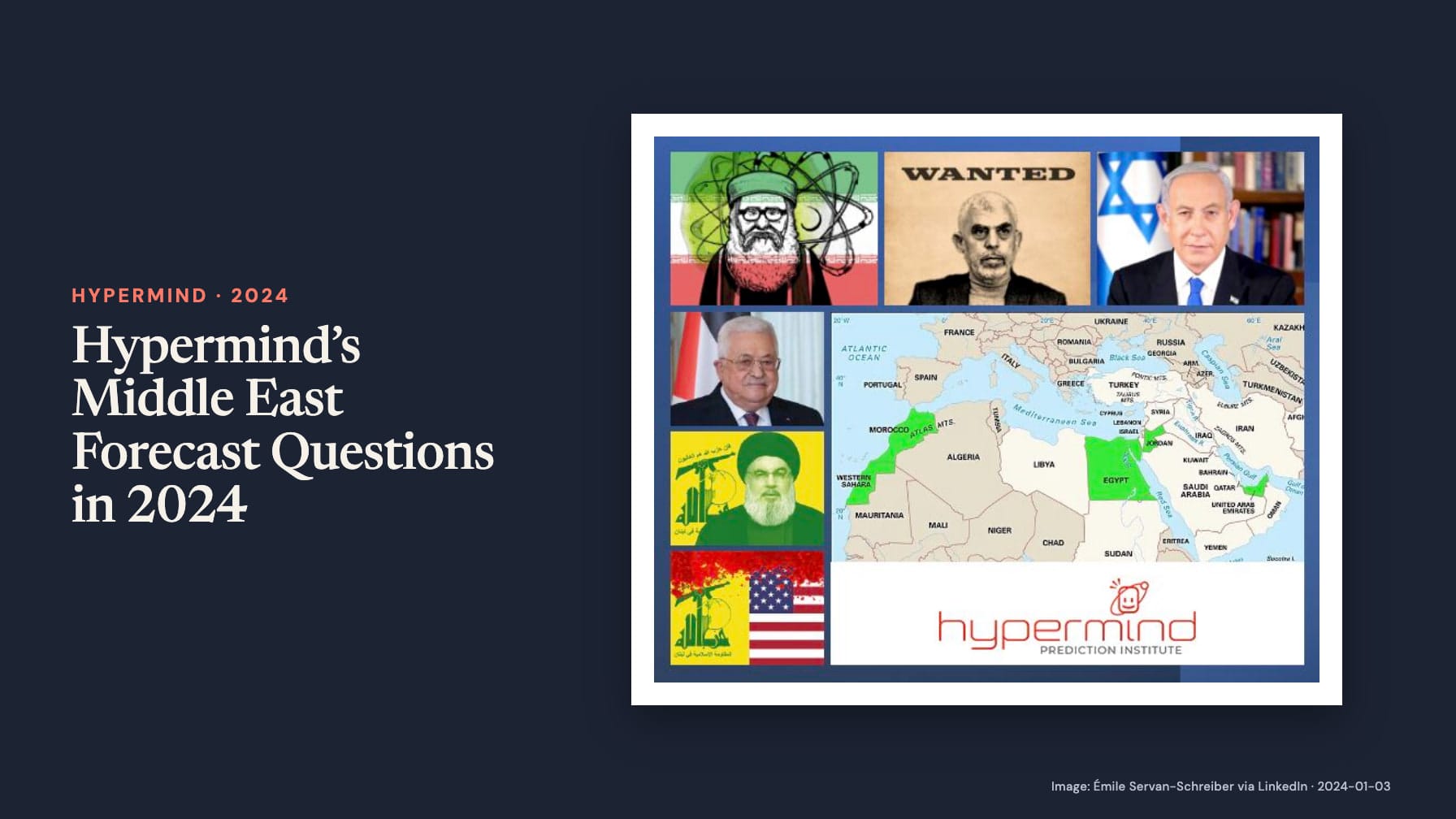
On 3 January 2024, Émile Servan-Schreiber announced a new set of Middle East questions on the Hypermind prediction market. Rather than ask whether a regional war was “likely” in the abstract, the market separated uncertainty into nine observable questions about military escalation, diplomacy and political leadership. His invitation asked people to help quantify and monitor the uncertainty.
Three kinds of uncertainty
- Military escalation: would Israeli army tanks enter Lebanon during 2024; would Hezbollah strike American military or diplomatic assets or people; and would Iran’s nuclear programme suffer a military attack or sabotage?
- Diplomacy: would Egypt, Morocco, Jordan or the United Arab Emirates break off diplomatic relations with Israel during 2024?
- Leadership: where would Hamas leader Yahya Sinwar be on 31 March, and Hezbollah leader Hassan Nasrallah on 31 December? Would Benjamin Netanyahu, Mahmoud Abbas or Ali Khamenei lose power in their respective jurisdictions during 2024?
These nine questions created a monitoring agenda with separate deadlines and outcomes. No probabilities were published with the announcement. Asking whether an event will happen is an essential first step, but judging forecast accuracy also requires the crowd’s answer before that event unfolds.
Two later events with a public record
Some of the risks became concrete during the year. On 13 October 2024, the UN peacekeeping mission UNIFIL reported that two Israeli Merkava tanks had forced entry into one of its positions in southern Lebanon. That provides direct official evidence relevant to the tank-entry question.
The UN’s subsequent report on Security Council resolution 1559 records that Israel announced the killing of Nasrallah on 27 September 2024 and Hezbollah confirmed his death on 28 September. His death occurred before the December deadline. Both this record and UNIFIL’s statement concern observed events, rather than the market’s probabilities or settlement decisions.
Why the question set matters
The useful contribution was a structure for monitoring a fast-changing crisis. Entry of tanks, severance of diplomatic relations and loss of office each require different evidence. Combining them into one broad escalation forecast would obscure which risk had changed. The date attached to each question also creates a point at which a forecast can be checked.
Our review of Hypermind’s Ukraine forecasts has probabilities and updates that make a fuller assessment possible. The January announcement illustrates the first stage of that work: deciding which uncertain outcomes deserve explicit questions, before evaluating the crowd’s answers.