
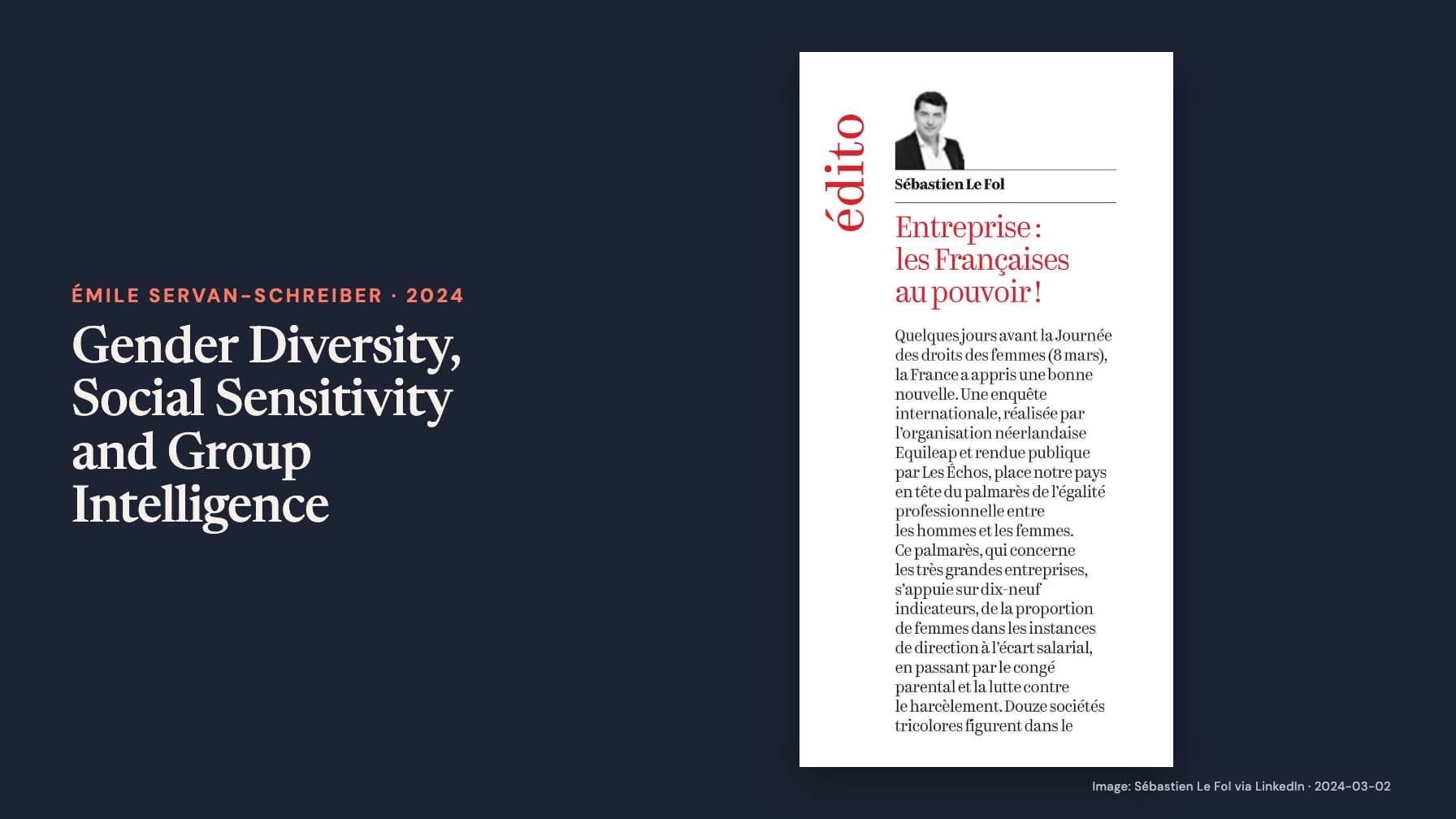
On 2 March 2024, Émile Servan-Schreiber shared Sébastien Le Fol’s editorial about France’s position in Equileap’s corporate gender-equality ranking. The introduction linked women’s participation to group intelligence, a subject that had appeared repeatedly in Servan-Schreiber’s posts and talks. The research behind that connection is more specific than the slogan suggests.
Equileap’s 2024 developed-markets report places France first in its country comparison and lists twelve French companies in its global top hundred. That ranking measures corporate gender equality. It does not measure group intelligence or demonstrate that gender composition causes a financial gain.
What the laboratory studies measured
In 2010, Anita Williams Woolley and colleagues published two studies involving 699 people working in groups of two to five. They found evidence for a collective-intelligence factor associated with performance across different tasks. It was not strongly correlated with the average or maximum individual intelligence of the members.
Instead, the factor correlated with average social sensitivity, a more equal distribution of conversational turns, and the proportion of women in the group. Social sensitivity concerns how well people read others’ social and emotional signals. These were findings about the groups and tasks studied, rather than a rule that any group becomes smarter whenever a woman joins it.
Servan-Schreiber emphasized emotional intelligence in a January 2015 post. In his long-form essay published on 8 March 2020, he explained the practical issue through listening and speaking time: a group cannot draw on all its members if some dominate and others remain silent. His essay adapted a talk delivered in Marseille on 19 January 2019.
Workplace evidence and a broader interpretation
On 2 March 2020, he shared Michel Ferrary’s SKEMA Observatory report on women’s representation in companies. The report examines gender composition alongside economic and stock-market performance. Its statistical associations offer a different kind of evidence from small-group laboratory tasks. Company size, sector and other differences complicate a causal interpretation.
A participant also reported a workplace conference for International Women’s Day on 8 March 2022. A participant described Servan-Schreiber discussing diversity, innovation and practical advice. Her account places the ideas in a practical setting: how colleagues can draw on different perspectives and use them to approach workplace problems.
His 2020 essay went further, arguing that women’s mate preferences helped shape the evolution of human intelligence. That is his evolutionary interpretation; neither the Woolley studies nor a corporate ranking proves it.