
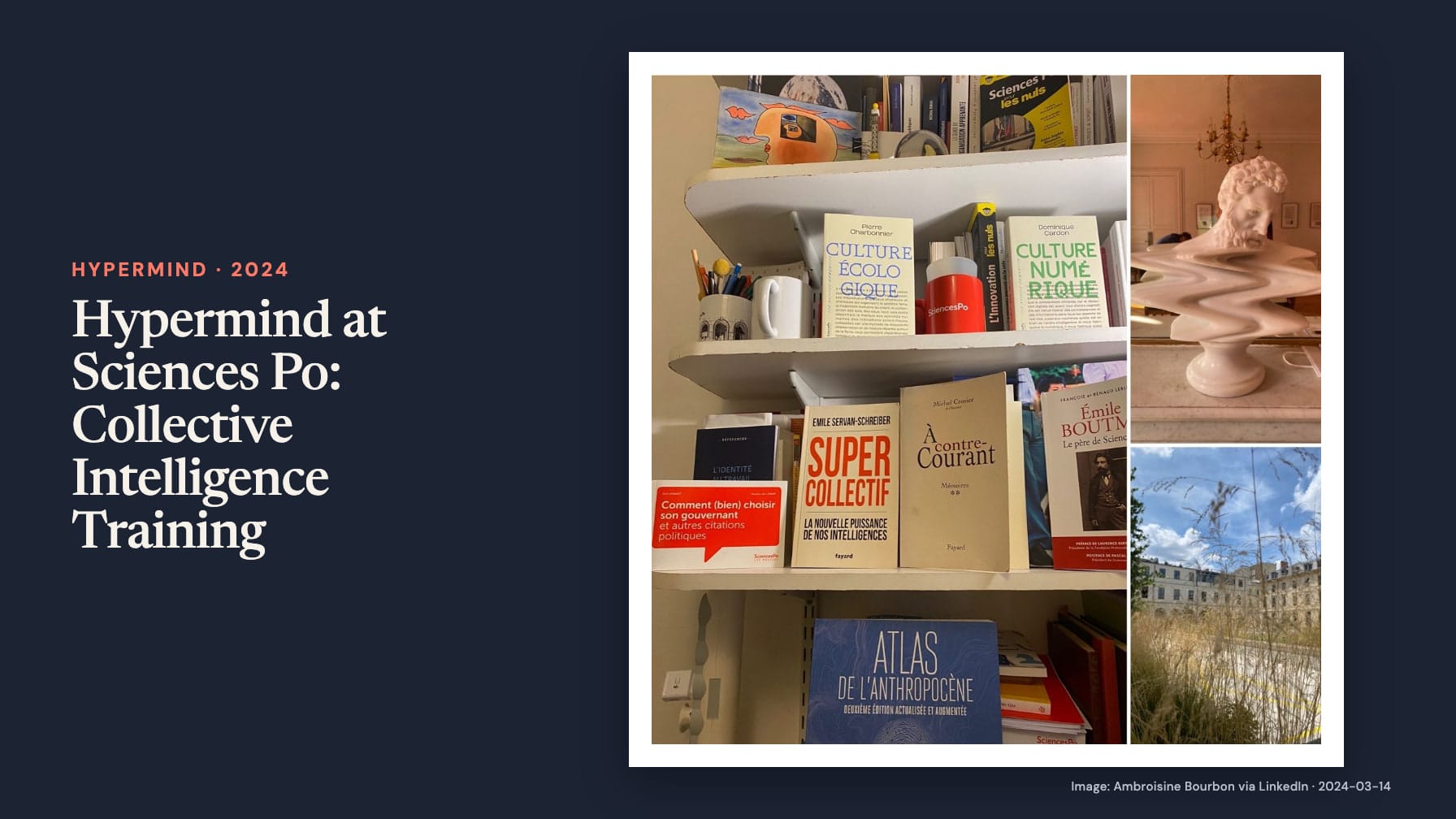
On 16 October 2019, Émile Servan-Schreiber described a first collaboration between Hypermind and Sciences Po Executive Education. The session brought collective intelligence and prediction into a leadership training programme. On 14 March 2024, he looked back warmly on working with Ambroisine Bourbon and her team around his book Supercollectif. The workshop took place in 2019; the later post returned to the experience of that collaboration.
An estimate, a creative exercise and a market
Camille Larmanou’s account, reshared on 17 October, describes accompanying Servan-Schreiber the previous day to train executives. Participants were asked to estimate his weight. Larmanou reported that the combined estimate missed by just 0.1 kg. The reported 0.1 kg error is a classroom anecdote rather than a repeated-trial accuracy result.
The workshop then moved through three connected topics. First came cognitive diversity, independence and aggregation: the ingredients needed to turn different judgements into a useful shared answer. Next came ideation and brainstorming on corporate problems, with a question about how to increase a group’s creativity. Finally, participants were introduced to prediction markets on Hypermind’s platform.
That sequence separates different jobs a group can do. Estimation combines answers about an existing quantity. Ideation generates possible answers to a problem. Forecasting assigns expectations to events whose outcomes have yet to be observed. A successful estimate demonstrates one exercise, but does not establish that the same group will produce accurate probabilities about the future.
Collective intelligence alongside artificial intelligence
Bourbon’s accompanying account placed the session in a Sciences Po Executive Education programme in partnership with thecamp for executives of a large French company. She also named Dominique Cardon’s contribution on digital culture and artificial intelligence. The programme thus brought human group judgement and digital technology into the same leadership curriculum.
Servan-Schreiber drew an analogy between the two subjects: artificial intelligence relies on collections of neurons, while human collective intelligence also needs deliberate organisation. His analogy made organisation the link between a human group and a computational system: what matters is how their components work together.
Hypermind’s own master-class page separately describes instruction on crowd wisdom, diversity and collective intelligence. The Sciences Po account shows what such teaching looked like in practice. Like the later forecasting seminar at IE University, it made the method something participants could try, question and distinguish from a persuasive lecture.