
On 4 September 2019, Émile Servan-Schreiber announced a change that was less a new venture than a consolidation: Lumenogic would become Hypermind. The company had already used the Hypermind name for its public prediction market. The announcement put its public forecasting, business services and collective-intelligence work under that single brand.
The image attached to the announcement reduced the history to one arrow and three names: NewsFutures in 2000, Lumenogic in 2010 and Hypermind in 2019. Behind that simple line were three changes in what the company was trying to make usable: public prediction markets, forecasting inside organizations, and a broader set of tools for collective judgement.
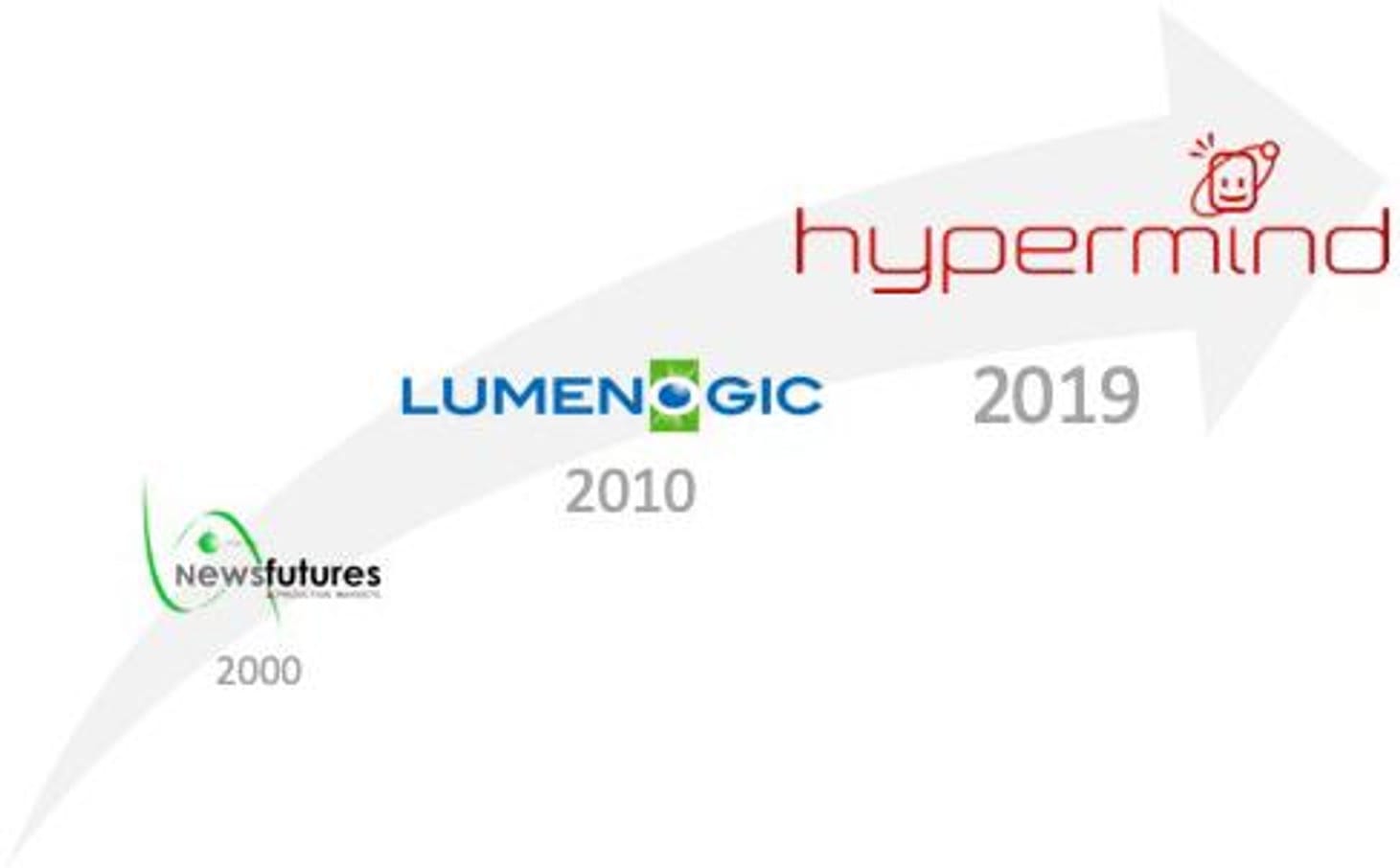
NewsFutures: a public market for probabilities
Servan-Schreiber and Maurice Balick developed the first NewsFutures prediction market in Annapolis, Maryland, in 2000. Hypermind's current history says that the platform launched first in France before USA TODAY hosted its US version as the Sports Exchange. Readers traded with play money on future outcomes, producing prices that could be read as probabilities and updated as events changed.
That period also supplied an important result for the later Hypermind model. A 2004 experiment compared NewsFutures' play-money forecasts with a real-money market across 208 National Football League games. Both had predictive power, and the paper found no significant accuracy advantage for the cash market. It did not prove that incentives never matter, but it showed that money at risk was not the only route to informative prices.
Lumenogic: from a public platform to organizational work
In 2010 the company adopted the Lumenogic name as it expanded its business-to-business offering. The change reflected a wider job than operating a public market. Companies and public institutions wanted help defining answerable questions, recruiting the right participants, aggregating their judgements, and connecting the output to a decision. Technology was only one part of that work.
The official history records another step in 2012, when Lumenogic joined the IARPA-funded Good Judgment Project. That research programme tested how ordinary people could forecast geopolitical events and how their judgements should be combined. It helped establish both the existence of consistently strong forecasters and alternatives to market trading, including direct probability elicitation and weighted aggregation.
Hypermind: one public identity
The Hypermind prediction market launched in 2014. Five years later, Servan-Schreiber wrote that the company was entering its third decade and would consolidate all activities under that name. The current Hypermind timeline dates the regrouping to 2018, while the public LinkedIn announcement is dated September 2019. The safest reading is simply that the official timeline and the public announcement record different points in the transition; neither source explains the one-year difference.
A single identity made the relationship between the pieces clearer. Hypermind could describe prediction markets, crowd-forecasting panels, idea prioritization and consulting as parts of the same collective-intelligence practice rather than as unrelated products. Later programmes with Johns Hopkins, the OECD and the Swedish Defence Research Agency would apply that practice to infectious disease, AI governance and the war in Ukraine.
Why the 2019 announcement matters
Company renamings can be cosmetic. This one is useful because it marks how the forecasting problem had expanded. NewsFutures demonstrated a public prediction market. Lumenogic carried the method into organizations and research programmes. Hypermind presented those strands as one system for turning distributed knowledge into accountable estimates.
That lineage also explains why later Hypermind projects do not all look like a trading screen. A crowd can express its judgement through prices, direct probabilities or structured comparisons. What makes the result a forecast is not the brand or interface, but the discipline around the question, the timestamp, the aggregation and the eventual outcome.