On 5 March 2020, as COVID-19 was spreading beyond China, the US House Committee on Science, Space, and Technology held a hearing titled “Coronaviruses: Understanding the Spread of Infectious Diseases and Mobilizing Innovative Solutions”. It had four witnesses: Suzan Murray of the Smithsonian, John Brownstein of Boston Children’s Hospital, Peter Hotez of Baylor College of Medicine, and Tara Kirk Sell, a senior scholar at the Johns Hopkins Center for Health Security. Part of Sell’s testimony was about a forecasting tool her team had built with Hypermind.
Five days later, on 10 March 2020, Émile Servan-Schreiber shared a video extract of that testimony on LinkedIn. Hypermind had already published a transcript on its blog on 8 March under the title “A client testifies in the U.S. Congress”.
What Sell told the committee
In her oral statement, Sell described crowd forecasting as a way to combine many people’s views into probabilities. This shows the most likely outcome and also how uncertain that outcome is. Her team, she said, had worked with Hypermind over the previous year on a crowdsourced disease-prediction platform. They had asked forecasters about Ebola in the Democratic Republic of the Congo, measles in the United States, and how many US counties would see Eastern equine encephalitis. More recently, they had asked how many countries would report COVID-19 cases and how many cases there would be worldwide and in the US.
On most occasions, forecasters provided accurate predictions about 3 weeks ahead of time.
Tara Kirk Sell, House Committee on Science, Space, and Technology, 5 March 2020
Sell also said that for global case counts, the forecasts showed high confidence in a rapid spread. She did not oversell the tool. On the few occasions the forecasts had missed, she said, forecasters probably lacked information. “Essentially, there’s no magic here,” she said. Without timely disease surveillance, forecasters have nothing to go on. Her written testimony added detail. The Johns Hopkins Disease Prediction Platform had been built with the help of Hypermind. It had posed more than 50 questions and had more than 1,000 registered users from 88 countries, more than 500 of them active forecasters. They came from public health, medicine, academia, veterinary medicine, the pharmaceutical industry, policy and other fields. The full evaluation of that platform was published the next year; we cover it in a separate article.
A proposal for France
On 28 March 2020, Le Point published an interview with Servan-Schreiber by Sébastien Le Fol. Most of it was about telework and management after the lockdown. But he also suggested that the French government invite any citizen who wished to help forecast how well a health policy would work before it was adopted. A prediction market would turn their views into probabilities. One question he suggested was how many confirmed COVID-19 cases France would have at the end of June: one forecast if schools reopened in early May, another if they stayed closed. He presented these as forecasts to sit alongside experts and statistical models, not to replace them.
In the same interview, Servan-Schreiber said that forecasters on the Johns Hopkins market had expected a strong signal from the World Health Organization from 23 January. In his account, the organisation waited about a week longer. That claim is his own reading of the market, and we have not checked it against the platform’s archived data.
Public forecasts and a teaching contest
Hypermind also opened coronavirus questions to the public. A screenshot of its dashboard taken on 3 April 2020 shows three of them:
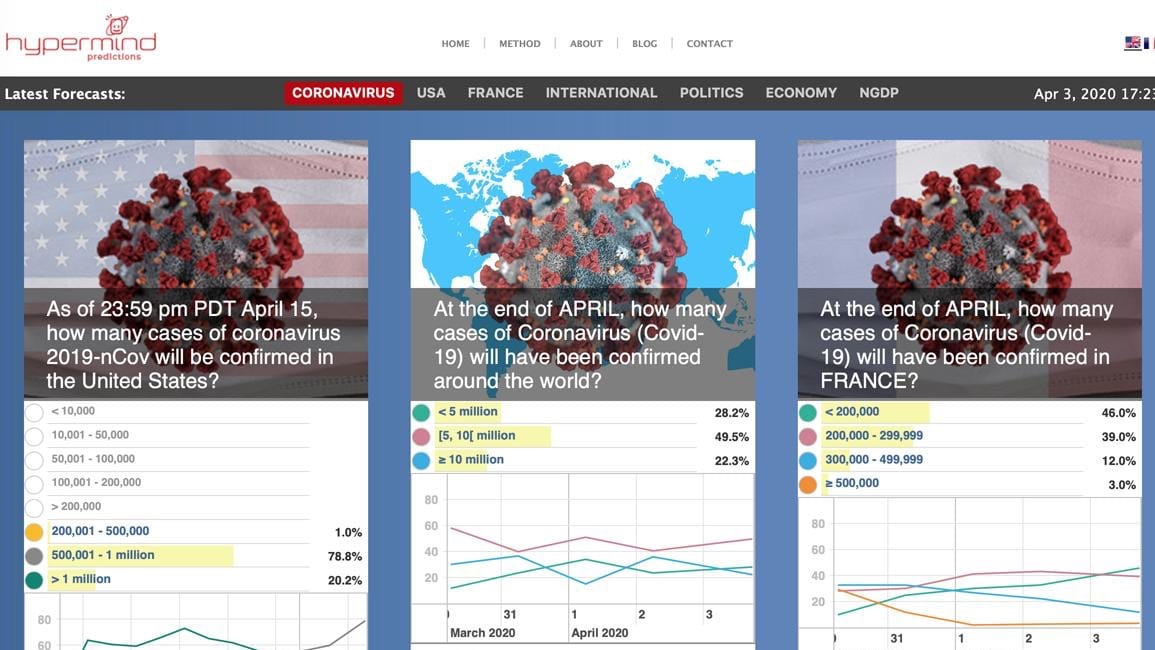
- Confirmed US cases by 15 April: 78.8% on 500,001 to 1 million, and 20.2% on more than 1 million. The WHO’s situation report of 16 April listed 604,070 confirmed US cases, inside the favoured range.
- Confirmed cases worldwide at the end of April: 49.5% on 5 to 10 million, 28.2% on fewer than 5 million. The WHO reported 3,175,207 cases on 1 May, so the crowd’s favourite range was wrong.
- Confirmed cases in France at the end of April: 46% on fewer than 200,000, and 39% on 200,000 to 299,999. The WHO listed 128,121 on 1 May, inside the favoured range.
These were probabilities, not promises. Two of the three favoured ranges were right, and the worldwide question shows how a crowd can expect faster growth than official counts later record. The WHO counts used here are only a reference point; each question resolved on its own stated source, which the screenshot does not show.
The same uncertainty reached business forecasts
The pandemic work soon extended beyond case counts. On 30 April, Servan-Schreiber shared an interview in the Moroccan newspaper L’Economiste framed around business restarts, border and school reopenings, infection peaks and geopolitical change. The article is now behind the publisher’s subscription wall, so those topics and its description of collective intelligence as decision support are the extent of what can be verified from the accessible page and Servan-Schreiber’s post.
On 10 May he announced the Prescience 2020 Challenge: a nine-month, US$5,000 competition in which members of Hypermind’s forecasting panel estimated worldwide quarterly and annual sales of cars, televisions, phones and other products. Hypermind intended the aggregated forecasts to inform strategic and commercial decisions at a time when historical data and established models had become less dependable. It was a different target from epidemiology, but the operating idea was the same: define outcomes that can be checked, collect probabilistic judgements, and update them as the shock unfolds.
On 20 March 2020, Servan-Schreiber announced a second project, with Scott E. Page of the University of Michigan. “Pandemic Impacts” was a free prediction-market contest for teachers to use in online classes. It ran eight markets from 17 March to 15 April. Participants traded with play money, which is virtual currency with no cash value. A US$500 pool, paid as gift certificates, was shared among those who finished with a profit. Most of the questions were about the pandemic’s side effects: the Dow Jones index on 15 April, US box-office takings, the happiness of tweets, air pollution in Los Angeles, and the number of followers of the CDC’s Twitter account.
A further teaching project followed in Morocco. On 27 April, Servan-Schreiber reshared an invitation from the UM6P School of Collective Intelligence for Moroccan residents to attend six sessions on crowd wisdom, probabilistic thinking and accurate forecasting, then enter a prediction contest on the pandemic’s effects in Morocco. The sign-up form placed in the original post’s first comment is now only a historical registration link, but the course outline remains visible in the LinkedIn post.
The contests continued into 2021
On 4 January 2021, Hypermind launched an Open Philanthropy-backed contest about recovery from COVID-19, beginning with the speed of US vaccination. A May follow-up asked whether repeated vaccinations would be needed in later years. Both first comments pointed participants to Hypermind’s forecasting platform; that old entry point no longer supplies a public archive of the questions or outcomes, so the surviving posts document the calls to forecast rather than their results.
The most detailed follow-up came on 18 September. Hypermind offered US$15,000 for forecasts of COVID-19 mortality in the United States and worldwide over the next six months. Instead of only fixed calendar deadlines, participants made rolling forecasts for 30, 60 and 90 days ahead, with each day’s estimate later compared with the observed outcome at the same horizon. The collective projections were to remain public in real time, and Open Philanthropy supported the experiment. The contest URL from Servan-Schreiber’s first comment now returns a service-unavailable page, so the dated LinkedIn post is the durable evidence here.