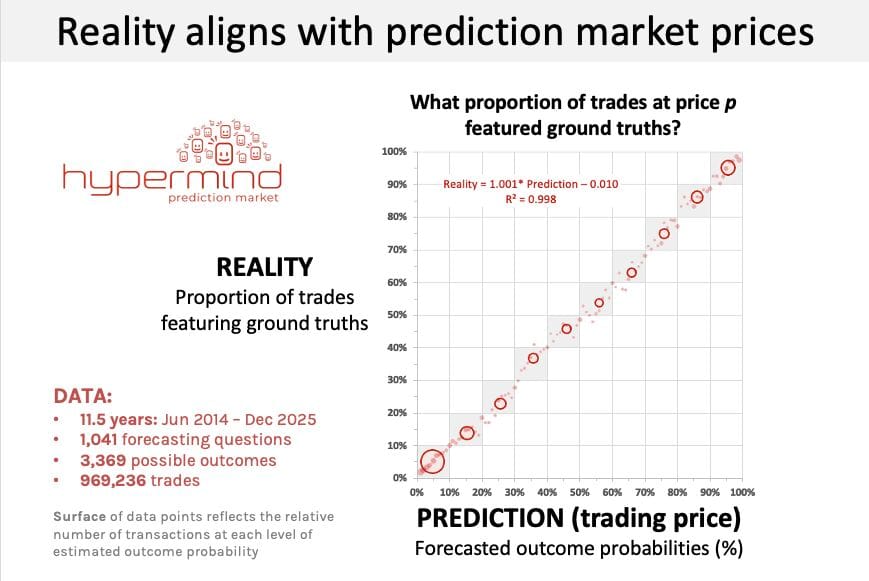
On 1 January 2026, Émile Servan-Schreiber posted a chart he had just recomputed. It covers every current-events question resolved on the Hypermind prediction market from its launch in 2014 up to 31 December 2025: 1,041 questions, 3,369 possible outcomes and 969,236 trades, or eleven and a half years of forecasting. His verdict was that the match between market prices and real-world frequencies was “simply amazing”.
The chart answers one question: when the market priced an outcome at a given probability, how often did that outcome actually happen?
What calibration means
A forecaster is well calibrated if their probabilities mean what they say. Of all the events given a 70% chance, about 70% should happen and about 30% should not. A single forecast cannot be judged this way. A forecast of 70% that misses is not necessarily wrong, because 30% outcomes are supposed to happen three times in ten. Calibration can only be checked across many forecasts.
On Hypermind, a forecast is a trade. Each outcome is a contract that pays out if it happens, and its price, between 0 and 100, is read as the crowd’s probability. To check calibration, every trade is grouped by price and the analysis asks what share of the trades in each group were on outcomes that came true. If the market is calibrated, the points line up on the diagonal: trades at 20 win about 20% of the time, trades at 80 about 80%.
The 2025 result
On the chart, the points sit close to that diagonal from the lowest prices to the highest. A straight-line fit gives reality = 1.001 × prediction − 0.010, with an R² of 0.998. In plain terms, the slope is essentially one and the line sits about one percentage point below the diagonal, and the fit explains almost all of the variation between price levels.
Servan-Schreiber stressed that this calibration is “entirely endogenous”. No statistical correction is applied after the fact; the prices are simply what traders paid. He offered two readings. One is that people, collectively, can discern the probabilities underlying events, like the hero who sees the code at the end of The Matrix. The other is that the future really is probabilistic: “Nothing ever ‘had’ to happen.”
Three snapshots of the same market
Servan-Schreiber has published the same analysis several times, each covering a longer stretch of data.
- December 2019. “Can Hypermind predict the future?” covered 400 questions, 1,185 possible answers and 537,640 forecasts made between spring 2014 and spring 2019.
- February 2023. “This is how good Hypermind is at predicting the future” covered 816 questions, 2,535 possible outcomes and 875,735 forecasts over eight and a half years on geopolitics, business and economics. It reported, for example, that 91% of trades made at a price of 90 were on outcomes that happened, and 9% of trades at a price of 10.
- January 2026. The latest chart: 1,041 questions, 3,369 outcomes and 969,236 trades to 31 December 2025.
Across the three, the picture is stable: as the record grows, the points stay on the diagonal. A calibration chart is a demanding test because it includes every question the market took on, not a selection of its successes.
The 2019 article also gave a reminder of what a probability is. On the eve of 2020, Hypermind gave Donald Trump a 51% chance of re-election, any other man 40% and any woman 9%. Trump lost that November. A 51% forecast was never a prediction that he would win; it said the race was close to a coin toss.
What makes it notable
Hypermind is a play-money market. According to its accuracy page, participation is free and trades are made with play money only. Everyone starts with the same endowment and there are no refills, so poor forecasters lose influence while good ones gain it. The best traders share yearly prizes of a few thousand euros in proportion to their play-money profits. In 2004, Servan-Schreiber co-authored “Prediction Markets: Does Money Matter?”, which found that a play-money market forecast the 2003 American football season as accurately as a real-money one. A July 2026 Hypermind report extends this analysis and compares the market with real-money platforms.