
On 27 January 2026, Rafał Kierzenkowski, who leads strategic foresight at the OECD, presented to an expert hearing of the European Economic and Social Committee (EESC) in Brussels. The topic was “strategic foresight in geopolitics”. Two of his sixteen slides covered forecasting tools: one on crowd forecasting with Glimt, the Swedish government-backed project that runs on Hypermind’s platform, and one on AI forecasting with The Forecasting Machine.
Reposting the slides on 31 January, Émile Servan-Schreiber wrote that the OECD’s Strategic Foresight Unit had been working with his teams for two years to test both technologies. In his view, geopolitical forecasting has become mandatory for strategic decisions in business, not only in government.
The hearing and what it fed into
The EESC is the EU’s advisory body for employers, workers and civil society. It was preparing its opinion on the European Commission’s 2025 Strategic Foresight Report, reference INT/1099, with Philip von Brockdorff as rapporteur. The opinion was adopted at the March 2026 plenary. It argues that the Commission’s report is “too closely aligned with current political trajectories” and asks for several divergent scenarios rather than one expected path.
Kierzenkowski’s talk addressed the same concern. He summarised it in three messages:
- Foresight turns uncertainty into action. The OECD’s Strategic Foresight Toolkit for Resilient Public Policy is built around decisions. Teams challenge assumptions with possible disruptions, build scenarios, stress-test strategies, pick robust options and turn the results into plans with indicators and decision triggers.
- New forecasting methods make foresight more useful to policy. Crowd and AI forecasting add probabilities, diversify viewpoints and help detect signals, so that experts can update scenarios as evidence changes. He cautioned that they do not replace governance: outputs still need validation, bias management and clear links to decision points.
- Success is hard to measure. Good foresight can look like “nothing happened”, because the worst case was avoided. He argued that it should be judged on preparedness, robustness and response rather than prediction accuracy alone.
Two tools, two roles
The slides give each method a distinct role. Glimt gathers forecasts from thousands of volunteer citizens on questions about the war in Ukraine; our report on its first-year results covers the details. The Forecasting Machine slide describes “predictive analytics at unparalleled speed and scale using generative AI models and real-time information”. It highlights both the probability levels and how they change over time as a way to detect signals. It also notes that the platform is paywalled.
Servan-Schreiber put the difference in his own terms. Crowds engage tens of thousands of human forecasters, while the machine lets an analyst ask, as he wrote, 100 times more questions and get answers 100 times faster. That is his claim about throughput, not a measured accuracy result.
Earlier: a question for the foresight community itself
The collaboration was already public by October 2025. On 6 October, Servan-Schreiber presented The Forecasting Machine at the annual meeting of the OECD’s Government Foresight Community in Paris. According to the OECD’s summary, the meeting brought together 159 participants from 37 countries under the theme “Foresight in the Age of AI”. The summary describes the platform as synthesising real-time news with an ensemble of models to produce transparent, probabilistic forecasts. Glimt was presented at the same meeting by Ivar Ekman of the Swedish Defence Research Agency (FOI).
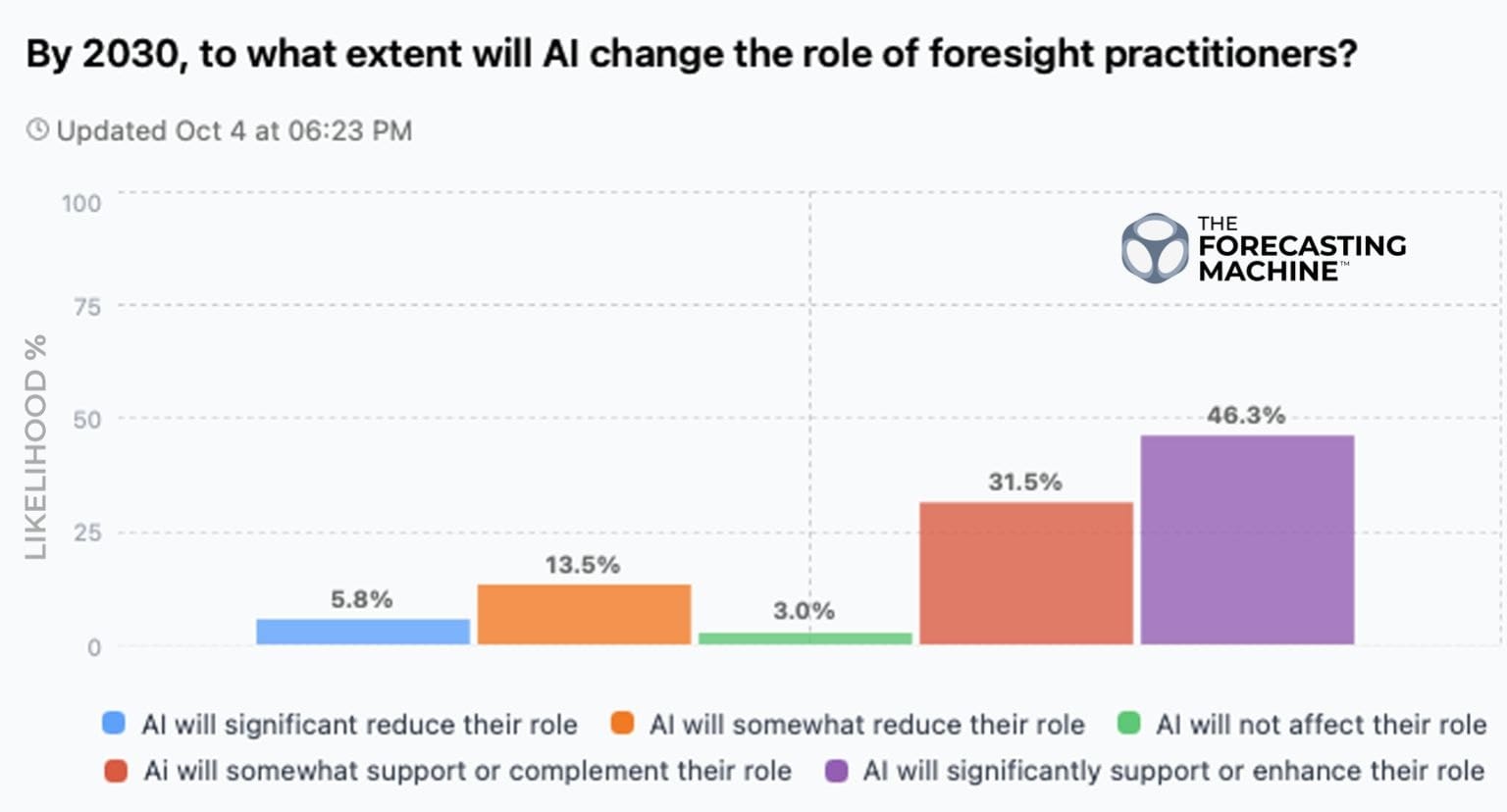
Before the meeting, Servan-Schreiber put the meeting’s own question to the machine: by 2030, will AI replace or empower foresight practitioners? It put about 78% on AI supporting or significantly enhancing their role, and about 19% on it reducing their role. Its rationale argued that practitioners who adopt AI tools would become more productive and influential, while those who resisted might be displaced. This is an open forecast about 2030, not a result.
In breakout sessions later that day, according to the OECD summary, participants discussed how AI might change their jobs. They stressed the human and interpersonal side of foresight and ethical questions, including AI’s environmental impact. That matches Kierzenkowski’s point in Brussels: forecasts are an input to judgement, not a substitute for it.