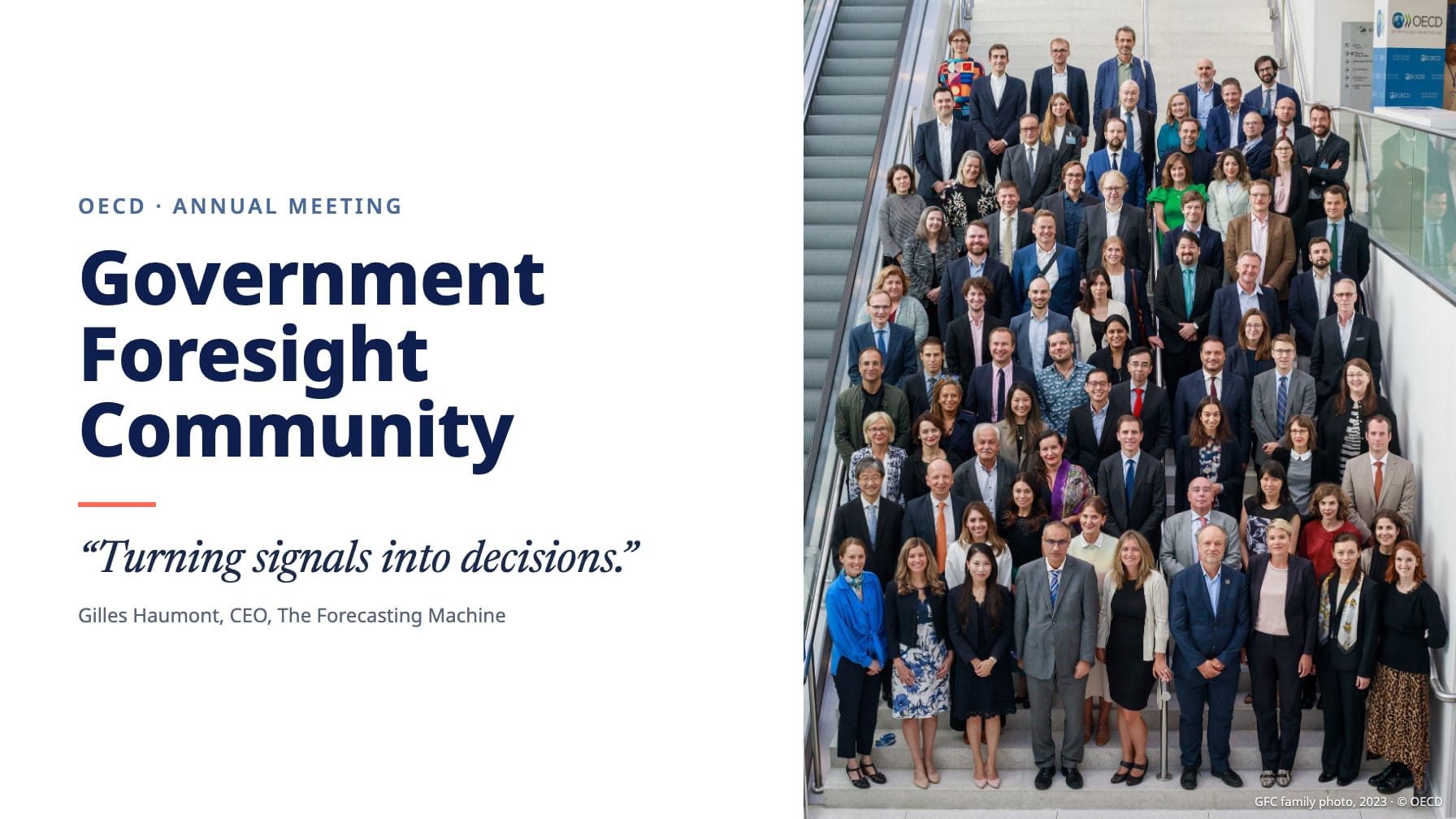
Gilles Haumont, The Forecasting Machine’s co-founder and CEO, attended the OECD Government Foresight Community’s 2026 annual meeting, according to his account published on LinkedIn on 8 October. He described two days with 120 senior foresight practitioners from governments and international organisations around the world, focused on a practical challenge: turning signals into decisions.
His takeaway was about what happens after the analysis. Foresight teams can identify possible changes and explore their consequences, he argued, yet still struggle to get that work into decisions quickly enough. He said the conversations reinforced the need for tools that combine speed, scale and actionability.
A community built around public-sector foresight
The OECD’s Government Foresight Community brings together public-sector practitioners to exchange methods and experience and strengthen foresight capacity. The OECD describes its annual meeting as an invitation-only gathering at its headquarters each October, with one day devoted to methodology and institutionalisation and another to applying foresight to thematic issues. The network also holds a virtual GFC Day and regular masterclass seminars.
The OECD’s Strategic Foresight Unit sits in the Office of the Secretary-General. Its remit includes strengthening foresight within the organisation, supporting government capacity through networks such as the GFC, and bringing future-oriented analysis to policy debates. Haumont thanked Rafał Kierzenkowski for convening the community. The OECD identifies Kierzenkowski as Senior Counsellor for Strategic Foresight and Head of the Unit.
The last mile from analysis to action
The bottleneck isn't the forecast, it's making it actionable at the speed institutions need.
Gilles Haumont, LinkedIn, 8 October 2026
Haumont framed this as the problem The Forecasting Machine is being built to address. In his view, change moves faster than institutional cycles, so producing scenarios alone is insufficient: foresight tools must help institutions act on what they learn. That is his assessment of the discussions and the company’s ambition.
The OECD’s own Strategic Foresight Toolkit for Resilient Public Policy, published in January 2025, makes the connection to action explicit. Its five-step process takes users through challenging assumptions, creating scenarios, stress-testing strategies and developing actionable plans. Read alongside that methodology, Haumont’s argument concerns the route from an analytical result to a policy choice, rather than the production of more analysis for its own sake.
What the OECD forecasting record establishes
Haumont also said that the OECD is already using The Forecasting Machine. Earlier public material documents forecasting experiments and presentations that give context to that statement.
A 2024 OECD Global Strategy Group background note reported a pilot on possible AI benefits and risks by 2030. Human forecasts were its primary focus; an early AI-powered Forecasting Machine answered the same questions as a comparison. The note described the exercise as experimental and indicative, and treated the AI output as a baseline rather than an authoritative forecast. Our account of the Hypermind pilot explains that distinction.
The OECD’s summary of the GFC meeting on 6 October 2025 lists Émile Servan-Schreiber among the panelists and describes an AI forecasting presentation combining real-time global news with an ensemble of models to produce transparent probabilities. In a presentation dated 27 January 2026, Kierzenkowski explicitly named The Forecasting Machine and highlighted probability levels and their changes over time as inputs to signal detection. These earlier discussions are covered in our report on the OECD’s use of crowd and AI forecasting in policy planning.
The 2026 meeting adds Haumont’s account of the practical need behind that work: making foresight usable within institutional decision cycles. The OECD toolkit supplies a useful frame for that ambition. A forecast becomes relevant to policy when it helps people examine an assumption, test a strategy or decide how to prepare.