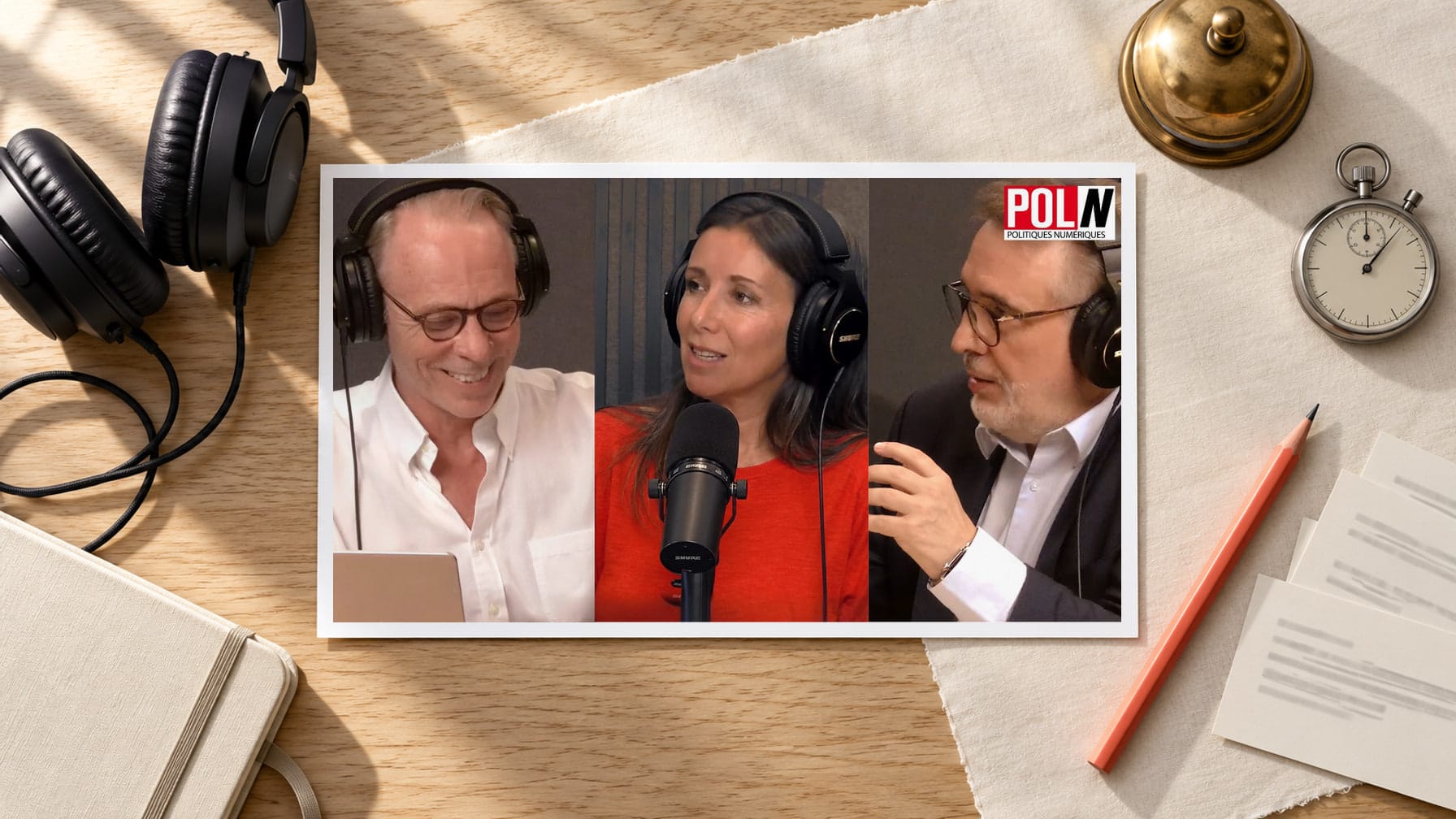
On 2 October 2026, the journalist Delphine Sabattier opened a new season of her podcast POL/N (Politiques numériques) with an episode titled “Numérique : quel candidat en parlera le mieux ?”, or which candidate will talk about digital issues best. The season is a 2027 presidential special: debates until the end of the year, then interviews in 2027 with candidates and their advisers on how they approach digital policy. Her guests were Bernard Benhamou, secrétaire général of the Institut de la souveraineté numérique and a former interministerial delegate for internet uses, and Émile Servan-Schreiber, co-founder and Chief Scientific Advisor of The Forecasting Machine and CEO of Hypermind. Servan-Schreiber shared the episode on LinkedIn on 3 October, presenting it as The Forecasting Machine’s first predictive analyses of the role of digital technology in the 2027 campaign.
Sabattier, who had already interviewed Servan-Schreiber about the machine on B SMART in March, introduced it as an engine that runs several AI models, searches current news in real time and combines what they find into forecasts. She asked him to bring the machine’s answers to four of the questions she wanted to cover, then put each one to Benhamou.
Digital is everywhere in the campaign, and named nowhere
Benhamou does not expect digital policy to stand on its own as a campaign theme. He expects it to run through the others: whether AI unsettles whole professions, including highly skilled ones; AI as a military matter, visible daily in Ukraine and Iran; and the energy the technology consumes. For campaigners, the most pressing strand is interference and disinformation that now rely heavily on AI. He noted that Gabriel Attal, Édouard Philippe and, he believed, Raphaël Glucksmann had recently faced such attempts, and he expected them to multiply sharply in the months ahead.
Servan-Schreiber described the mood as anxiété numérique, digital anxiety. Digital technology does not appear among the French public’s main concerns in surveys by pollsters such as Ifop, he said, yet it touches education, health, jobs, young people’s phones and social media, and disinformation. When he and Sabattier worked together at Science & Vie Micro, a magazine that no longer exists, digital technology was a source of hope. Today it is a source of anxiety that neither voters nor politicians name: candidates talk about purchasing power, he said, rather than AI’s impact on jobs and on young people’s first jobs.
What worries France most over the next five years
The first question asked the machine which source of risk is the most worrying for France and the French over the next presidential term. The options were geo-economic conflict, military conflict, social conflict, climate change, artificial intelligence, pandemics and debt. Servan-Schreiber said he wanted to see where AI would land, since global assessments such as the World Economic Forum’s rank it among the main threats of the coming years. For France specifically, the machine put climate change first at about 40%, debt and social conflict at about 20% each, and AI fourth, at around 5%.
Benhamou read the ranking less as indifference than as a stage in a learning curve. When his institute was founded, he said, nobody understood the very notion of digital sovereignty; today he is only asked how to achieve it. He pointed to the moment Anthropic’s latest models were cut off for non-Americans at Washington’s request, access that he said has since been restored. Every declared candidate reacted, which he could not recall ever happening on a technology issue. LCP reported in June that Attal, Philippe, Bruno Retailleau, Jean-Luc Mélenchon and Jordan Bardella had all responded publicly.
The institute is preparing a report on industrial policy for digital technology, which he expects to publish at the very end of 2026 or early in 2027. In his reading, the doctrine of leaving everything to the market has ended. Asked whether AI industrial policy is well championed by politicians, his short answer was no. There is political room, he argued, to push further on the Draghi and Letta reports on European funding and common debt for research and business. But not, in his view, as far as the €750–800 billion a year of additional investment that Mario Draghi’s report called for.
AI’s effect on the election: rather negative, at 70%
The second question asked whether AI’s impact on the presidential election would be rather positive or rather negative. The machine answered rather negative, at 70%. Benhamou called the figure massive, but not surprising. Sabattier stressed that this is not an opinion poll. Servan-Schreiber described it as a reasoned forecast: AI consolidates what has been published on the subject worldwide, and on France in particular, and weighs it against the record of comparable situations in the past.
The machine’s reasoning, as he relayed it, is that the uses of AI most relevant to a campaign lean negative. Many French voters will turn to AI for information about the campaign, in an information environment that AI has already badly degraded. Even systems built with good intentions hallucinate, so false claims will surface by accident as well as through malice. People trying to inform themselves properly may still be misled. The pollster Laure Salvaing listed AI’s still poorly understood effect on campaigns and the spread of deepfakes among her pitfalls for 2027 in a cross-interview with Servan-Schreiber for Atlantico last month.
Foreign interference: many targets, little measurable damage
Sabattier then asked which candidate is most likely to be penalised by foreign digital interference or influence operations. Benhamou answered first, in his own name: everyone between the two extremes. On his reading of the campaign so far, deepfakes and the other tools of disinformation have spared the candidates at both ends of the spectrum and concentrated on everyone else.
The machine agreed on who will be targeted but went further: no candidate will be significantly penalised. Many will be attacked, but the record of other campaigns in other countries that faced such interference suggests that its effect on the result is very hard to demonstrate.
Benhamou’s answer was about margins. He cited a recent study suggesting that AI is about four times as persuasive on electoral choices as a traditional political campaign. A paper published in Nature in December 2025 reported a comparable direction: in experiments around the 2024 US, 2025 Canadian and 2025 Polish elections, conversations with AI models advocating a candidate shifted preferences more than traditional video advertisements typically do. No technology can swing 10% of the vote in a democracy, Benhamou said, but democratic elections are decided by one to three points. France’s first round, he expects, will come down to a few tens of thousands of votes. If some voters treat AI as a wise and dispassionate oracle on which programme serves them best, an effect of under one percent could still decide the outcome.
Where Europe can still compete
The last question asked whether Europe can still become a digital power that rivals the United States and China, and in which field. The options were artificial intelligence, semiconductors, quantum computing, cybersecurity, cloud and digital infrastructure, green and sustainable technologies, and digital platforms and online services. According to the machine, quantum computing is the only field where Europe could become a genuine competitor, rather than merely reduce its dependence. On cloud, Europe is reducing its dependence, not competing head-on with the Americans and the Chinese.
Benhamou rejected the framing. If Europe does not exist technologically, he said, it will exist neither industrially, economically nor politically; watching the trains go by means becoming a vassal province. In his view, institutional creativity only comes out of crisis. ARPA, later DARPA, was created after Sputnik and moved fast because its military status let it bypass the usual procurement rules. Europe’s own crisis response was NextGenerationEU, the post-Covid recovery plan funded by €750 billion of joint borrowing by the 27 member states, which Berlin had long ruled out. He noted that Bundesbank president Joachim Nagel has since argued that German industry’s situation will require common debt again. He sees Europe’s strengths in health, sustainable energy, financial technology and transport beyond the car industry, and wants technologies judged by how they fit into each sector rather than in isolation.
Servan-Schreiber, who said he enjoys playing the machine’s advocate, pushed back. DARPA is American, he noted, and its move-fast, cut-the-bureaucracy culture is deeply American rather than European. A closer analogy, Airbus catching up with Boeing, took 20 years, as did China’s catch-up with the United States, in a far less fragmented setting than Europe’s. Without enthusiasm, though, he added, Europe will never get there at all.
Skipping digital has become a political risk
Benhamou’s closing point was that no political, economic, strategic or military question today is independent of technology, and that politicians can no longer treat it as a matter of logistics. Whether that produces courageous answers depends on many things, he said, including what experts manage to bring to the candidates.
Mais fondamentalement, faire l’impasse est devenu un risque politique.
Bernard Benhamou, POL/N, 2 October 2026
In our translation: “But fundamentally, skipping the issue has become a political risk.” That, he added, was not the case at previous elections.