
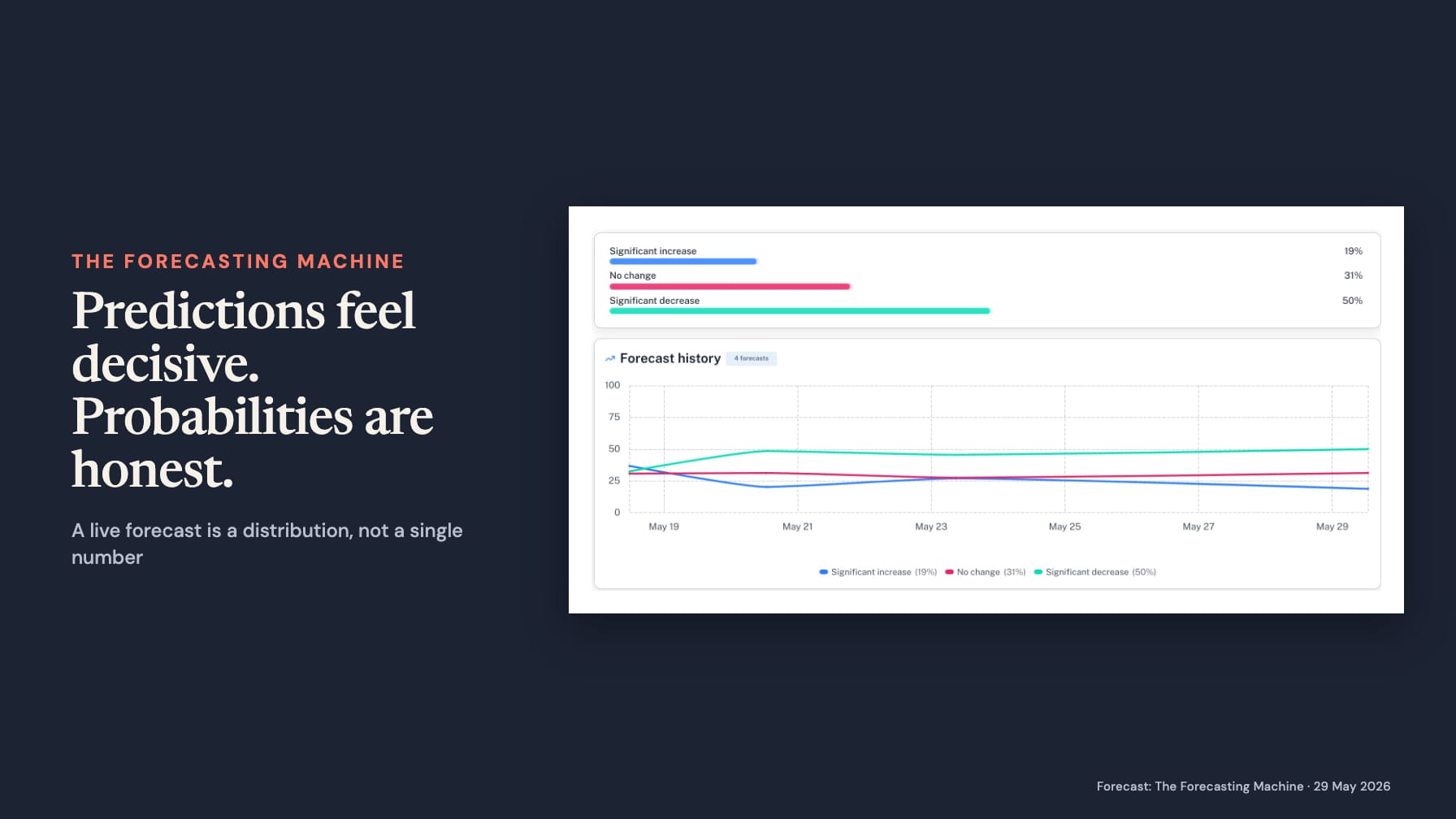
Ask a forecaster “will it rain tomorrow?” and the honest answer is never yes or no. It is a number: a 70% chance. That number carries more truth than any confident headline, because it admits what every real forecast must — that the future is a distribution of outcomes, not a single fixed point waiting to be guessed.
Point predictions hide their own uncertainty
A single number feels decisive. “Sales will be $4.2M next quarter” is easy to put on a slide and easy to act on. But it quietly throws away the most important information you have: how sure you are. A forecast of $4.2M that could plausibly land anywhere between $3M and $6M is a completely different business decision than one tightly clustered around $4.2M — yet the point estimate renders them identical.
When you collapse a distribution to its mean, you also invite a subtle error: people read the number as a promise. The moment reality lands at $3.9M, the forecast looks “wrong,” even though it may have been excellent. A probability, by contrast, can only be judged over many calls — and that is exactly the discipline good forecasting demands.
A forecast that cannot be wrong in an interesting way is not a forecast. It is a wish with a decimal point.
Emile Servan-Schreiber
Distributions make decisions better
Once a forecast is a distribution, you can ask the questions that actually matter for a decision:
- What is the chance we miss the floor we have promised investors?
- How much upside are we leaving on the table if we plan only for the median?
- Where is the tail risk large enough to justify a hedge?
None of these can be answered by a point estimate. All of them fall out naturally once you carry the full shape of the uncertainty through to the decision.
How we build forecasts as distributions
Every forecast The Forecasting Machine produces is an ensemble: many models, many signals, re-aggregated continuously as new information arrives. The spread between those views is not noise to be averaged away — it is the signal that tells you how confident the system should be. We surface that spread directly, as calibrated probabilities you can act on.
Predictions feel decisive. Probabilities are honest. And in the long run, honesty compounds — which is why we build every forecast as a distribution, not a single number.