
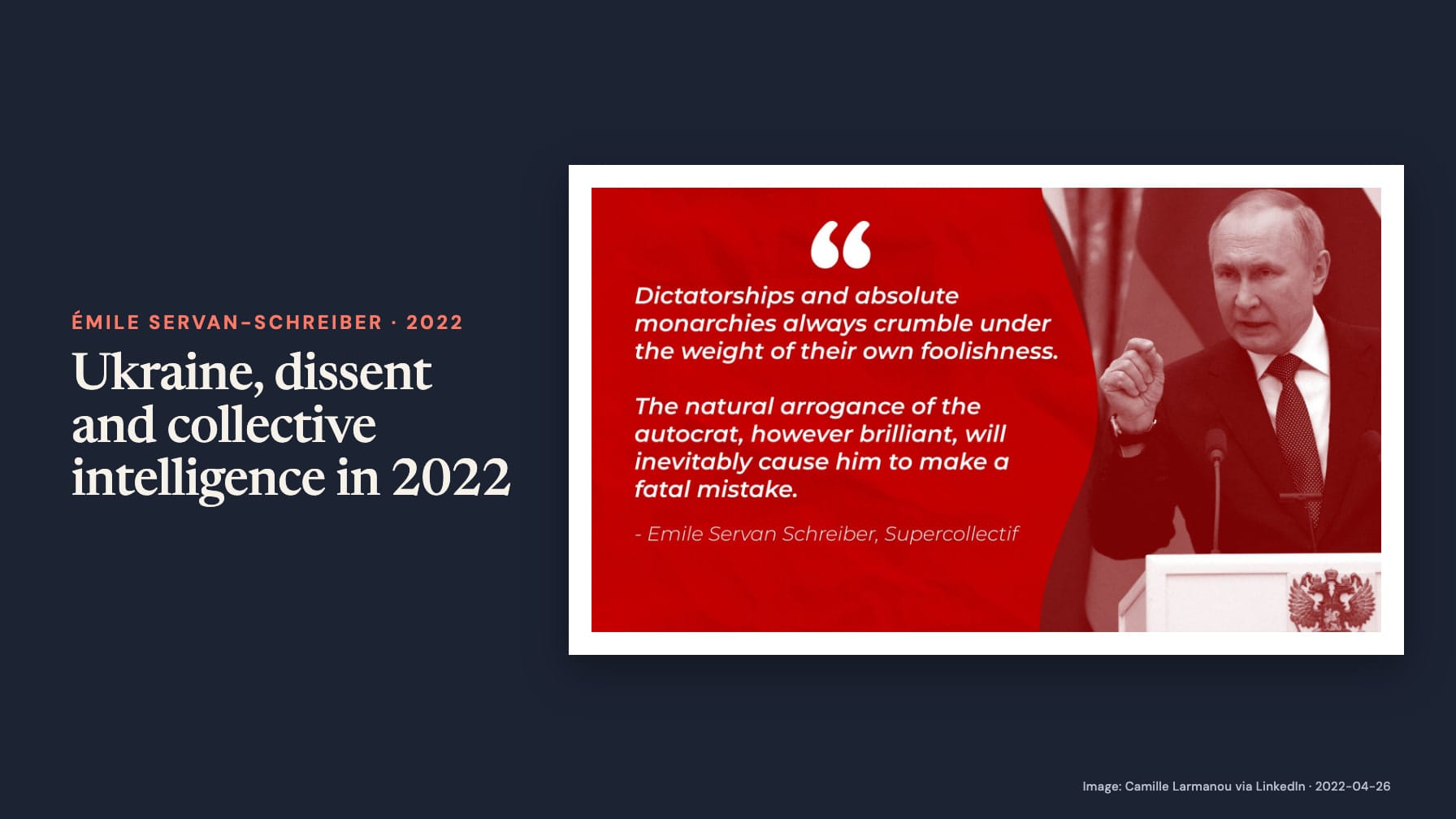
On 26 April 2022, Émile Servan-Schreiber reshared Camille Larmanou’s argument that dissent helps institutions think and adapt. She used Russia’s failure to capture Kyiv as the starting point. Servan-Schreiber added a question about whether Vladimir Putin’s mistake might prove fatal to his position. Neither post supplied a numerical probability or a forecast deadline.
The military episode is documented separately from the interpretation. At a 6 April briefing, a senior US defense official assessed that Russian forces near Kyiv and Chernihiv had completed their withdrawal to regroup and refit in Belarus and Russia. That assessment supports the immediate context of Larmanou’s post. It does not reveal the private reasoning that preceded Russia’s invasion.
A claim about how organisations correct errors
Larmanou contrasted institutions that permit disagreement with leadership surrounded by people reluctant to challenge it. She argued that democracies can draw on collective intelligence by tolerating dissent and correcting mistakes more readily. She connected this argument to Servan-Schreiber’s book Supercollectif and a masterclass on crowd wisdom and forecasting.
Her practical recommendations were to let dissenting views emerge, listen especially carefully to people whose views differ from one’s own, and avoid making consensus the objective of every discussion. Those are recommendations about how a group treats information. Her claim concerns the potential for an institution to notice an error and respond when someone challenges its assumptions.
The forecasting lesson: preserve disagreement
The connection to forecasting is straightforward. If participants suppress their own judgements to match a leader, the apparent agreement can conceal missing information. A useful forecast process makes disagreement visible before deciding how to combine it. Changing an estimate when evidence changes is equally important; preserving dissent does not mean protecting an opinion from correction.
The journal’s review of Hypermind’s Ukraine forecasts examines actual dated probabilities, including mistakes and subsequent updates. This April post supplies a different contribution: an argument for institutional conditions that make correction possible. The battlefield episode illustrates why errors matter. It does not, alone, prove which organisational practice caused the outcome.