
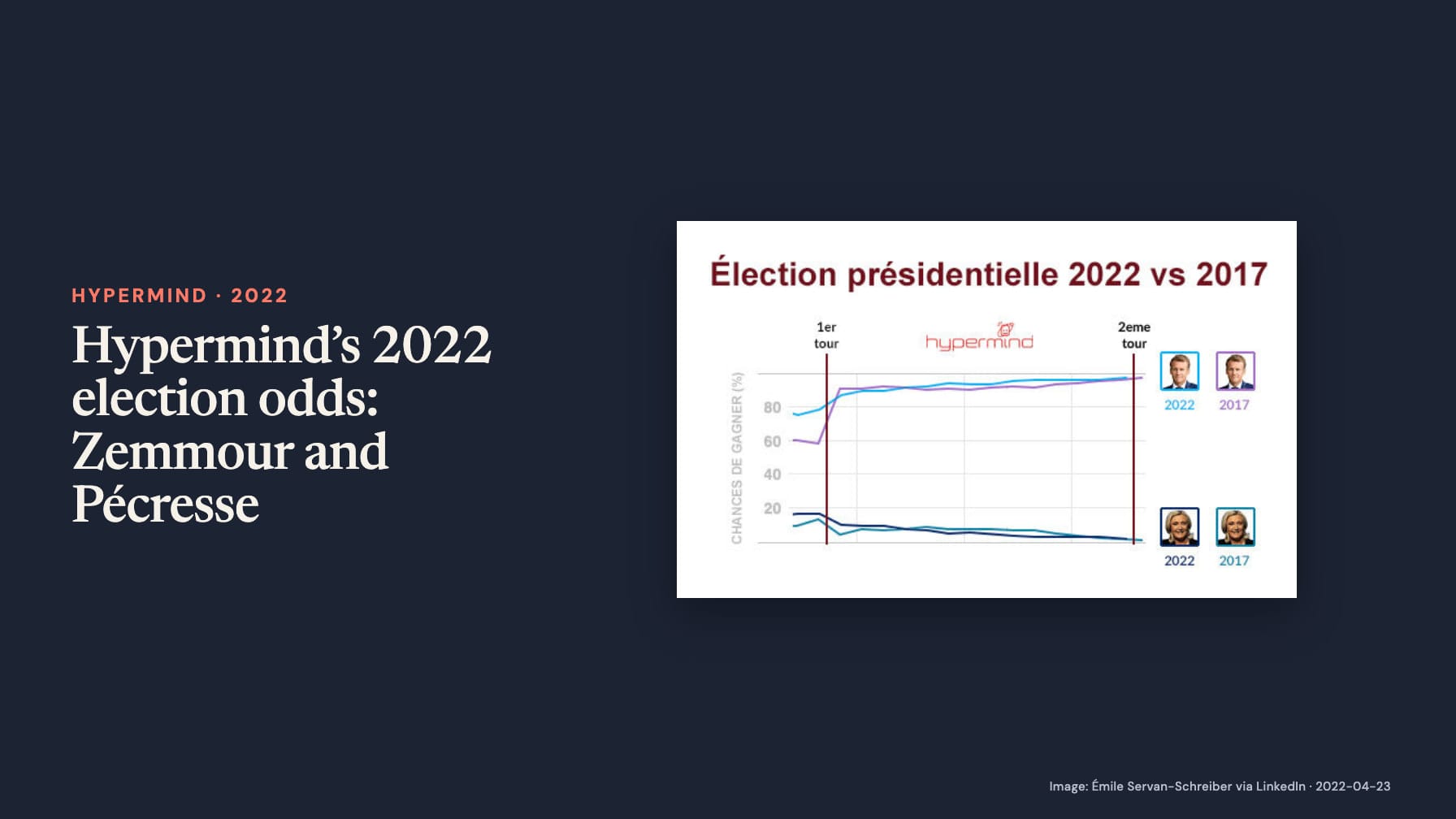
On 23 April 2022, the eve of France’s presidential run-off, Émile Servan-Schreiber remarked that Hypermind’s Macron–Le Pen victory probabilities had followed almost the same path between the two rounds as five years earlier. The finalists were familiar. The route to that contest had been much less settled, as the market’s earlier updates show.
September 2021: even the finalists were uncertain
In an update shared on 16 September 2021, Hypermind gave Marine Le Pen a 49.5% chance of reaching the second round, compared with 94.2% for Emmanuel Macron. It also put the chance of a serious Éric Zemmour candidacy at 66%, and suggested that this possibility was contributing to Le Pen’s fall below 50%.
The attached chart, dated 15 September, split the possible final pairings: Macron and Le Pen 46.6%; Macron without Le Pen 47.6%; Le Pen without Macron 2.9%; neither 2.9%. These were qualification scenarios. They did not say that Macron would win 94.2% of the vote or had a 94.2% chance of becoming president.
October: Zemmour’s chance of winning
On 6 October, Hypermind argued that its signal had anticipated a polling trend that placed Zemmour ahead of Le Pen. That was the platform’s interpretation of the sequence, not an independently established general advantage over polls. The same post explicitly distinguished probabilities of victory from voting intentions.
The next day’s update provided a fuller breakdown. Servan-Schreiber reported 29% for Zemmour to win the presidency and 58% for Macron. Together, he said, they accounted for 87% of the chances of victory; no other potential candidate exceeded 2%. The accompanying graphic dates those estimates to 7 October 2021 at 06:00.
Zemmour’s 64% chance of reaching the run-off and 45% chance of winning the final duel answered different questions. The latter was conditional on qualification. Multiplying 64% by 45% gives approximately 29%, illustrating why a relatively competitive hypothetical duel can coexist with much lower overall victory odds. The graphic also gave Macron 86% to qualify and Le Pen 19%.
December and February: Pécresse and Zemmour trade places
In his 13 December 2021 Le Point article, Servan-Schreiber reported victory probabilities of 51% for Macron and 24% for Valérie Pécresse. The headline rounded that comparison to twice as likely. The dated figures introduced a different challenger while keeping Macron the individual favourite.
By 15 February 2022, he reported that Zemmour had overtaken Pécresse for second place in the presidential market. The accompanying chart gives the scale of that ranking: Macron 59%, Zemmour 15%, Pécresse 12% and Le Pen 5%. Zemmour’s second position was in estimated chances of winning the presidency, not a prediction that he would necessarily finish second in first-round vote share.
An April recap shared by Hypermind described how participants updated estimates using polls, campaign news and one another’s arguments. It also described rewards and recognition as incentives for accuracy. The updates describe how the panel gathered information throughout the campaign.
The April election result
France’s official first-round results for the voting on 9–10 April 2022 record Macron and Le Pen as the two leading candidates. Neither Zemmour nor Pécresse qualified. The Conseil constitutionnel subsequently proclaimed Macron elected after the 23–24 April run-off. The early forecast that Le Pen might miss the final round did not describe what eventually happened; the market nevertheless preserved a substantial probability that she would qualify.
The final pairing also repeated 2017, as Servan-Schreiber noted. Our 2017 market history provides the earlier comparison. These dated observations show a market revising its view of a changing field. They do not, by themselves, establish calibration or prove that it generally led polls. The separate 2022 run-off retrospective addresses the comparison of forecasts with polling.