
Emmanuel Macron won the French presidency on 7 May 2017 with 66.10% of the vote against Marine Le Pen, according to the Conseil constitutionnel. A few hours later, Émile Servan-Schreiber posted a single chart that, in his words, summed up the wild and crazy history of the race. It showed the probability of winning that Hypermind’s prediction market gave each candidate every day from 1 July 2015 to 6 May 2017.
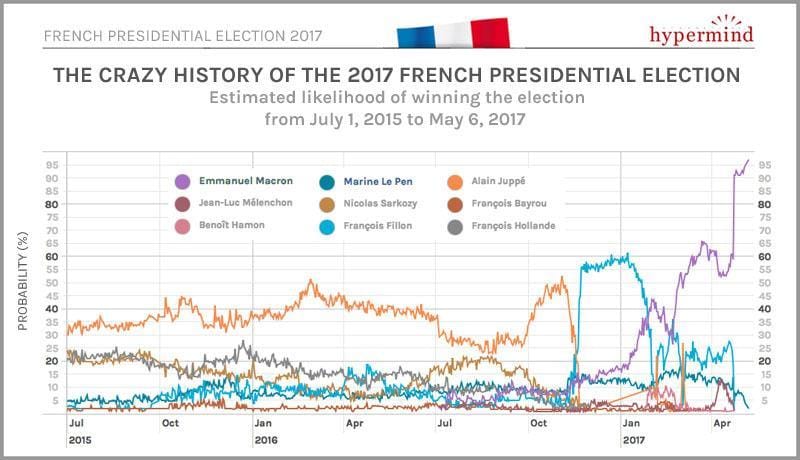
The chart shows chances of winning the presidency, not vote shares. A candidate at 50% was, in the traders’ collective judgement, as likely to win as not. Hypermind was then a play-money market: traders bet virtual currency, not their own money, and those who forecast badly lose influence over the prices.
The favourites who did not make it
For most of 2016, the favourite was Alain Juppé, a former prime minister, who moved between roughly 30% and 50% on the chart. Servan-Schreiber stressed that the election was never a sure thing for the right. At their peak, in March 2016, the three main right-wing contenders, Juppé, Nicolas Sarkozy and François Fillon, had a combined chance of only about 65%, he wrote.
The first upset came in the right’s primary in November 2016. Hypermind’s blog reported that the final polls had Juppé, Sarkozy and Fillon roughly tied near 30%. The market, by contrast, already had Fillon tied with Juppé for the lead, with Sarkozy far behind, and in the last two days Fillon became the clear market leader. Fillon then won the first round of the primary with 44.1%, ahead of Juppé at 28.5% and Sarkozy at 20.6%, figures the blog cited.
Fillon’s chance of winning the presidency then peaked just under 60%, Servan-Schreiber wrote, shortly before the “Penelopegate” affair over his wife’s paid parliamentary job broke in January 2017. On the chart, his line falls away within weeks, and Macron’s climbs.
Marine Le Pen and the Brexit–Trump question
The point Servan-Schreiber chose to highlight concerned Le Pen. Despite Brexit in June 2016 and Donald Trump’s victory that November, her chance of winning on Hypermind never rose much above 15%, or about one in six.
That set the market apart. In April 2017, Reuters reported that bookmakers and US prediction markets put Le Pen’s chances at around one in four, though polls had her losing the run-off by about 20 points. Hypermind put them at around one in eight. Its election panel had almost 2,500 forecasters, about eight in ten of them from France. Each received 100,000 units of play money, and around one in ten fell out after losing it, according to the report. Servan-Schreiber offered Reuters an explanation for the gap:
The further you are removed from French territory, the more you see Le Pen as a high probability.
Émile Servan-Schreiber, quoted by Reuters, April 2017
Even the bookmakers had doubts. Ladbrokes offered 3 to 1 against a Le Pen win, about 25%, yet its head of political betting, Matthew Shaddick, told Reuters: “Le Pen’s odds are overestimating her chances of winning.” Servan-Schreiber also gave the agency his view of what makes a good forecaster:
What makes a good forecaster is not previous expertise in the domain; it’s not how much you know about what you’re trying to forecast.
Émile Servan-Schreiber, quoted by Reuters, April 2017
“It’s how you think,” he added.
The final stretch
The first round, on 23 April, put Macron first with 24.01%, ahead of Le Pen at 21.30% and Fillon at 20.01%, according to the official results. Servan-Schreiber reported that Macron’s chance of winning the presidency on Hypermind went from 53% before the first-round results to 94% the next morning.
Hypermind also forecast the size of the win. On 5 May, the market’s average forecast for Macron’s run-off score was 62.3%. He took 66.10%, so the crowd had the winner right but underestimated his margin by almost four points.
How the market compared with the pollsters
Five years later, in Le Point, Servan-Schreiber compared the 2017 market with the “victory forecasts” published by Ifop’s and OpinionWay’s daily polls, which reported the share of respondents expecting each candidate to win. Over the ten weeks before the first round, he wrote, the market’s daily forecast was more accurate than Ifop’s on 93% of days and than OpinionWay’s on 89%.