
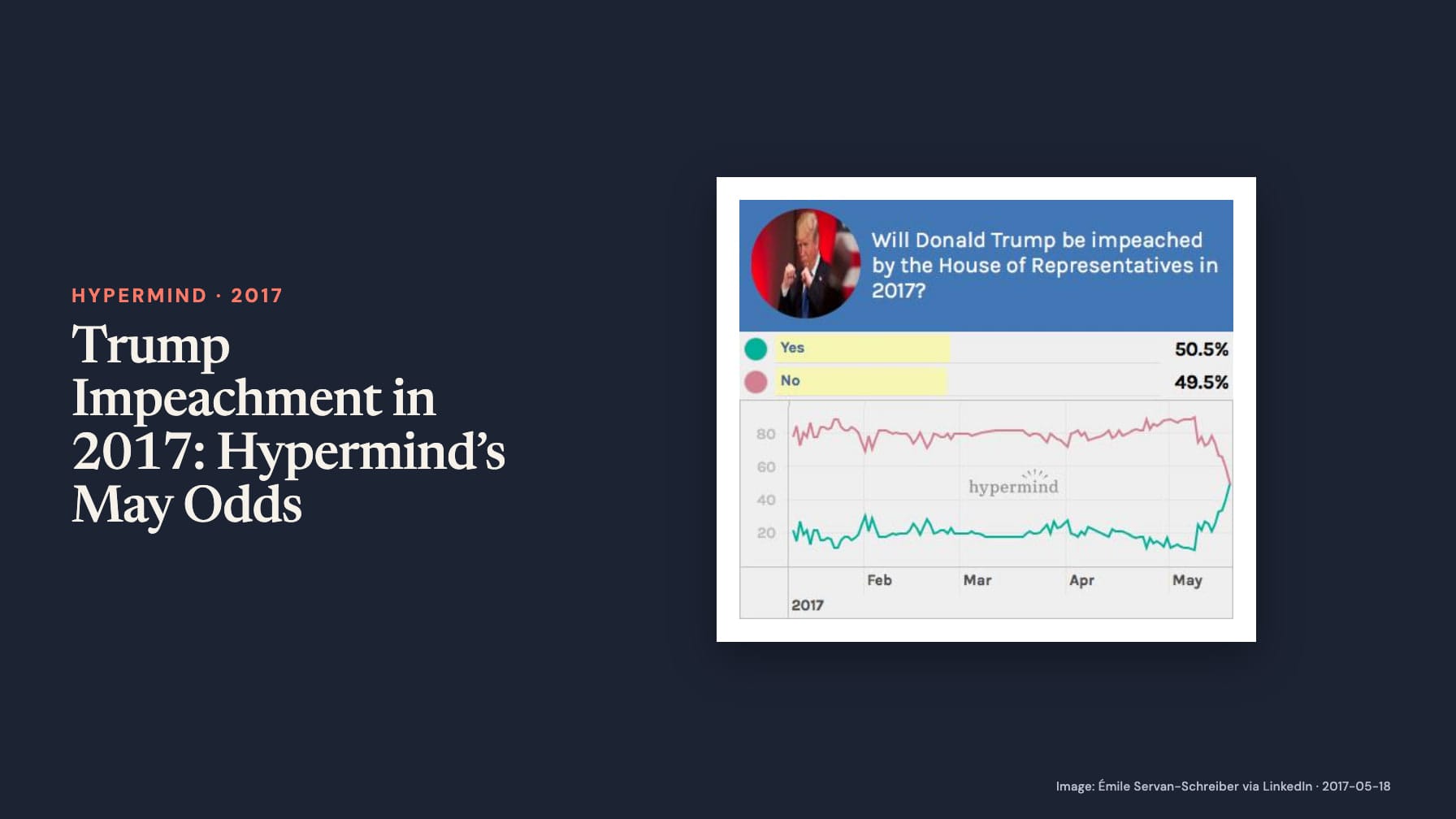
On 17 May 2017, Émile Servan-Schreiber reported a 40% chance that Donald Trump would be impeached that year. The following day, he said the probability had crossed 50% after news of a special counsel. The attached Hypermind charts preserve more exact figures: Yes 40.6% on the first share and Yes 50.5% on the second.
The contract concerned the House and the year 2017
Both images ask whether Donald Trump will be impeached by the House of Representatives in 2017. Their Hypermind watermark confirms the platform attribution, which the brief posts alone do not state. The forecast concerned a House impeachment, rather than conviction by the Senate or removal from the presidency. Its visible horizon was the calendar year 2017.
The 17 May image gives No 59.4%; the 18 May image gives No 49.5%. The change in the Yes estimate is 9.9 percentage points, calculated from 50.5% minus 40.6%. Servan-Schreiber’s description of a 10% increase is approximate. Percentage points express the difference between the two probabilities, avoiding confusion with a relative percentage increase.
What changed in the news
The official White House statement of 9 May 2017 announced that Trump had terminated FBI director James Comey. Servan-Schreiber’s first update referred back to that firing. On 17 May, the Justice Department announced that Deputy Attorney General Rod Rosenstein had appointed Robert Mueller as special counsel to oversee the investigation of Russian interference in the 2016 election and related matters.
The chronology supports Servan-Schreiber’s description of a forecast updated around the special-counsel announcement. It does not establish that this single development caused every trade or that opening an investigation made impeachment inevitable. The market question required a separate institutional action by the House.
What happened within the forecast horizon
The House’s official list of impeached individuals records Trump’s first impeachment on 18 December 2019. There was no House impeachment of Trump in 2017. The later event therefore does not rescue a forecast explicitly tied to that earlier year.
At the 18 May snapshot the crowd made impeachment in 2017 slightly more likely than its absence, and the more likely answer did not occur. That records a forecast moving with significant news while retaining substantial uncertainty. It is one observation in a larger calibration question: how frequently do events occur when a market assigns them probabilities close to this level?