
On 25 February 2016, Émile Servan-Schreiber described Donald Trump as almost certain to become the Republican presidential nominee, citing Hypermind. The accompanying image put Trump at 78% for the nomination. Yet its neighbouring panel favoured a Democratic victory in the presidential election. The apparent contradiction disappears once the two questions are read carefully.
A party’s candidate and a party’s victory
The nomination panel showed Trump at 78%, Marco Rubio at 18%, and Ben Carson, Ted Cruz, John Kasich and the other-candidate option each at 1%. Jeb Bush and Carly Fiorina were each at 0%. Those displayed, rounded figures describe who would become the Republican nominee. Servan-Schreiber’s emphatic wording expressed his reading of a strong favourite.
The adjacent panel asked which party would win the White House. It showed Democratic at 61%, Republican at 36% and Other at 3%. This was a forecast about a party’s eventual victory, whichever candidate it selected. The Republican percentage was therefore not Trump’s personal chance of becoming president.
Why the percentages cannot be substituted
A nomination forecast and a party-win forecast describe different events. To derive a candidate’s presidential prospects, a forecaster would also need to consider election chances conditional on the possible nominees. The displayed party probability does not provide those conditional estimates. Simply treating the nomination number as the election number would discard the second stage of the contest.
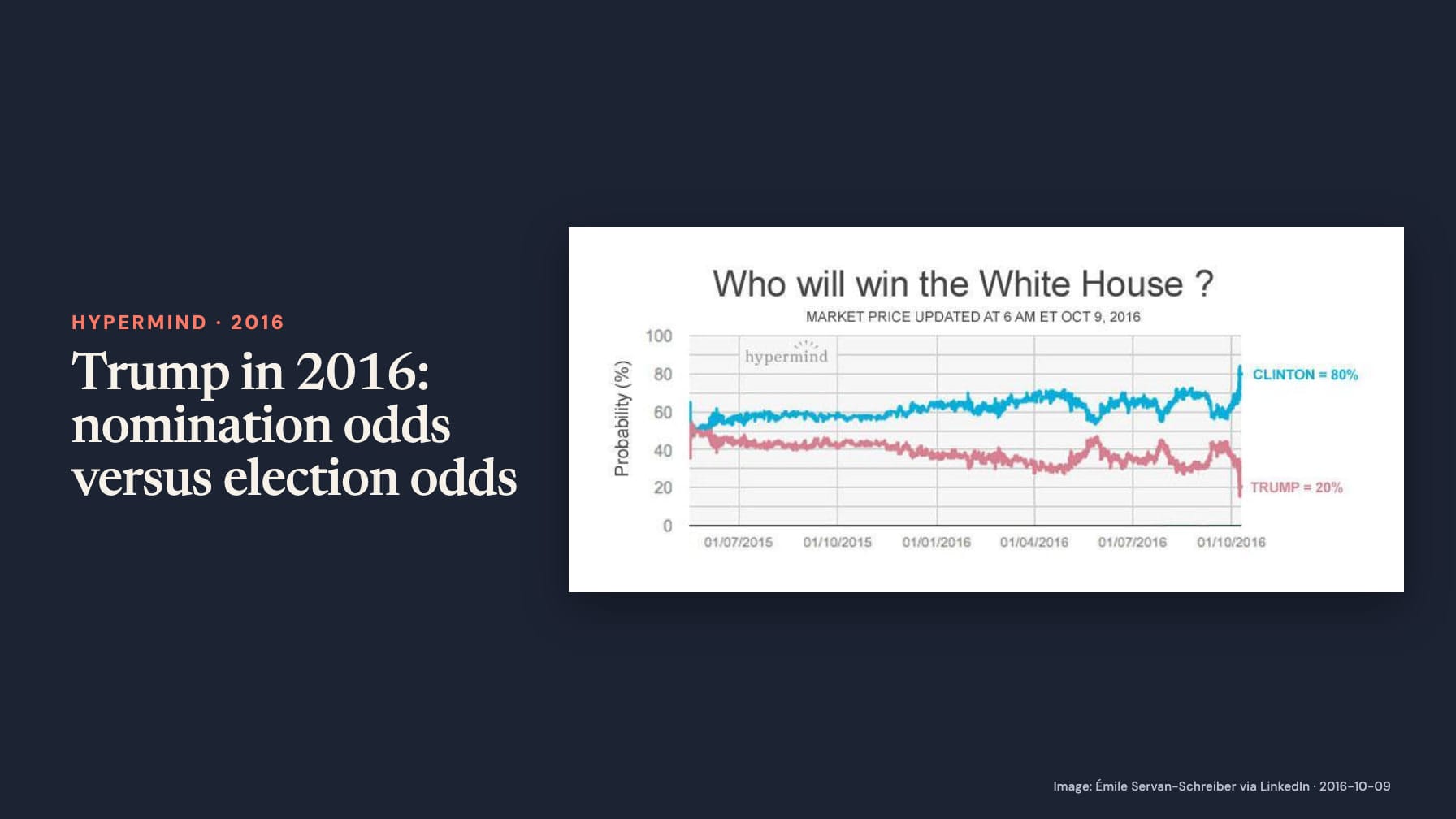
A later snapshot made the distinction visible again. On 9 October 2016, at the image’s stated update time of 6 AM ET, Hypermind showed Clinton at 80% and Trump at 20% to win the White House. These dated figures cannot be read as Trump’s nomination chances falling from 78% to 20%: the October chart concerned the presidency.
Define the target before judging the forecast
Trump accepted the Republican nomination on 21 July, according to the address preserved by the American Presidency Project, and later won the presidency, as the National Archives records. The two results correspond to two different forecast targets. Neither result makes the February nomination odds interchangeable with the October election odds.
The journal’s broader 2016 account examines market performance through the year. The paired February panels teach a narrower practical lesson: a percentage needs an outcome, a date and a clear description of whose victory it concerns. A strong nomination favourite can coexist with a party that is less likely to win the general election.