
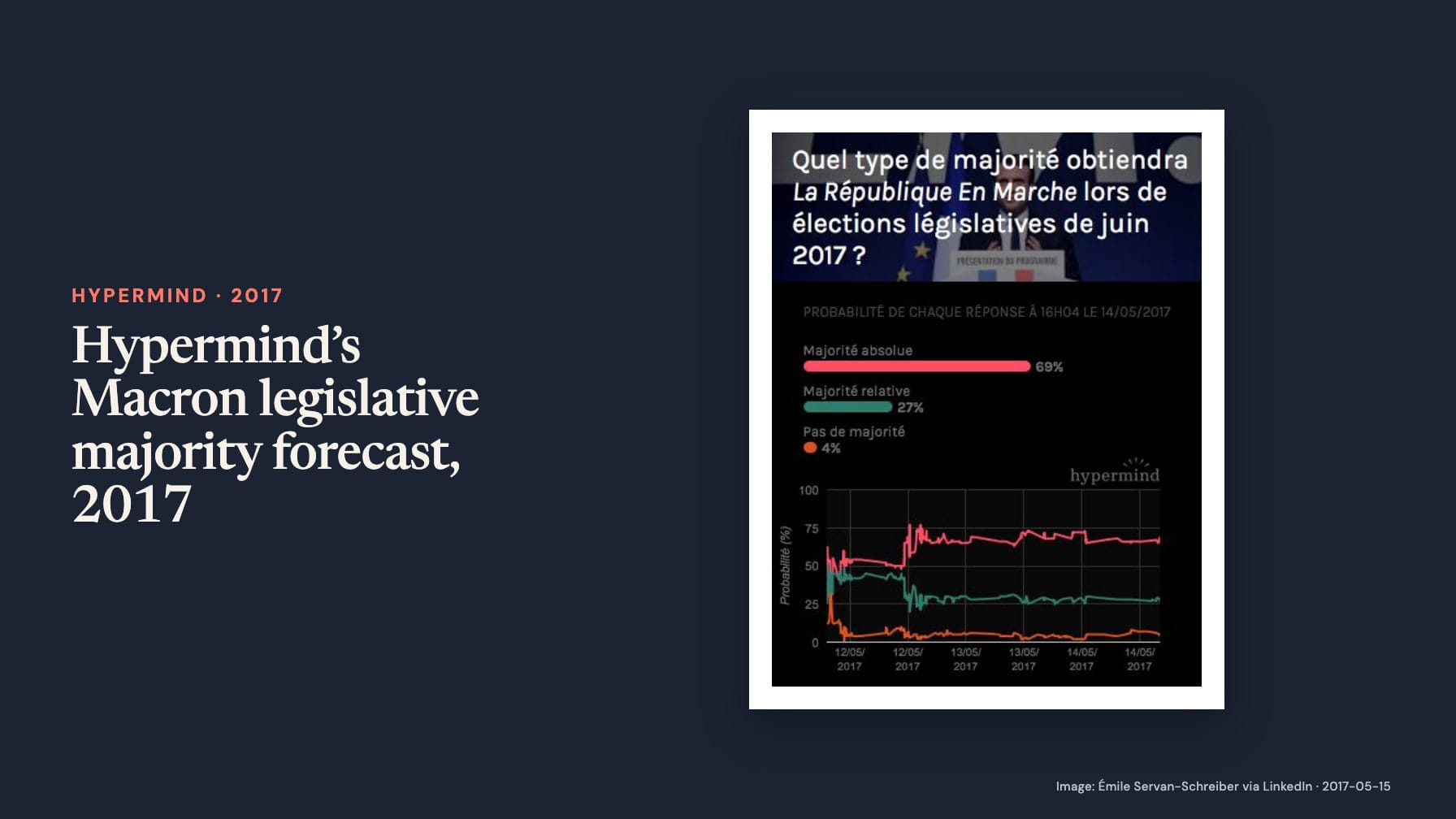
On 15 May 2017, Émile Servan-Schreiber described Emmanuel Macron’s next electoral challenge: securing a parliamentary majority in the following month’s legislative elections. He reported Hypermind odds of 69% for an absolute majority and 27% for a relative majority. On 19 May, he shared the legislative forecasting dashboard, giving readers a place to follow those questions.
The image accompanying the earlier post identifies the market more precisely. It asks what type of majority La République En Marche would obtain in the June 2017 legislative elections. Its printed snapshot is dated 14 May 2017 at 16:04; no timezone is shown. The three displayed options are:
- Absolute majority: 69%.
- Relative majority: 27%.
- No majority: 4%.
The first two figures agree with the 15 May post; the image also labels the 4% no-majority option. The 19 May dashboard share pointed readers to these legislative questions without supplying a replacement probability. The observation therefore remains dated 14 May at 16:04, while the later share records continued attention to the contest.
A distinct electoral question
The 2017 presidential market history concerns who would win the presidency. Here, the outcome was the size and position of the president’s party in the National Assembly. An absolute seat majority requires more than half the chamber’s seats; a relative majority means leading other parties while falling short of that threshold. These definitions explain the political distinction, although the complete market’s contractual rules have not been recovered.
The June result
The Interior Ministry’s official results dates the legislative elections to 11 and 18 June 2017 and records 308 seats for La République en marche, with another 42 classified as Modem. La République en marche’s own 308 seats exceeded half of the 577-seat chamber. Thus the election result matches the chart’s absolute-majority option without needing to combine the two parties’ totals.
The outcome favoured by the 14 May snapshot occurred. That is a documented comparison between a forecast and a later result, rather than evidence that the market was perfectly calibrated or outperformed another forecasting method. The case preserves a useful distinction between presidential victory, a parliamentary plurality and an absolute legislative majority: winning one election does not answer the question posed by the next.