
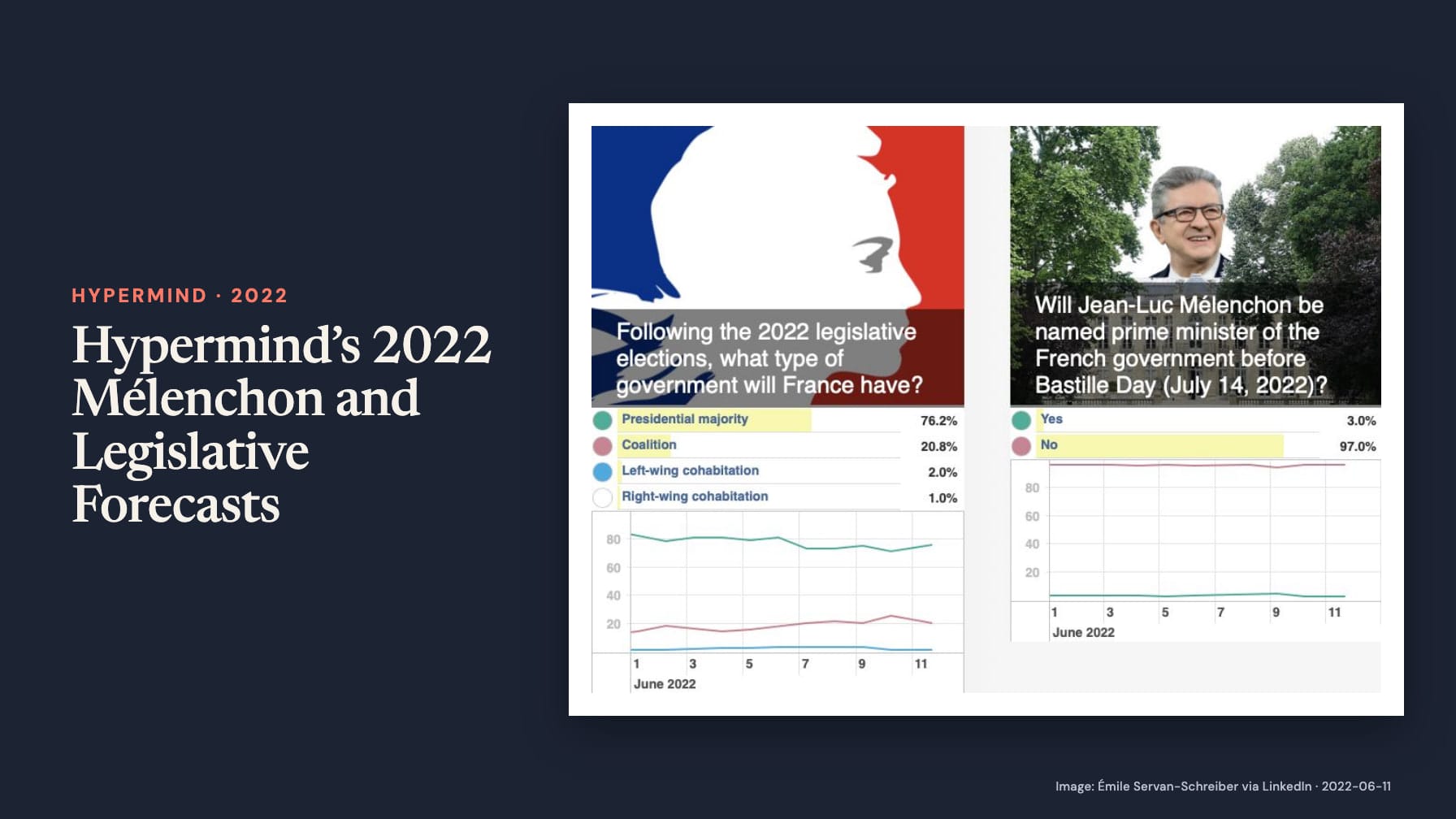
On 11 June 2022, the day before France’s first round of legislative elections, Émile Servan-Schreiber reported a 3% estimate from Hypermind’s forecasting crowd for a left-wing victory bringing Jean-Luc Mélenchon to the premiership. The accompanying graphic is more precise than that summary. It contains two questions, with different probabilities and different outcomes.
An appointment by Bastille Day
One question asked whether Mélenchon would be named prime minister of the French government before Bastille Day, 14 July 2022. The displayed probabilities were Yes 3.0%, No 97.0%. These are the figures published in the 11 June post, rather than the odds at the close of trading.
That event did not happen. The French government’s official biography records Élisabeth Borne as prime minister from May 2022 to January 2024, spanning the forecast’s deadline. The post’s low estimate therefore pointed towards the outcome that occurred. It does not mean Mélenchon’s appointment was impossible at the time.
The separate government forecast
The other question asked what type of government France would have following the 2022 legislative elections. Its displayed distribution was:
- Presidential majority: 76.2%.
- Coalition: 20.8%.
- Left-wing cohabitation: 2.0%.
- Right-wing cohabitation: 1.0%.
The election was held on 12 and 19 June. The Interior Ministry’s official results assign 245 seats to Ensemble, the presidential alliance, and 131 to candidates classified as NUPES, the left-wing alliance. Ensemble’s 245 seats were short of an absolute majority in the 577-seat Assembly. The crowd’s strong expectation of a presidential majority therefore did not match an absolute-majority reading of that outcome.
The market’s full definitions and settlement record are unavailable, so the official payout category cannot be inferred from these labels alone. The election results nevertheless show why excluding a left-wing government and forecasting a presidential majority were different judgements: the left could fail to take power while the presidential alliance still fell short of an absolute majority.
Two questions with different outcomes
The journal’s review of the 2022 presidential forecast concerns the earlier Macron–Le Pen contest. This legislative snapshot adds a separate case: a low-probability appointment that did not occur, alongside a much more confident government forecast that deserves scrutiny.
One snapshot cannot establish calibration, meaning how often events at a given probability actually occur across many questions. It can establish what was said before the result. Preserving both panels makes that record more informative than retaining only the successful call.