
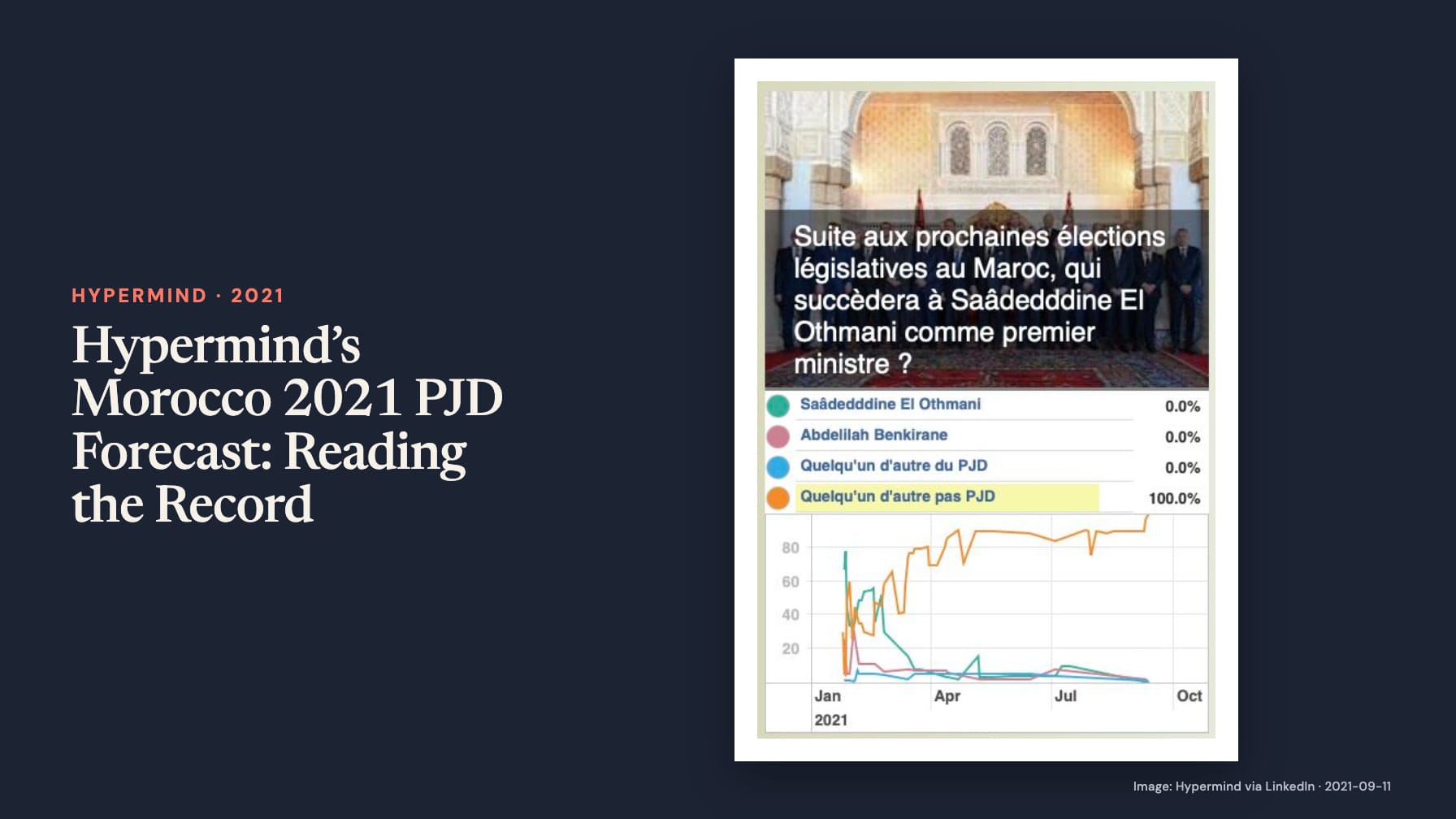
On 11 September 2021, Émile Servan-Schreiber reshared Hypermind’s claim that its prediction market had expected Morocco’s PJD to be removed from power for several months. He added that the case was particularly interesting because, in his account, there were no electoral polls in Morocco. The attachment preserves the forecast question and a historical trace, making it possible to examine the claim more carefully.
The question concerned the next head of government
The market asked who would succeed Saâdeddine El Othmani as prime minister following Morocco’s next legislative elections. It separated four answers: El Othmani himself, Abdellah Benkirane, another person from the PJD, and someone outside the PJD. The outcome concerned the party affiliation of the successor, rather than the PJD’s exact number of seats or vote share.
In the image shared on 11 September, the displayed figures are 0.0% for each of the three PJD options and 100.0% for a successor outside the PJD. Those are the exact prices in the published screenshot. They must be read with their date: Morocco’s government website records King Mohammed VI’s appointment of Aziz Akhannouch as head of government on 10 September, the day before the update. Kuwait’s official news portal identifies him as the RNI leader.
An earlier lead cannot be scored from the final prices
The chart runs from January through September 2021, with an October tick at the right edge. Visually, the non-PJD line becomes dominant well before the final jump to certainty. That supports the direction of Hypermind’s account, but exact earlier prices and formal settlement rules are unavailable.
Consequently, the final 100% figure cannot tell readers how confident the crowd was immediately before the election. A price published after the appointment answers a different question from a probability recorded while the successor was uncertain. Servan-Schreiber’s observation about the absence of electoral polls explains why he considered the case interesting; it does not itself establish a comparison with every survey available at the time.
This case complements the more detailed history of Hypermind’s 2017 French election market. The Moroccan contract focused on who would lead the government, rather than a vote-share threshold or a seat total. Its four alternatives also separated continuity under particular PJD politicians from continuity under another party member. That structure makes the eventual change in party affiliation explicit. To evaluate the earlier forecast quantitatively, the same alternatives would need probabilities recorded before the appointment became known.