
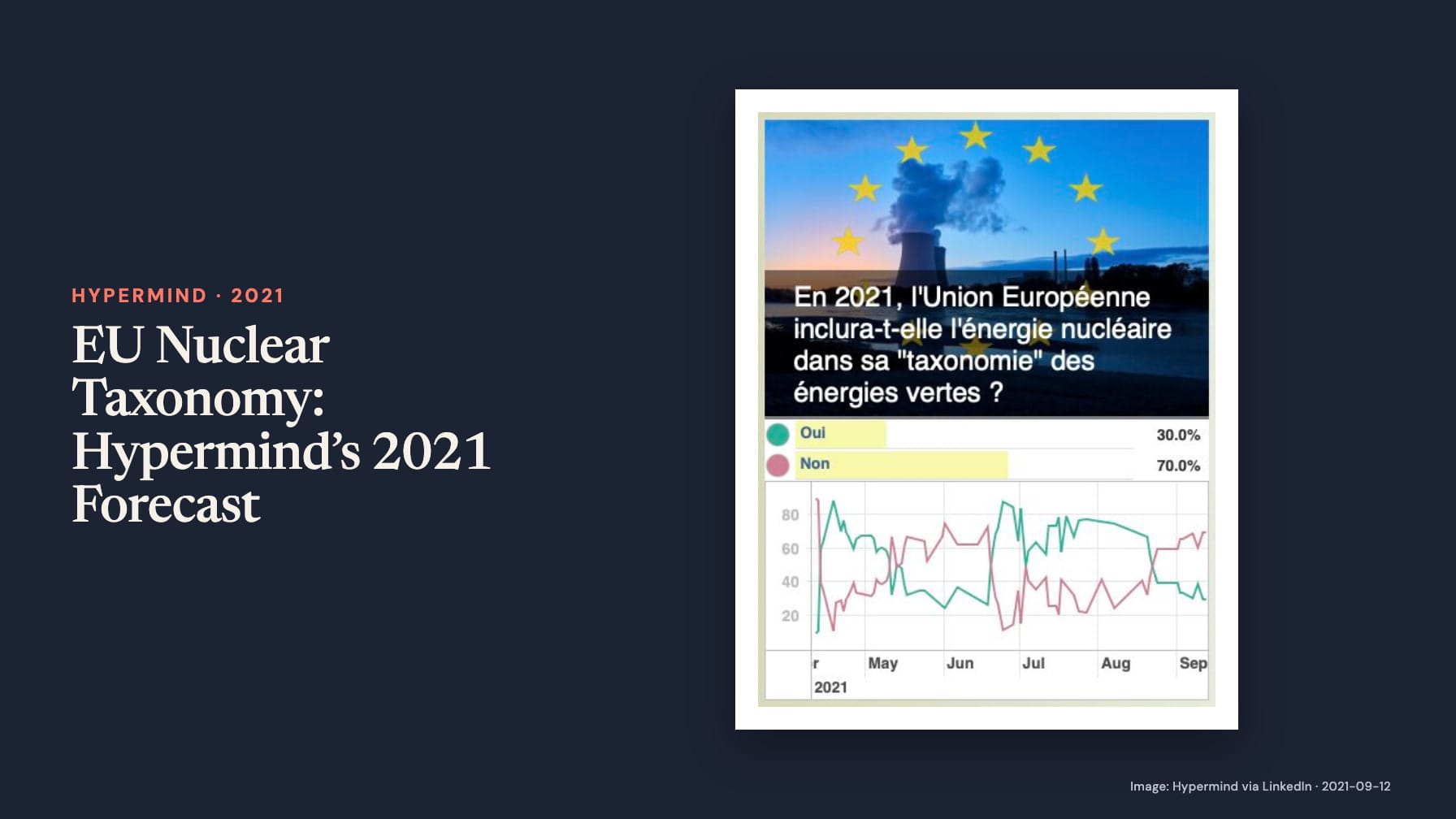
On 12 September 2021, Émile Servan-Schreiber reshared Hypermind’s account of a struggle over nuclear energy in European policy. His own comment defended nuclear technology. The attached market card makes the forecasting question much more precise than the accompanying political argument: would the European Union include nuclear energy in its “taxonomy” of green energies in 2021?
The screenshot displays yes 30.0%, no 70.0%, the figures attached to the 12 September 2021 update. Its French wording is: “En 2021, l’Union Européenne inclura-t-elle l’énergie nucléaire dans sa "taxonomie" des énergies vertes ?” In our translation: In 2021, will the European Union include nuclear energy in its “taxonomy” of green energies? The calendar year is part of the event being forecast.
A forecast alongside an opinion
Hypermind framed the dispute as France’s support for nuclear energy versus Germany’s position and said its market had recently favoured the German side. Its language contrasted ideology with rationality. Servan-Schreiber’s comment likewise expressed a preference for retaining nuclear expertise. Those are the authors’ positions. They do not explain the market’s aggregation method or establish that participants shared the same policy preference.
The taxonomy is a classification system for sustainable economic activities. Forecasting whether an activity will be included is a question about institutional action. Supporting or opposing that activity is a value judgement. A prediction market can be useful precisely because a person’s desired policy and their expected policy need not coincide.
What happened to the policy afterwards
The European Commission’s official chronology places approval in principle of the complementary climate delegated act on 2 February 2022. The measure included specific nuclear and gas activities under strict conditions. The Commission records formal adoption on 9 March 2022, and its taxonomy chronology states that the complementary act applies from January 2023.
Those milestones occurred after the year named on the market card. Nuclear activities ultimately entered the framework, under conditions, but an eventual policy change and a change completed in 2021 are different events. The contract’s definition of inclusion and its official settlement are unavailable, so the later milestones cannot be treated as a market score.