
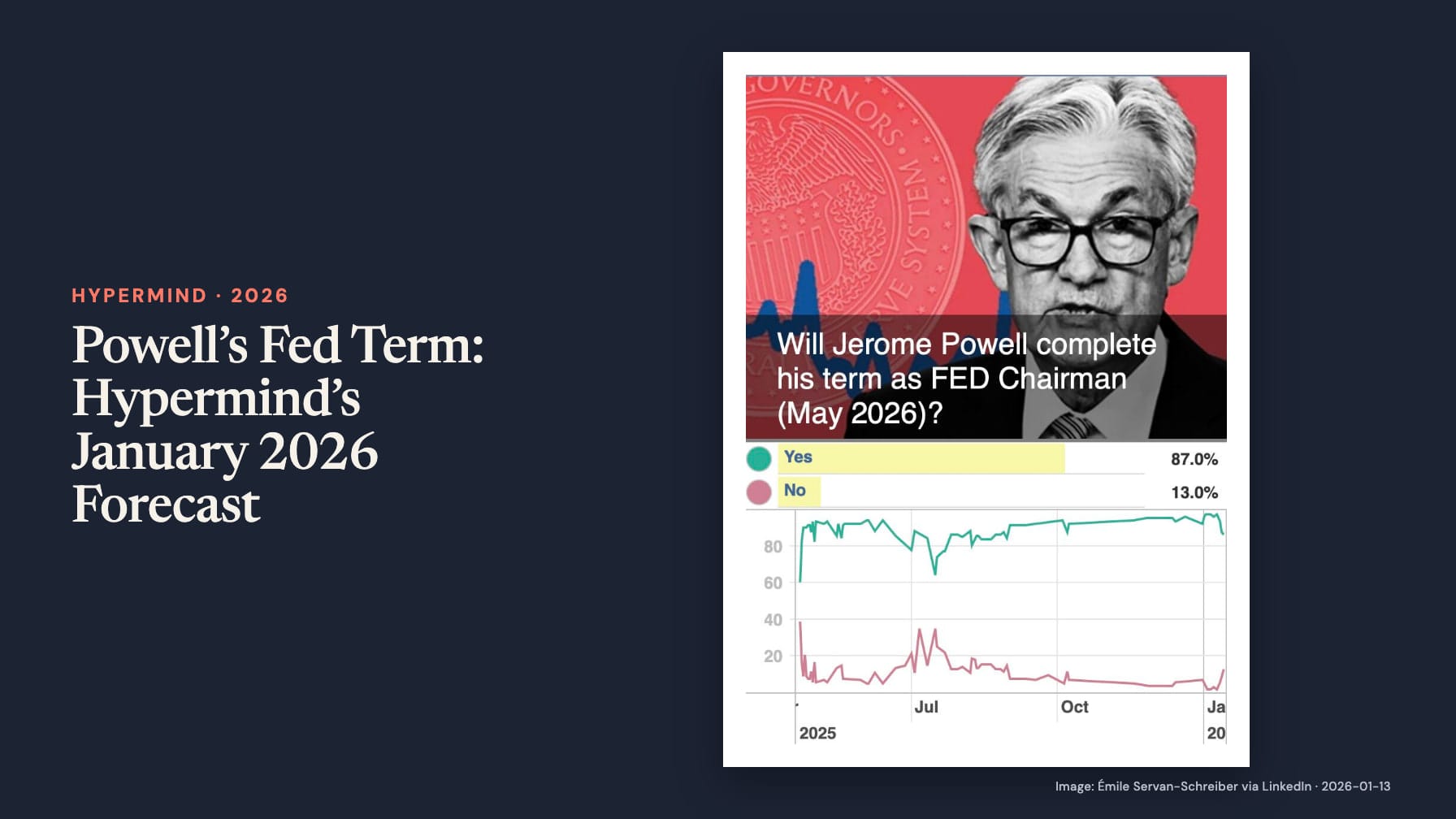
On 13 January 2026, Émile Servan-Schreiber shared a Hypermind prediction-market forecast with a brief assessment: Powell was likely to prevail. The attached chart made that assessment precise. It asked whether Jerome Powell would complete his term as Federal Reserve chairman in May 2026, and displayed Yes: 87.0%; No: 13.0%.
That wording matters. The market was pricing whether Powell would reach the end of his chairmanship. It was not asking whether he would be cleared of allegations, remain chair indefinitely, or win every confrontation with the White House. The date supplied a short and identifiable horizon.
The pressure behind the January forecast
Two days earlier, on 11 January, Powell had published a statement on the Federal Reserve’s website. He said the Justice Department had served the Fed with grand jury subpoenas threatening a criminal indictment related to his testimony before the Senate Banking Committee the previous June. The testimony concerned renovation of Federal Reserve buildings.
Powell argued that the threat was a pretext for political pressure over interest-rate decisions. That was his interpretation of the dispute, rather than a judicial finding. The primary statement establishes the confrontation that surrounded the January market snapshot; it does not supply Hypermind’s traders’ reasoning.
What happened in May
Federal Reserve records establish the subsequent tenure outcome. On 15 May 2026, the Board announced that Powell’s term as chair was concluding and named him chair pro tempore until Kevin Warsh was sworn in. A second announcement records Warsh taking the oath on 22 May. Powell therefore reached the scheduled end of the term identified in the dated question.
The official records support the question’s Yes outcome, although the original market settlement record is unavailable. Completing the term is a distinct outcome from resolving a legal dispute: the market’s question concerned tenure, and its probability should be evaluated on that basis.