
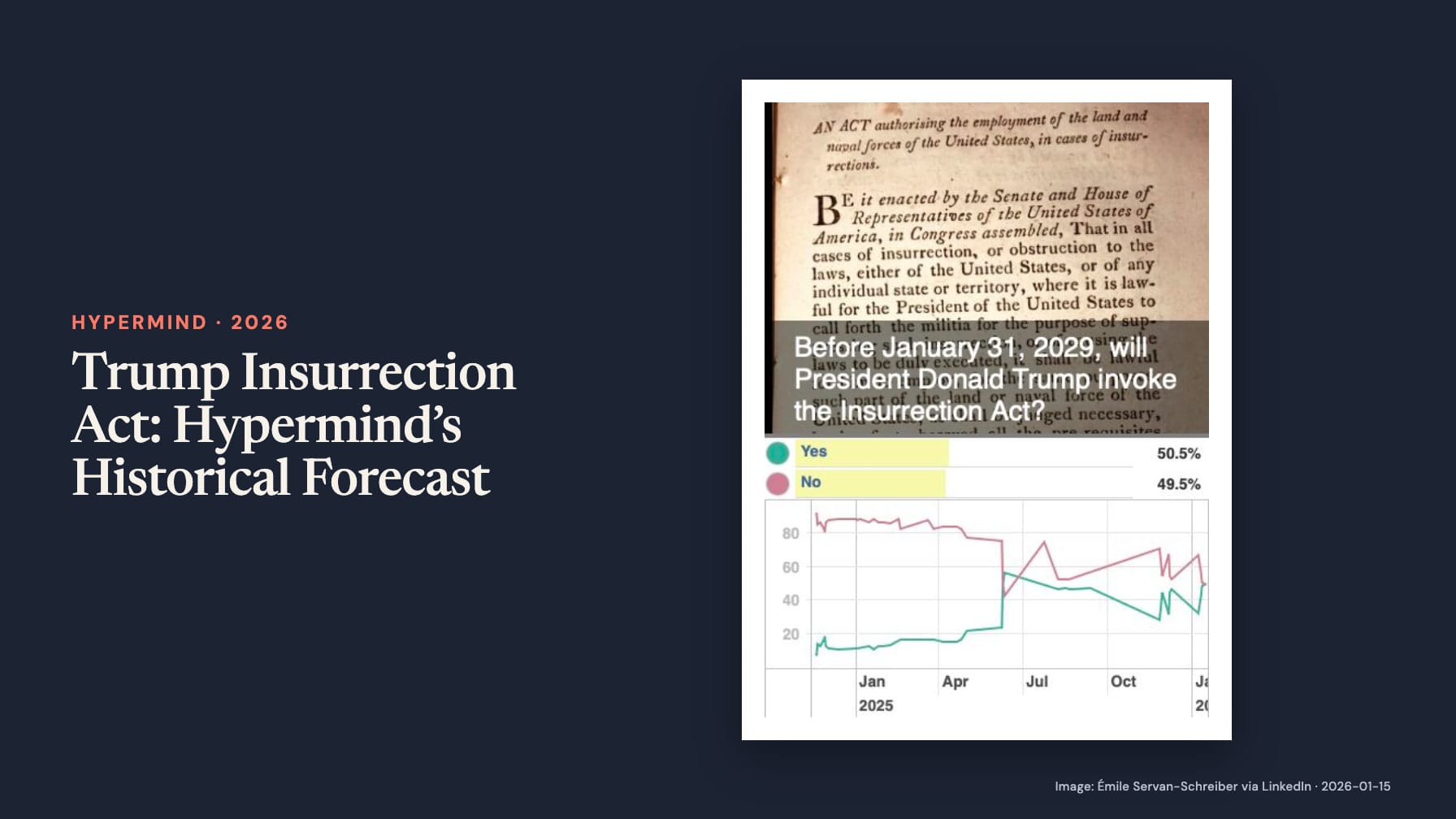
On 11 June 2025, Émile Servan-Schreiber reported that Donald Trump invoking the Insurrection Act had become a 50–50 possibility on Hypermind’s prediction market. On 15 January 2026, he returned to the question, saying the probability had remained troublingly high for months. The attached charts make the story more precise: these were forecasts about a possible invocation before 31 January 2029, rather than predictions that troops would enter an American city the following day.
What the two charts actually say
The June image asks whether President Donald Trump will invoke the Insurrection Act before January 31, 2029. Its displayed values are Yes 49.0% and No 51.0%. Servan-Schreiber’s description of a 50–50 chance was therefore a rounded account of the attached snapshot. The January image repeats the same wording and deadline, with Yes 50.5% and No 49.5%.
The yes probabilities differ by 1.5 percentage points, although the history line moves in both directions between the snapshots. The two endpoint values therefore do not establish a steady rise across the whole interval. The visible question concerns invocation of a named law over a long horizon, which is a different claim from predicting the next military deployment.
A deployment is not automatically an invocation
The distinction mattered in June. The White House memorandum of 7 June 2025 called National Guard units into federal service under 10 U.S.C. 12406 to protect federal personnel and property. In the government’s published transcript of remarks on 8 June, Trump was asked whether he was prepared to invoke the Insurrection Act and answered conditionally. Those records show why a forecast about invoking a named law should not be resolved simply by pointing to a military deployment.
Probability and political judgement
In January, Servan-Schreiber argued that invoking the Act to deploy the military in American cities would mark a decisive authoritarian turn. That was his political interpretation of the consequences. The market’s roughly one-in-two estimate concerned an event; it did not measure the truth of that interpretation or endorse it.
The two posts show how a long-running institutional risk can remain prominent even when its endpoint probabilities are similar. Political attention and market movement are different things: a renewed warning may accompany a price near its earlier level. As in Hypermind’s Ukraine forecast history, evaluation requires matching each dated probability to the exact event that was asked.