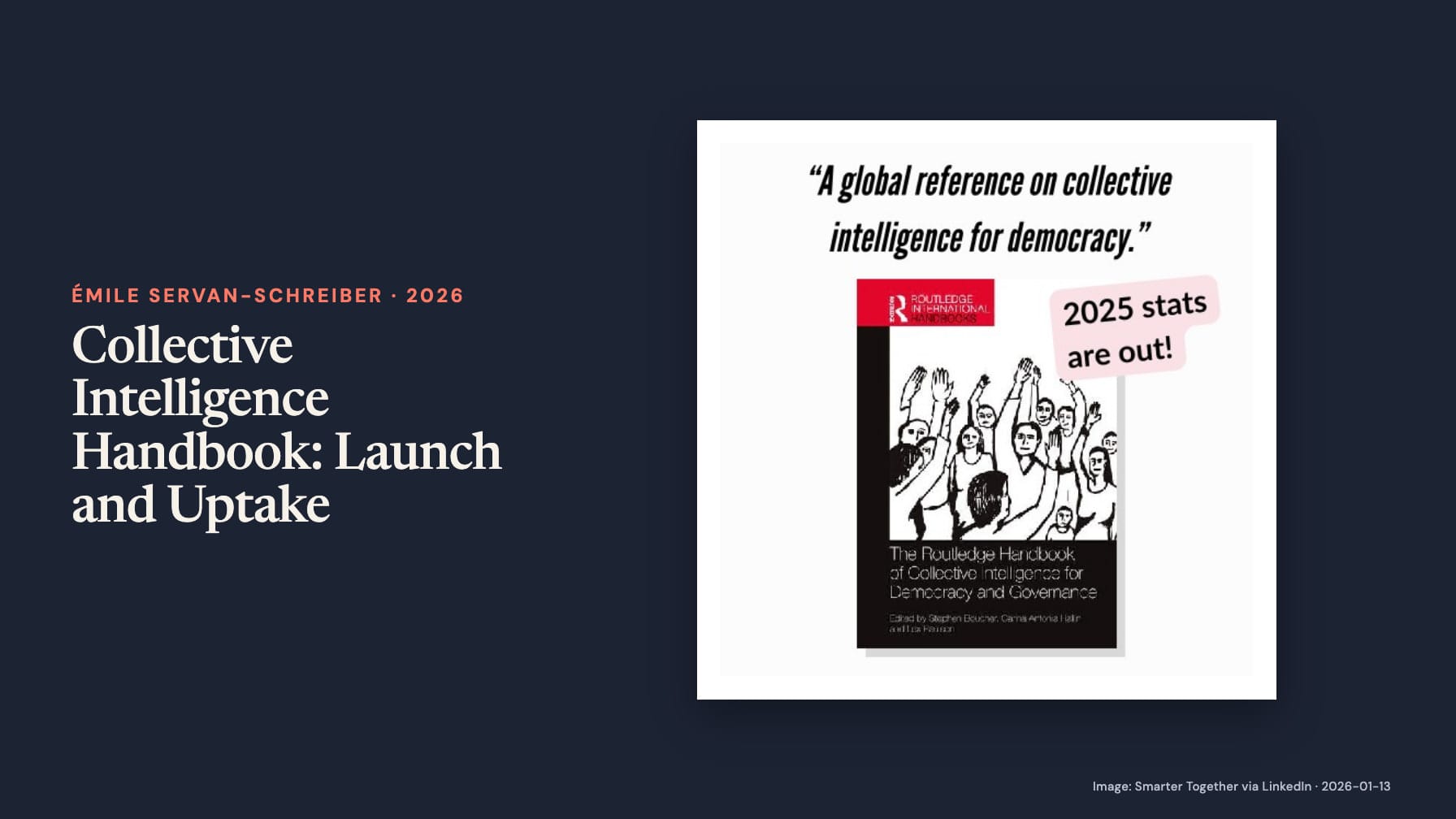
On 13 January 2026, Émile Servan-Schreiber returned to a book he had helped write: The Routledge Handbook of Collective Intelligence for Democracy and Governance. He shared an account from Smarter Together reporting readers in public institutions as well as universities. The figures described the circulation of a handbook, rather than a measured improvement in government decisions.
A forecasting chapter in a governance handbook
On 15 November 2022, he welcomed the forthcoming book and confirmed his contribution. Routledge identifies its editors as Stephen Boucher, Carina Antonia Hallin and Lex Paulson. Its contents place “Crowd forecasting infectious disease outbreaks”, by Servan-Schreiber and Camille Larmanou, in the section on international governance.
The book sets forecasting beside other ways of making groups more useful to public decision makers. Its case studies include deliberation in Taiwan, online argument mapping in Italy and dialogue among national parliaments. These are different methods, with different purposes; the shared question is how institutions can gather and combine knowledge that no individual possesses.
In December 2022, Servan-Schreiber reshared Hypermind’s explanation of its contribution. Hypermind described combining divergent forecasts and adjusting contributors’ weights using their past performance. That is a practical design choice: collecting more answers and deciding how much influence to give each answer are separate tasks. The disease study behind the chapter is covered in our review of the Johns Hopkins crowd-forecasting research.
Open access, then two reports of uptake
On 11 June 2023, Servan-Schreiber shared the announcement that the chapters were freely downloadable. Smarter Together’s own account subsequently dated the open-access release to 19 June 2023. The announcement preceded the date recorded on the project’s website. In his accompanying argument, he presented large-scale citizen intelligence as a democratic answer to increasingly powerful AI; that was his political assessment.
On 9 January 2025, he shared Stephen Boucher’s report of 148,156 individual chapter downloads and 9,138 full-handbook downloads since the June 2023 launch. On 13 January 2026, the Smarter Together account reported 150,000 chapter downloads, 10,000 full-book downloads and engagement from 290 institutions in 49 countries. These are the editors’ and project’s reported figures at those two dates.
The 2026 account named the European Commission, European Parliament and European Central Bank as its leading public institutions. Those reported reading patterns do not establish that any institution adopted a chapter’s methods or endorsed its arguments.