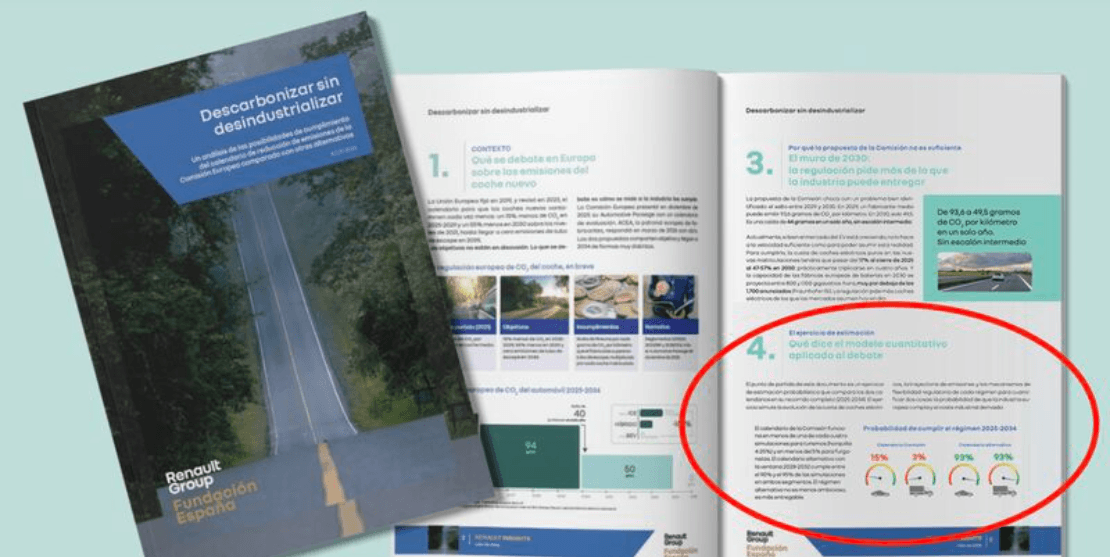
A new report from Fundación Renault Group España uses probabilistic estimates calculated with The Forecasting Machine’s technology in a live European industrial-policy debate. Published on 13 July 2026, Descarbonizar sin desindustrializar—Decarbonising without deindustrialising—compares two ways of measuring whether European carmakers comply with EU carbon-dioxide targets between 2025 and 2034.
Émile Servan-Schreiber, founder of The Forecasting Machine, described the publication as what may be the first documented use of AI-generated objective probability forecasts in a high-stakes industrial-policy argument. That priority claim is his assessment. The documented milestone is narrower and still significant: the Renault Foundation report explicitly says its compliance probabilities were calculated using The Forecasting Machine’s technology.
The policy question behind the probabilities
The underlying EU objectives are not the variable being forecast. The report starts from the statutory path it describes: average emissions from new cars must remain 15% below the 2021 baseline during 2025–2029, fall 55% below that baseline from 2030, and reach zero tailpipe emissions for new cars in 2035. Its question is whether the industry can comply under different accounting windows.
Under the schedule attributed to the European Commission, performance is assessed in several short periods: 2025–2027, then 2028 and 2029 individually, 2030–2032 together, and 2033 and 2034 individually. The alternative supported by ACEA and Renault Group would combine 2028–2032 into one five-year window. That design would allow over-performance before the sharp 2030 threshold to offset under-performance in the first years after it.
What the Renault report estimates
The shorter Renault Insights brief presents those four headline estimates. The full technical analysis focuses principally on passenger cars and reports wider ranges: 4–25% compliance under the Commission schedule and 90–95% under the Renault Group schedule, depending on how strongly manufacturers are assumed to react to regulatory pressure. Its strict central model produces 4.0% and 94.5%, respectively.
The technical study says it ran 10,000 paired Monte Carlo simulations so that both schedules faced the same market and policy conditions. It calibrated electric-vehicle demand with projections from BloombergNEF, the International Energy Agency, Lazard, Transport & Environment, and ACEA; used Eurostat sector data; and incorporated probabilities for eight pending political or market events. The study says those probability inputs update as prediction-market estimates change.
How The Forecasting Machine enters the analysis
The Renault Insights brief states that the simulation’s compliance probabilities were calculated on the basis of The Forecasting Machine’s technology. This is a different role from publishing a standalone forecast about one future event. Here, probabilistic inputs and simulation are part of a wider policy model that compares regulatory designs across a decade.
- Defined alternatives: the comparison changes the compliance windows while holding the stated emissions targets and model assumptions constant.
- Paired uncertainty: both schedules are tested against the same simulated demand, production, and policy conditions.
- Decision-relevant output: the model translates uncertainty into probabilities of compliance and estimated industrial costs.
The public documents do not expose the eight individual prediction questions, their resolution criteria, or a time-stamped history for each probability. Readers can inspect the overall simulation, sources, sensitivity analysis, and headline results, but they cannot independently audit every changing forecast input from the published material alone. That boundary matters when a probability becomes evidence in a policy argument.
The report’s industrial-policy argument
Fundación Renault Group España argues that the five-year window would preserve the nominal reduction targets and the 2035 destination while making compliance more achievable. It estimates that the Commission schedule would generate €20–25 billion in fines and payments to other manufacturers during 2025–2034, whereas the alternative would avoid almost all of that cost in the central simulation. These figures are the report’s modelled estimates, not costs already incurred.
The comparison is not cost-free environmentally. The full study estimates 9.4 million tonnes less cumulative carbon dioxide under the Commission schedule across the regulated 2025–2034 vehicle cohorts. It characterises that difference as small relative to total road-transport emissions and argues that the industrial cost is disproportionate. A reader can accept the probability model while still disagreeing with that value judgement.
This distinction is especially important because Renault Group is an interested participant in the policy debate and the analysis supports its preferred regulatory design. Probabilistic methods can make assumptions and trade-offs more explicit; they do not make a policy recommendation neutral. The strongest use of forecasting is to clarify what must be believed for each option to succeed, then show how the conclusion changes when those beliefs move.
Why this publication matters for applied forecasting
The Renault Foundation report shows AI-assisted forecasting moving beyond a forecast page or media widget and into a quantified institutional argument. Instead of adding a single percentage to a headline, it uses probability inside a model that connects regulation, electric-vehicle adoption, manufacturing capacity, compliance, and cost.
That broader use raises the standard of evidence. Policy forecasts should expose their scenarios, dates, sources, sensitivity ranges, and update rules; separate model outputs from the sponsor’s preferred decision; and preserve enough of the probability trail for later evaluation. The Renault publication is a concrete milestone because it makes probabilistic forecasting part of the public record—and therefore open to scrutiny as well as use.