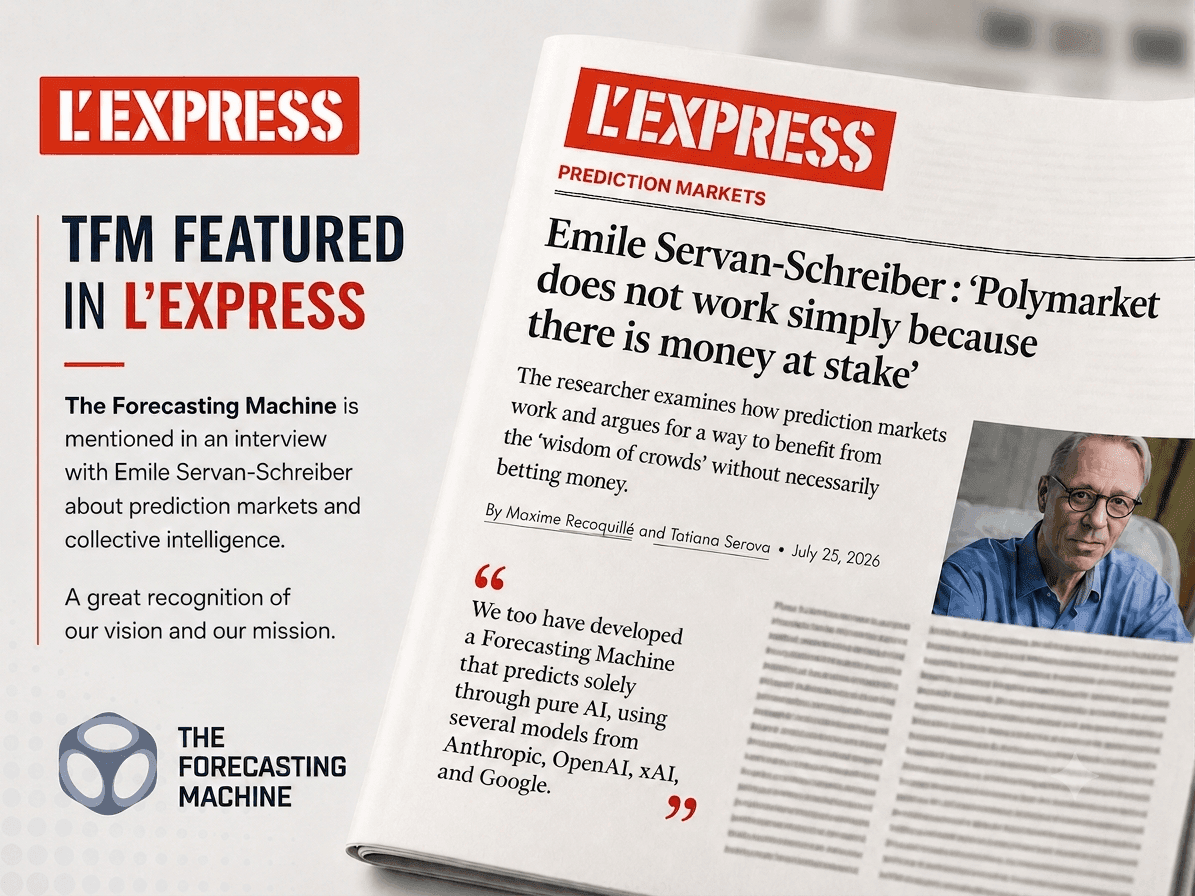
On 25 July 2026, French weekly L’Express published a long interview with Émile Servan-Schreiber, Chief Scientific Advisor at The Forecasting Machine and CEO of Hypermind, under its Marchés de prévision rubric. The interview, conducted by Maxime Recoquillé and Tatiana Serova, appeared eight days after France cut off access to Polymarket. Its argument is narrower than the headline suggests: not that betting platforms fail, but that the money is not what makes them work.
The regulatory decision behind the interview
France’s gambling regulator, the Autorité nationale des jeux, published a decision dated 16 July 2026 ordering internet service providers to block the Polymarket website. The ANJ says it first put the operator on notice in November 2024, that the geoblocking introduced in response was circumvented in practice, and that the site’s homepage—displaying live odds on events open to wagering—amounted to advertising an unauthorised gambling offer in France. Citing Similarweb, the regulator recorded 578,751 visits and 205,057 unique French visitors in June 2026.
That decision is the news peg. L’Express went to Servan-Schreiber because he has worked on this exact question since before the current platforms existed: he holds a doctorate in cognitive psychology, specialises in collective intelligence, and launched the NewsFutures prediction market in 2000. The paper also notes a detail of its own history—his father, Jean-Jacques Servan-Schreiber, co-founded L’Express in 1953.
His central claim: money is not the mechanism
The usual defence of real-money prediction markets is that traders have skin in the game. Servan-Schreiber’s response is that skin need not mean cash. Reputation works too, and he argues that a pseudonymous leaderboard can be the better incentive because it pushes participants less toward conformity than a visible price does. On the platforms he runs, everyone starts with the same quantity of play money, and the participants who forecast well accumulate it from those who do not—so weaker forecasters progressively lose influence over the collective answer.
Ce n’est pas parce qu’il y a des dollars en jeu que Polymarket fonctionne
Émile Servan-Schreiber, L’Express, 25 July 2026
He goes further than preference, calling the claim that dollars are what make these markets work scientifically false and long known to be so. Readers can check part of that record independently. In a 2004 study in Electronic Markets covering 208 National Football League games, Servan-Schreiber and his co-authors compared a play-money market with a real-money one and found no significant accuracy advantage for the cash version. That is evidence about one sport over one season rather than a universal law, but it is a published, checkable result rather than an assertion.
Two different businesses inside prediction markets
The interview separates two activities that share a mechanism. The first is online betting, where the operator takes money from players; Servan-Schreiber notes that the absence of a central bookmaker setting the odds is not new, since Betfair launched on that model more than 25 years ago. The second is the forecasting business, where the operator solicits expertise rather than stakes and sells the resulting forecasts to organisations that need them. That is not new either: the non-profit Iowa Electronic Markets has run election forecasts since 1988, and he says they long outperformed conventional polling.
His criticism of the betting side is specific, and it is his assessment rather than a documented finding. These are the objections he raised:
- Regulatory exposure: he describes the platforms as operating in legislative grey zones, and judges Polymarket’s position more precarious in the short term than that of a competitor which sought narrow authorisation first and widened its scope gradually.
- Perverse incentives: money markets can create a reason to monetise state secrets. He cited a reported wager on the capture of Venezuelan president Nicolás Maduro as his illustration; the interview does not document that episode further.
- The wrong regulatory argument: he does not call for the platforms to be banned, but he rejects the case that they should answer to the U.S. financial regulator rather than to gambling authorities on the grounds that their forecasts are good.
Expertise plus diversity, not volume alone
Asked whether Polymarket’s far larger user base is itself an advantage, Servan-Schreiber answered with the diversity theorem. Collective forecast quality depends on two inputs: the average expertise of the participants and the diversity of their opinions. At equal expertise, less agreement improves the group’s chances of being right—which is why a large, mixed crowd can substitute for scarce specialist knowledge.
The corollary is that scale has limits. Beyond a threshold that can be reached surprisingly early, adding another participant changes nothing; a dozen genuine experts forecasting against one another can be enough. The remaining work is design. He describes weighting the better forecasters more heavily than the weaker ones, weighting this morning’s forecast above the one from two days ago because it is better informed, and correcting the favourite-longshot bias familiar from betting markets, where longshots carry inflated probabilities and favourites are underpriced.
Glimt as the money-free counter-example
His practical example is Glimt, the Swedish government platform that Hypermind supplies and that forecasts questions related to the war in Ukraine. Participation is free, the questions come from Ukrainian services, and the campaign—promoted as far as the Stockholm metro—told Swedes that they were the new weapon for the war in Ukraine. He told L’Express that twenty thousand Swedes have taken part, and argued that the sense of contributing to a war effort is a powerful motivation with no cash equivalent.
He also restated a limit on what any of this delivers. Forecasting is not governance: the decision stays with the decision-maker, and a probability is a power of suggestion grounded in field information. Crediting Robin Hanson’s original insight, he described the useful split as separating the objectives everyone agrees on from the means nobody agrees on, then attaching a number to each option—this policy has this chance of reaching the goal.
Where The Forecasting Machine appears
Asked whether artificial intelligence will make human prediction markets obsolete, Servan-Schreiber gave a split answer—and it is here that The Forecasting Machine enters a French national newspaper. He told L’Express that his team has also built a forecasting machine that predicts purely by AI, drawing on several models from Anthropic, OpenAI, xAI and Google, and described its output as fully sourced and reasoned and produced at volume. That is a description of the product, not an independent accuracy measurement.
He was more precise about where AI currently stands. On economic prediction—his example was a small or medium-sized company that has to anticipate disruption to its supply chain—he estimated that AI forecasting is still 5 to 10% short of superforecasters, and expected parity within roughly six months. He doubted AI would displace betting-based prediction, because the lure of a payout keeps players coming. Both statements are his forecasts about forecasting, offered without a published benchmark attached, and they are the kind of claim that should be checked against results rather than accepted.
Why the distinction matters to readers of forecasts
The interview closes on an argument he has made elsewhere: no intelligence is not collective. He points to multi-head attention in a transformer, where the same sentence is read in parallel by many internal readers and the output is a weighted average of their partial readings, as the same operation his platforms perform by hand when they give more weight to forecasters with a strong record.
For anyone deciding which forecast to trust, the practical test is not whether money changed hands. It is whether the question is precise enough to resolve, whether the evidence behind the number can be inspected, whether the forecast is time-stamped and updated when the evidence moves, and whether the record can be scored afterwards. That standard is what The Forecasting Machine publishes against, and it is the reason a probability is more useful than a prediction—it can be wrong in a measurable way.