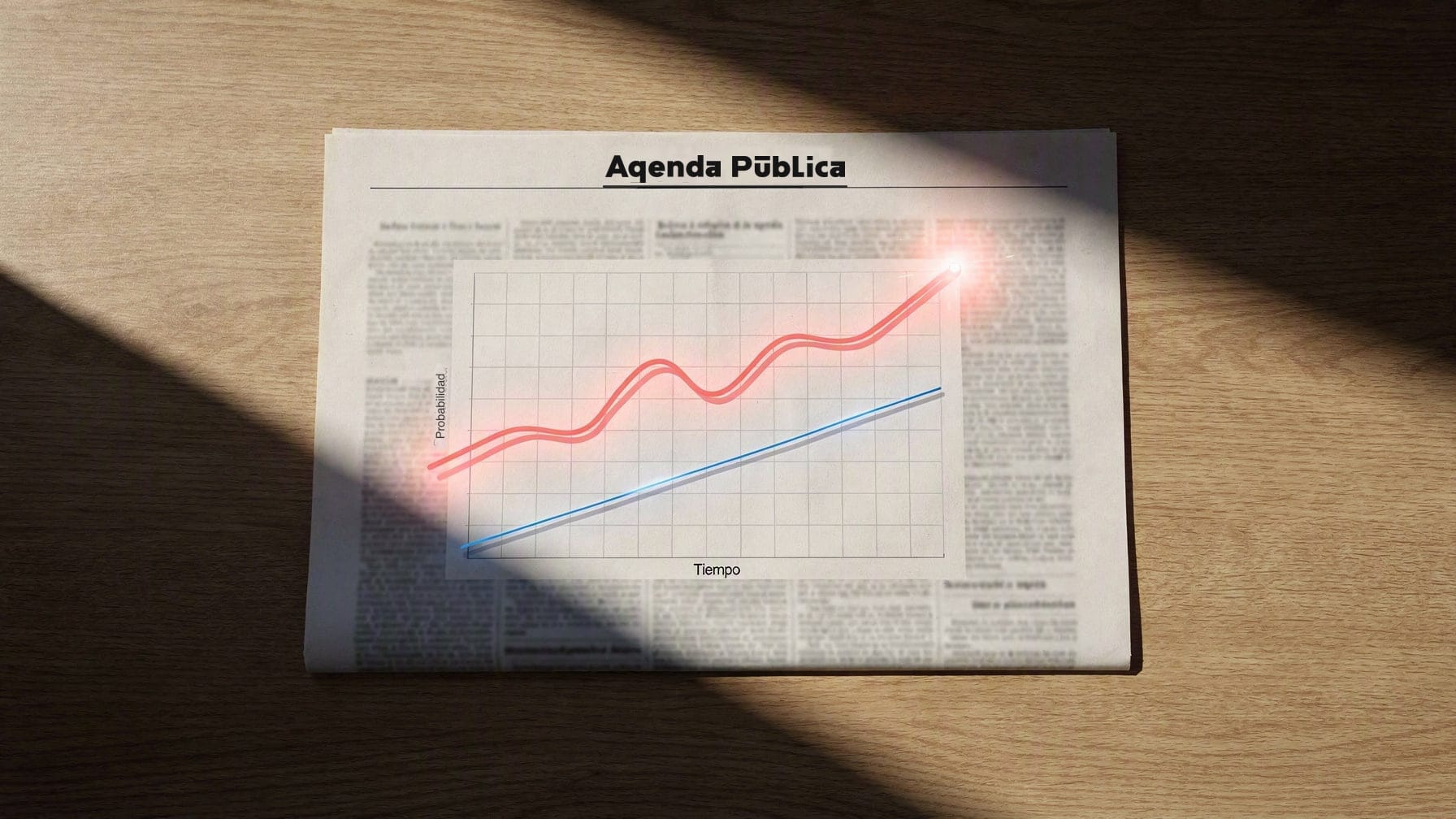
On 5 September 2026, Spanish policy and politics publication Agenda Pública launched Agenda Futura, a new editorial section that combines continuously updated probabilities from The Forecasting Machine with analysis by Agenda Pública’s journalists and expert contributors. The section gives uncertain political developments a numerical baseline while keeping interpretation and editorial judgement in human hands.
Émile Servan-Schreiber, founder of The Forecasting Machine, announced the launch on LinkedIn later that week and described TFM as the engine behind the new section. Agenda Pública’s own launch article defines the collaboration more precisely: TFM generates and updates the forecasts, while its editors explain the causes, signals and implications behind the possible outcomes.
A probability becomes part of the reporting
Agenda Futura is designed to move beyond commentary that labels an outcome merely possible or likely. According to Agenda Pública, The Forecasting Machine identifies causal factors, monitors news and open sources, gathers independent forecasts from multiple AI models and aggregates them into one probability. That estimate can then change when new evidence alters the balance.
- The Forecasting Machine supplies the probabilistic baseline: a time-stamped estimate supported by current evidence and multiple model judgements.
- Agenda Pública supplies the editorial frame: its journalists and experts select consequential questions and explain the political, economic and social forces behind each scenario.
- The reader sees both: a measurable expectation about what may happen and an argument about why the probability should be taken seriously.
The first Agenda Futura questions
The launch article demonstrates the format with two geopolitical questions. The first asks whether Friedrich Merz will complete his term as German chancellor or resign before May 2029. Agenda Pública reported that the forecast had been running since 29 July and, at launch, put completion of the term at roughly 60% against 40% for an earlier resignation.
The second asks whether Russia and a NATO member will enter direct military conflict before 31 December 2029. Agenda Pública reported a 22% probability at launch. The number was below the probability of no direct conflict, but high enough to treat the scenario as a material risk rather than a remote abstraction.
Both reports continued to update after the article appeared. When checked on 14 September, the live Merz report showed 58.0% for completing the term and 42.0% for resigning early; the Russia–NATO report showed 20.8% for direct conflict and 79.3% against it. The small movements are part of the product’s purpose: a probability belongs to a point in time, not permanently to a headline.
Definitions make the numbers accountable
A forecast becomes testable only when the question and outcome threshold are clear. For the Russia–NATO question, Agenda Pública specifies that a qualifying event must be an attributable armed exchange between Russian forces and the armed forces of a NATO member. Examples include an attack causing casualties, the downing of a crewed military aircraft or naval combat.
Drone incursions, cyberattacks, sabotage and threats do not resolve the question on their own unless they lead to a sustained military response. That boundary separates the forecast from a broad judgement about tension or hybrid conflict. Readers can disagree with the assigned probability while still knowing which observable event it is intended to measure.
AI as an editorial input, not an editor
Agenda Pública’s model assigns different responsibilities to the forecasting system and the newsroom. The system can process open evidence, compare causal signals and combine multiple model estimates at a speed that is difficult to reproduce manually. Editors remain responsible for choosing worthwhile questions, scrutinizing what the probability means and explaining the consequences of each scenario.
That division matters because numerical precision can otherwise create a false impression of certainty. A percentage is not a substitute for source criticism, domain knowledge or a clear resolution standard. Used with those disciplines, it can make assumptions visible, show when the evidence has moved and give later readers a record against which the forecast can be evaluated.
From an integration to a named editorial section
Agenda Pública first announced in June 2026 that it would bring AI-based synthetic prediction markets into selected analyses. The September launch gives that collaboration a named editorial home and a repeatable format: pose a consequential question, publish an updateable probability, then use reporting and expert analysis to explain the forces that could move it.
For The Forecasting Machine, Agenda Futura is evidence of a media partnership operating in public rather than a forecast presented in isolation. For readers, its value will depend on whether the questions remain precise, the timestamps stay visible and the analysis makes changes in probability understandable. The launch establishes that standard and puts it directly inside the news experience.