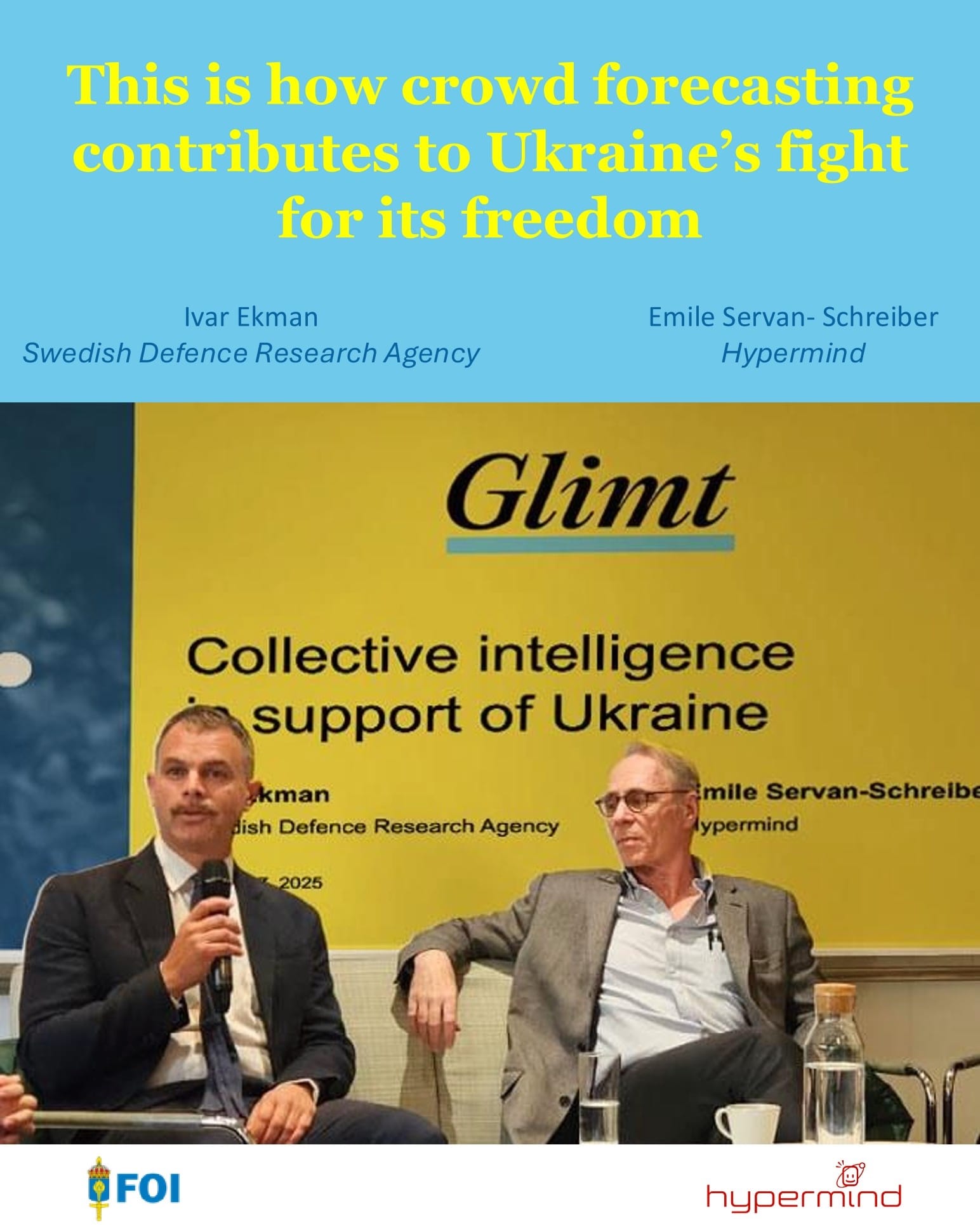
On 12 March 2026, the Swedish ambassador’s residence in Madrid hosted a seminar on Glimt, the crowd-forecasting initiative created to support Ukrainian decision-making. Ivar Ekman, Glimt Programme Director at the Swedish Defence Research Agency (FOI), presented the project with Émile Servan-Schreiber, Chief Scientific Advisor at The Forecasting Machine and CEO of Hypermind. Their focus was practical: what had a year of public forecasting produced, and what could the programme learn next?
Sweden’s ambassador to Spain, Per-Arne Hjelmborn, hosted the event, and Defence Attaché Colonel Malin Persson introduced the role of collective forecasting in strategic decision-making. The setting mattered. Glimt is not a general prediction website: FOI operates it on behalf of the Swedish government in close cooperation with Ukrainian authorities, as part of Sweden’s support for Ukraine.
What Glimt is designed to do
Glimt turns questions supplied by Ukrainian institutions into clear, time-bound forecasting problems. Participants estimate the probability of military, political, and economic outcomes; those individual judgements are then aggregated into a collective forecast. FOI says the resulting probabilities are intended to inform Ukrainian planning over both short and long horizons.
The public platform launched on 20 January 2025 and is open to participants around the world. No single contributor needs to know everything. The method is built on diversity and independence: different people notice different evidence, while aggregation can reduce individual noise and give more weight to forecasters who demonstrate accuracy over time. The presentation identified Hypermind as the provider of the platform’s forecasting technology.
How Glimt reported its first-year results
The Madrid presentation reported about 20,000 registered forecasters and 55 resolved questions during Glimt’s first year. Across those questions, the presenters said that 76% of the eventual outcomes had been forecast correctly under their stated measure. Spanish reporting from the seminar independently recorded the same figures.
The speakers also presented a calibration analysis comparing forecast probabilities with how often outcomes actually occurred. Good calibration means, for example, that events assigned probabilities around 40% happen roughly four times out of ten across a sufficiently large sample. It does not mean knowing which particular event will happen; it means that stated confidence and observed frequency line up over time. Glimt’s first-year sample is informative, but still small enough that continued measurement matters.
From public forecasts to decision support
A forecasting system becomes strategically useful only when its questions reflect real decisions. Glimt’s questions come from Ukraine and cover uncertainties in war, politics, and economics. The presentation reported that consolidated forecasts had been delivered to the Ukrainian government, connecting the public forecasting exercise to an institutional user rather than leaving the results as an isolated experiment.
This relationship also imposes discipline. Questions need explicit deadlines and resolution criteria. Forecasts must be time-stamped, updated as evidence changes, and compared with the eventual outcome. Without those elements, a confident prediction cannot become a measurable track record—and decision-makers cannot tell whether a method is improving.
Human judgement and machine aggregation
Crowd forecasting is sometimes described as a prediction market, but the core mechanism is broader: gather independent probability estimates, preserve different information sources, and combine them systematically. Algorithms can identify consistent contributors and adjust aggregation weights, yet the raw material still comes from people who search for evidence, challenge assumptions, and revise their views.
- Diverse evidence: participants bring different languages, expertise, locations, and information sources to the same question.
- Independent estimates: reducing social influence helps prevent one confident voice from determining the group’s answer.
- Measured learning: resolved questions reveal which forecasters and aggregation methods remain reliable across time.
The next tests for Glimt
The presentation described two areas for Glimt’s second year: experiments comparing groups with groups, and hybrid forecasting that combines artificial intelligence with human judgement. These were presented as the programme’s next innovations, not as settled results. The important question is whether each design improves calibration, responsiveness, or robustness when evaluated against resolved outcomes.
AI can search and synthesise evidence quickly; human forecasters can bring context, scepticism, and diverse perspectives. A hybrid system should therefore be judged by more than speed. It must preserve source provenance, expose revisions, resist correlated errors, and demonstrate its performance on questions that matter to the people using the forecast.
Why the Madrid presentation matters
Glimt offers a concrete example of forecasting moving from research into public decision infrastructure. Its first-year results do not remove uncertainty, and they should continue to be tested as more questions resolve. They do show the value of a transparent process: define the question, collect independent probabilities, aggregate them, update them, and score the result.
That discipline is also central to The Forecasting Machine. Émile Servan-Schreiber’s contribution in Madrid connected collective intelligence with AI-assisted forecasting while keeping the standard of evidence visible: probabilities are valuable when they can be traced, revised, and evaluated—not when they merely sound certain.