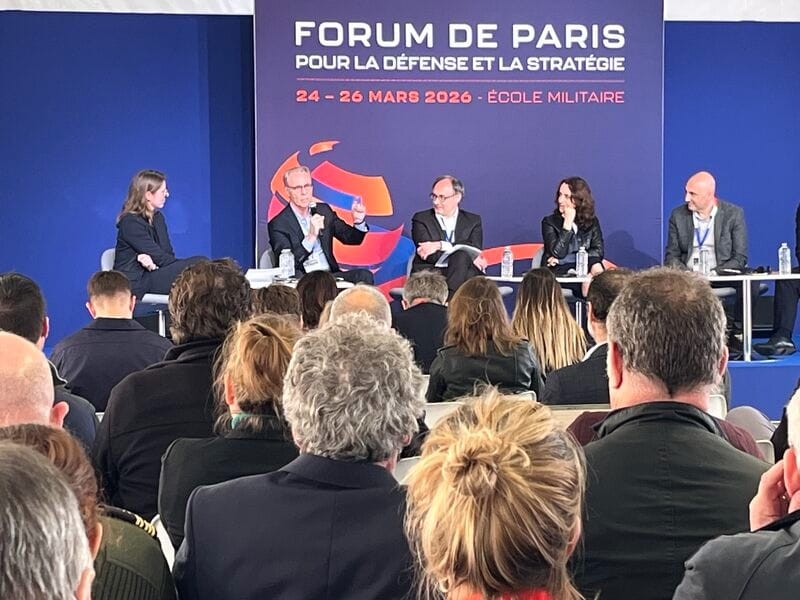
What does forecasting have to do with sovereignty? At the 2026 Paris Defence and Strategy Forum, Émile Servan-Schreiber, Chief Scientific Advisor at The Forecasting Machine, argued that the ability to anticipate is itself a strategic capability. A state that can turn uncertainty into well-calibrated probabilities can test assumptions earlier, allocate attention more intelligently, and make consequential decisions with a clearer view of risk.
The forum brought civilian and military experts to Paris’s École militaire from 24 to 26 March under the theme Sovereignty, alliances and partnerships. Servan-Schreiber joined a multidisciplinary roundtable on sovereignty, innovation, and long-term thinking alongside specialists in strategy, mathematics, health research, and innovation management. His contribution focused on a resource that countries rarely treat as infrastructure: their collective capacity to forecast.
Sovereignty includes the ability to anticipate
Debates about sovereignty often begin with what a country controls: territory, industrial capacity, technology, supply chains, or data. Servan-Schreiber added a decision-making dimension. Control matters, but so does the ability to recognise change before it becomes obvious and to express uncertainty precisely enough that leaders can act on it.
This is not a claim that forecasting eliminates surprise. It does the opposite: probabilistic forecasting makes room for surprise by showing decision-makers how much confidence to place in each scenario. Instead of a single official future, it offers a continuously updated distribution of possible outcomes.
A sovereign capacity to anticipate would give decision-makers access to probabilities before uncertainty hardens into crisis.
The Forecasting Machine
A national network of citizen forecasters
Drawing on large forecasting programmes sponsored by the United States government, Servan-Schreiber argued that a small share of any population is exceptionally skilled at assigning and updating probabilities. His proposal for France was direct: run an open national forecasting tournament across defence, economics, politics, health, and other strategically important fields.
Such a programme could identify roughly 50,000 high-performing citizen forecasters, he suggested, creating a standing network that public decision-makers could consult upstream. The forecasts would not be opinion polls. Participants would answer precise, time-bound questions; update their probabilities as evidence changed; and build measurable track records against outcomes.
Working examples in defence and public health
The proposal is ambitious, but its components are already being tested. Servan-Schreiber pointed to Glimt, an initiative associated with the Swedish Defence Research Agency and delivered through a Hypermind forecasting platform. It mobilises citizens around questions related to the war in Ukraine, with forecasts consolidated for analysts working on real strategic uncertainties.
He also highlighted the Johns Hopkins Disease Prediction Platform, developed with Hypermind to forecast infectious-disease outcomes. Johns Hopkins reported more than 1,000 registered users from 88 countries and over 500 active forecasters answering questions about outbreaks including Ebola, measles, influenza, and Eastern equine encephalitis. The example shows why domain knowledge and forecasting skill should be combined rather than treated as rivals.
Where artificial intelligence fits
The roundtable’s third question concerned AI as an instrument of strategic foresight. Servan-Schreiber’s answer was that modern language models make forecasting faster and more scalable across domains. They can gather evidence, generate an initial probability, explain the factors behind it, and update their assessment as new information arrives.
Scale is valuable only when it remains accountable. A strategic forecasting system must preserve sources, distinguish evidence from inference, measure calibration over time, and make revisions visible. Human judgement and machine forecasting are most useful when they can challenge and correct one another.
Three principles for strategic forecasting infrastructure
- Ask resolvable questions. Broad scenarios become actionable when translated into clear outcomes, deadlines, and resolution criteria.
- Combine different kinds of intelligence. Domain experts, skilled citizen forecasters, and AI systems contribute different information and different failure modes.
- Update continuously. A probability is not a verdict; it is a disciplined snapshot that should move when the evidence moves.
From foresight exercise to decision infrastructure
The central idea presented at PDSF 2026 was institutional rather than technological. Forecasting becomes strategically useful when it is continuous, measurable, and connected to decisions—not when it is reserved for an occasional report about the distant future.
That is the direction behind The Forecasting Machine: turning complex strategic questions into evidence-backed probabilities that can be monitored and revised over time. Sovereignty is partly about retaining the freedom to act. Better anticipation helps preserve that freedom by revealing risks and alternatives while there is still time to choose.