
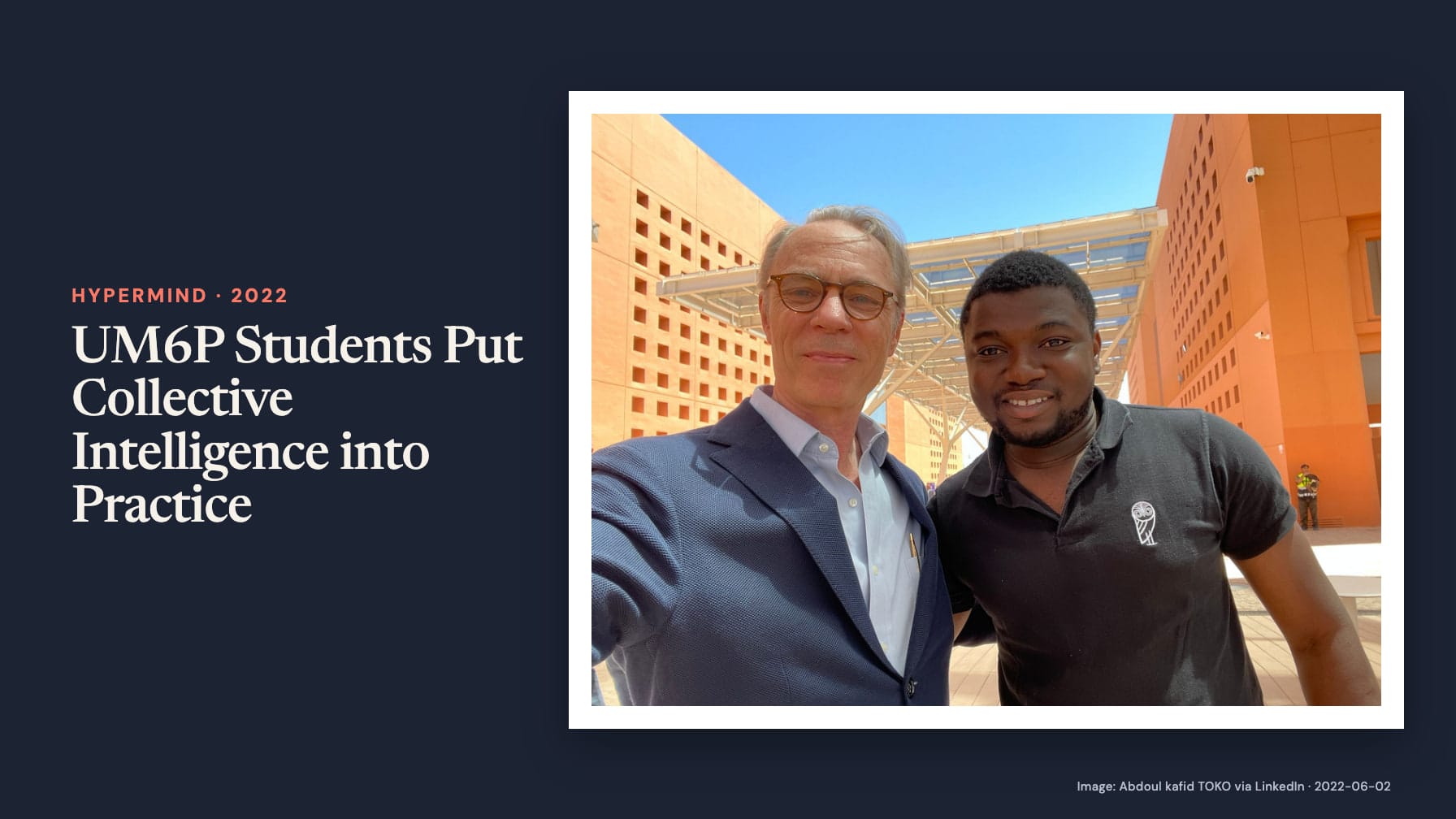
Between December 2020 and June 2022, Émile Servan-Schreiber shared several accounts of students applying collective-intelligence ideas at Mohammed VI Polytechnic University’s School of Collective Intelligence. They covered small research exercises, public invitations to contribute and a participant’s experience of forecasting on Hypermind. Together they show an approach to learning through designing and trying methods, rather than only discussing their promise.
Inviting people into a class project
On 5 January 2021, Servan-Schreiber invited readers to answer a survey about the quality of online education. He explicitly identified it as a class project designed by his UM6P students. In the accompanying post, Abdoul Kafid Toko described the switch to online education during COVID-19 and offered respondents a chance to win 1,000 Moroccan dirhams. The invitation presented participation as a way to contribute to a student-led inquiry.
A day earlier, Servan-Schreiber had reshared Toko’s invitation to a different questionnaire, about inclusive health insurance in Benin. Toko proposed involving many people in thinking through the problem. His later account, shared on 2 June 2022, says he joined the UM6P school in October 2020. The questionnaire broadened the educational thread to a public-policy concern, while Toko’s later reflection described the personal change he associated with joining the school.
Testing social sensitivity
Two posts on 29 December 2020, in English and French, promoted the same student exercise: an online test of people’s ability to infer others’ mental states from their eyes. Servan-Schreiber presented this ability as a component of collective intelligence. Both invitations asked readers to try an exercise in interpreting social information.
There is a research basis for the topic. A 2010 Science paper by Anita Williams Woolley and colleagues found a collective-intelligence factor associated with a group’s average social sensitivity and a more equal distribution of conversational turns. The association helps explain why students might investigate social sensitivity. It connects the exercise to the broader question of how people recognise and respond to one another’s perspectives.
Forecasting winnings become a learning budget
On 2 February 2022, Servan-Schreiber shared Ilyass Mousaid’s account of learning about prediction markets and using Hypermind. Mousaid reported winning €202 in an AI forecasting challenge and reinvesting the money in economics and psychology books. He thanked members of the UM6P community and Camille Larmanou for bringing him to the platform. Servan-Schreiber welcomed the reinvestment in knowledge.
The AI-progress forecasting contests are documented separately. Mousaid’s account adds a participant’s view: an incentive can encourage further study as well as reward a forecast. Mousaid’s testimony describes learning as a continuing process: working with the platform revealed how much more he wanted to understand.
The June 2022 reflection adds mentoring and a roundtable on transhumanism and collective intelligence. Across these examples, the educational thread is practical participation followed by reflection. These accounts describe participation and reflection; they do not establish measured learning gains or policy effects.