
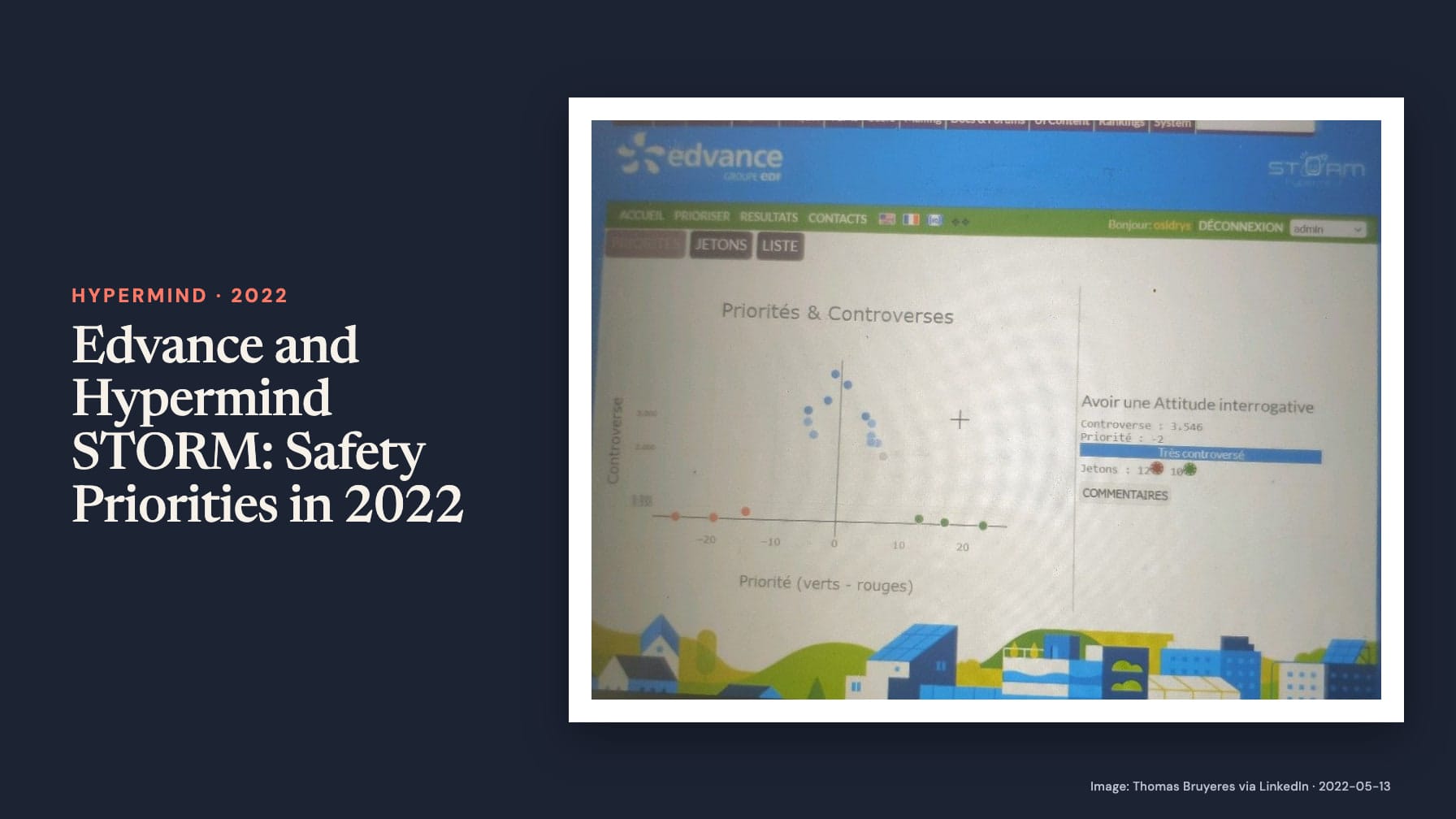
On 13 May 2022, Émile Servan-Schreiber shared Thomas Bruyeres’s account of a safety-leadership day at Edvance the previous day. Bruyeres described a collective-intelligence exercise designed to understand what employees regarded as good practices, risks and priorities. Servan-Schreiber identified the tool as Hypermind STORM and thanked EDF’s Parlons Énergies initiative for its work on collective intelligence.
Bruyeres framed the problem as building a shared safety culture in a young organisation with more than 3,000 employees. His recap described conferences and workshops on safety leadership, but the distinctive part was the process that preceded the discussion: first collecting ideas, then asking a smaller group to evaluate them.
From contributions to priorities
According to Bruyeres, the idea-generation phase involved more than 300 contributors discussing observed good practices and Edvance’s risks. Around 100 of them then participated in voting to identify development priorities and existing strengths. The numbers describe two stages of the exercise, with a smaller group evaluating the ideas gathered from the wider set of contributors.
He named Thomas Keith, Patrick Lizee and Alexandre Foucault as collaborators, and described the approach as coming through Parlons Énergies, based on Servan-Schreiber’s work and the Hypermind platform. Hypermind’s own product material distinguishes Storm’s ideation and prioritisation function from its Prescience forecasting platform. Its corporate history also documents a wider EDF collaboration beginning in 2021, separately from Bruyeres’s account of participation at Edvance.
Disagreement was part of the output
Bruyeres’s main assessment was that the process could make the degree of support for a culture or transformation more explicit, identify controversial topics and reveal collective needs that other participatory approaches might miss. The attached screenshot is consistent with that description: it displays priorities and controversies as separate dimensions. A priority can attract broad support or divide participants, making those two dimensions useful to examine together.
For forecasting, the case illustrates a neighbouring task: eliciting and comparing judgements before choosing an action. A ranking of safety practices is different from a probability that an event will occur. The journal’s discussion of incentives and collective judgement examines why the way opinions are elicited can matter.