
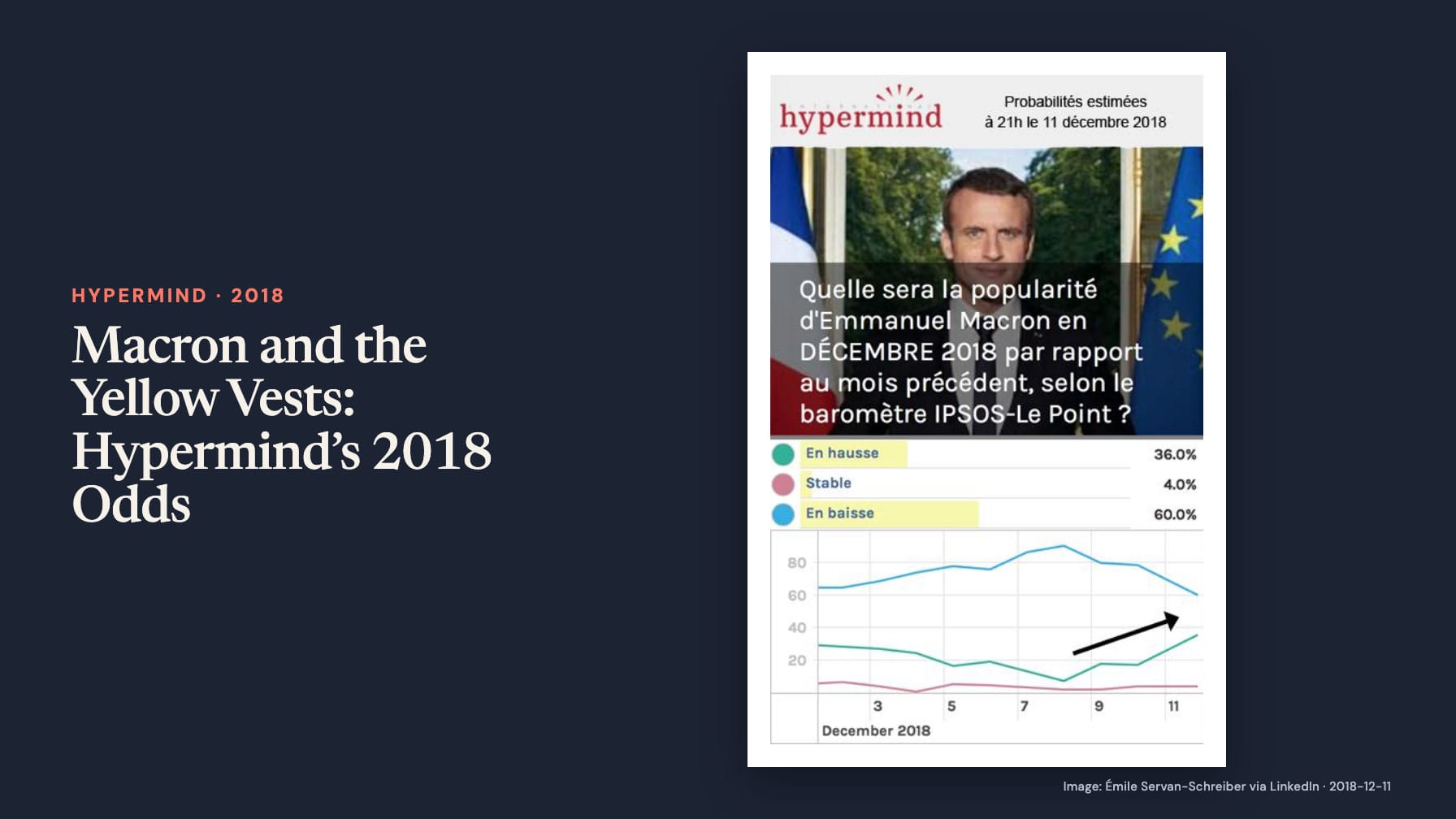
On the morning of 10 December 2018, after another weekend of Yellow Vests protests, Émile Servan-Schreiber shared Hypermind’s probabilities for several possible political consequences. The next evening he said Macron was rebounding after hitting bottom during the movement’s fourth act. The attached image identifies what was rising: the market’s estimate of a month-on-month increase in Macron’s popularity.
The four markets on December 10
The first screenshot is explicitly labelled 10 December 2018, 9:30. It contains four questions, with different outcomes and deadlines:
- A government declaration of a state of emergency before the end of 2018: yes 12.0%, no 88.0%.
- Macron’s December popularity relative to November, according to the Ipsos–Le Point barometer: up 18.0%, stable 2.0%, down 80.0%.
- Prime Minister Édouard Philippe leaving government: in 2018 19.1%, in 2019 before the European elections 19.1%, not before those elections 61.8%.
- Macron dissolving the National Assembly: in 2018 2.0%, in 2019 before the European elections 3.0%, not before those elections 95.0%.
Servan-Schreiber’s short caption mentioned resignation in general. The actual departure contract shown in the image concerns Philippe, not Macron. The four contracts address distinct possible consequences of the protests, from a poll result to changes in government or institutions.
The rebound still left decline more likely
The December 11 card is labelled 21:00. For the same Ipsos–Le Point popularity question, it displays up 36.0%, stable 4.0%, down 60.0%. The chance of an increase had doubled from the previous morning’s 18.0%, but a decline remained the most likely outcome. This was a change in expectations about a poll result, rather than a poll showing Macron recovering.
The Élysée confirms that Macron addressed the nation on 10 December. The two screenshots sit on either side of that address, but their timing alone cannot prove what caused traders to revise their estimates.
What the specified poll eventually reported
The original Ipsos report, dated 10 December 2018, records 20% favourable judgements of Macron’s action, against 26% in November. The observed direction was down: that outcome received 80.0% on the 10 December card and 60.0% on 11 December. Respondents were surveyed on 7 and 8 December, before Macron’s speech. The report’s date also cautions against assuming the 11 December price preceded public knowledge of the result; its exact release time is unconfirmed.
For the prime-minister question, an Élysée announcement records Philippe’s government resigning on 3 July 2020, later than either early-departure interval shown on the card. This gives the departure question a separately documented outcome. The displayed dates and answer intervals matter when relating a changing market price to a later event.