
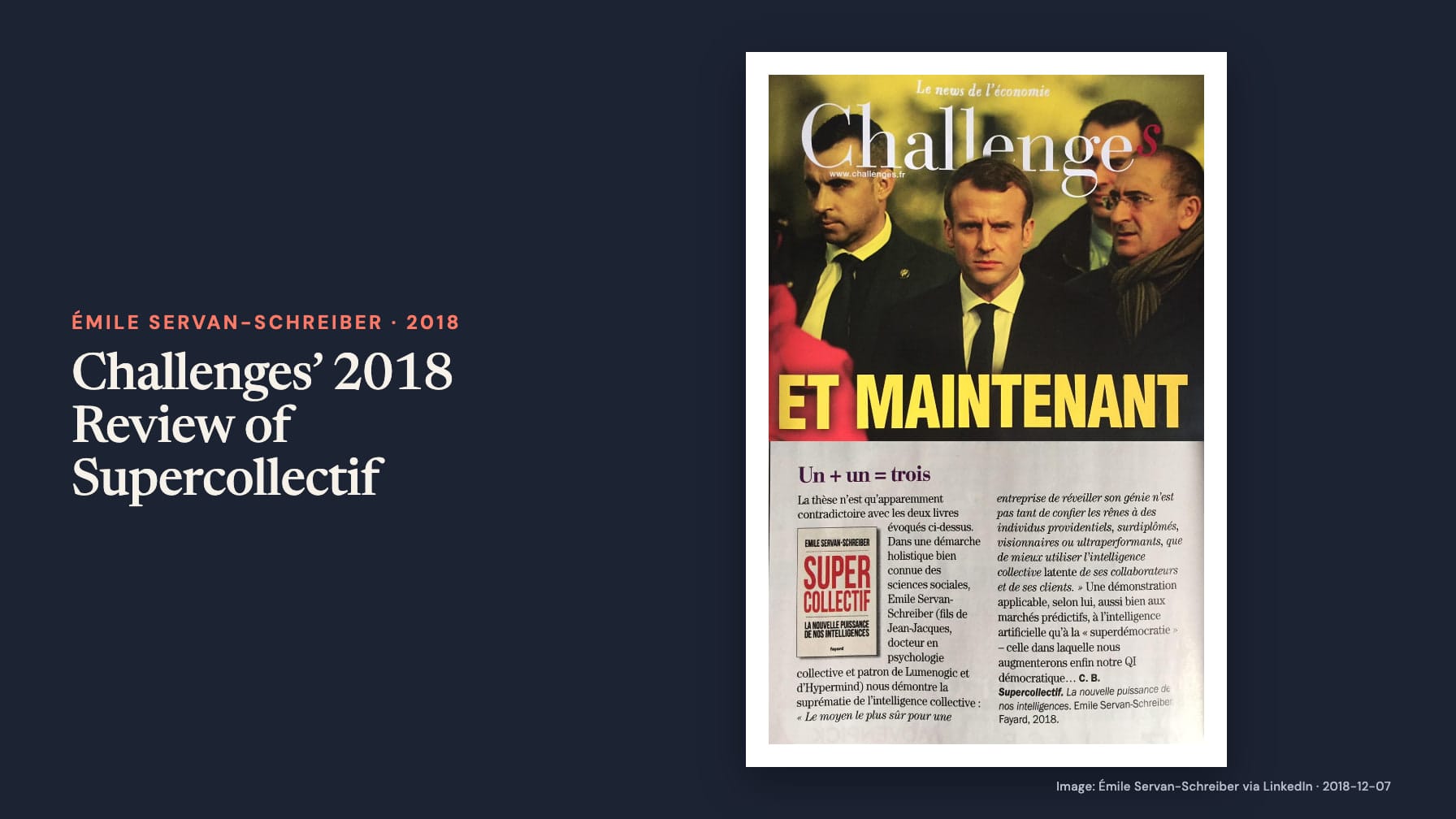
On 7 December 2018, Émile Servan-Schreiber drew readers’ attention to the previous day’s issue of Challenges: he saw a problem on the cover and a solution on page 95. His post’s attachment combines the magazine cover with a review of Supercollectif: La nouvelle puissance de nos intelligences, published by Fayard that year.
The cover reads “Et maintenant”. In our translation: “And now”. Servan-Schreiber’s juxtaposition framed the book as an answer to the magazine’s cover. That was his interpretation, rather than a political remedy endorsed by the magazine.
The review’s organizational argument
Un + un = trois
Challenges review heading, December 2018, signed C. B.
In our translation: “One plus one equals three.” The review’s heading captures its account of the book: a group can offer something beyond the individual talents within it. Signed C. B., the review presents Servan-Schreiber as the author advancing that case; its favourable description is a reviewer’s assessment.
The central idea it highlights concerns where a company looks for intelligence. Instead of relying principally on exceptionally qualified or visionary individuals, the book argues for making better use of knowledge already available among colleagues and customers. The review then describes applications to prediction markets, artificial intelligence and democracy. The emphasis is on organising contributions: a company can ask what its employees and customers know, then decide how to combine that knowledge. For forecasting, this shifts attention from finding a single authoritative voice to designing a process that can use many estimates.
What the publisher’s record adds
Fayard’s catalogue dates the French edition to 24 October 2018. Its presentation asks how groups can use crowd wisdom while avoiding conformity, and why diversity matters. It also identifies organizations and democracy among the book’s subjects. These details corroborate the review’s scope; the publisher’s description remains a presentation of the book’s claims.
The clipping is useful evidence of how collective intelligence was being introduced to business readers in 2018. It also forms part of the history continued in the later English edition. The review’s contribution is its focus on intelligence already present inside and around a company. Servan-Schreiber’s recommendation presented that argument as a response to the moment; the reviewer assessed the book’s organisational thesis.