
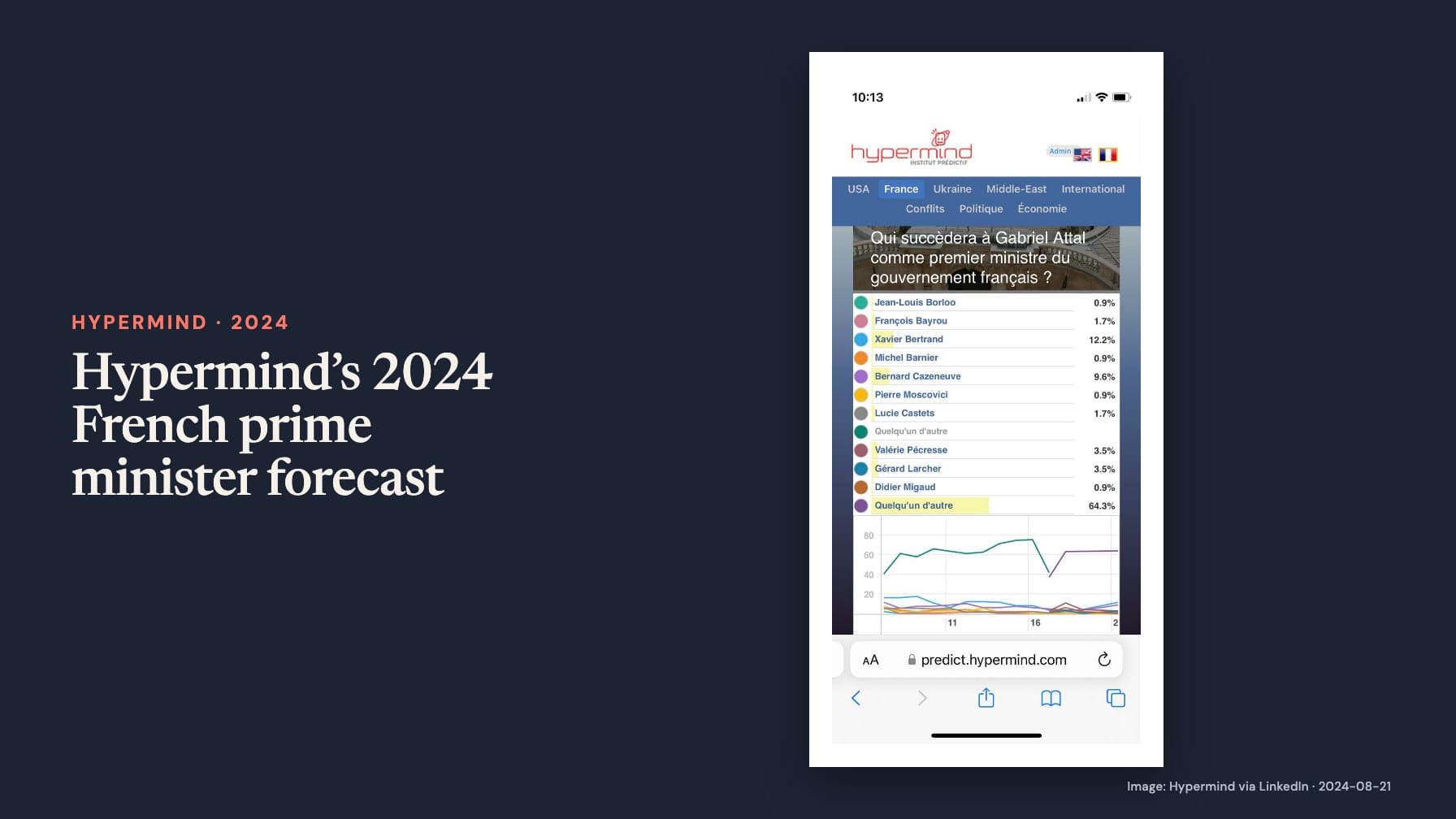
On 21 August 2024, Émile Servan-Schreiber asked who might be behind the leading residual option in Hypermind’s market for France’s next prime minister. The attached dashboard gave that residual option 64.3%. Michel Barnier, one of the named candidates, stood at 0.9%. On 5 September, President Emmanuel Macron appointed Barnier. This historical sequence records uncertainty, but also a substantial underestimate of the eventual choice.
The French label was “Quelqu'un d'autre”. In our translation: “Someone else”. It grouped candidates outside the named list, rather than identifying one particular person.
Different questions across July and August
The earliest post in the thread, on 8 July, concerned a different contract: who would be prime minister on 26 July 2024? Its screenshot assigned 1% to a member of the Rassemblement National, 37% to a supporter of President Macron, 20% to a member of the Socialist Party or Place Publique, 6% to a member of La France Insoumise, and 36% to another option. These were categories of officeholder on a fixed date, rather than the identity of Attal’s eventual successor.
By 1 August, Servan-Schreiber was asking about Lucie Castets. He described her chance as about one in four that day. The attached binary question asked whether she would become prime minister in 2024 and displayed yes at 23.6%, no at 76.4%. The text and chart are consistent, but this year-long question should not be treated as identical to the later successor market.
The unnamed option dominates
On 14 August, the question was who would succeed Gabriel Attal as prime minister of the French government. The chart showed the other-candidate option at 65.5%, Xavier Bertrand at 11.8%, Bernard Cazeneuve at 6.4%, Pierre Moscovici at 5.5%, Michel Barnier at 3.6%, Jean-Louis Borloo and François Bayrou each at 2.7%, and Lucie Castets at 1.8%. Hypermind’s accompanying post said none of the usual candidates convinced its forecasters.
A week later, the list had expanded. The leading residual option still held 64.3%; Bertrand had 12.2%, Cazeneuve 9.6%, Valérie Pécresse and Gérard Larcher each 3.5%, Bayrou and Castets each 1.7%, and Borloo, Barnier, Moscovici and Didier Migaud each 0.9%. The screenshot also contains an older greyed-out residual row without a displayed percentage. Its presence makes reconstructing the contract’s changes hazardous: the screenshot does not explain how adding candidates affected earlier holdings.
What the appointment establishes
The Élysée’s announcement confirms Barnier’s appointment on 5 September. Since he was explicitly listed in both August snapshots, his appointment cannot be counted as a success for the other-candidate option. On those dates the crowd strongly favoured an alternative and assigned little probability to the person eventually selected.
This does not establish the market’s final forecast: the August snapshots precede the 5 September decision. Nor does one surprising appointment establish poor calibration across all Hypermind questions. It does establish a miss in these preserved estimates. The longer 2017 French presidential market history shows why retaining successive dated forecasts is useful: readers can distinguish an early judgement, later updates and the eventual outcome.