
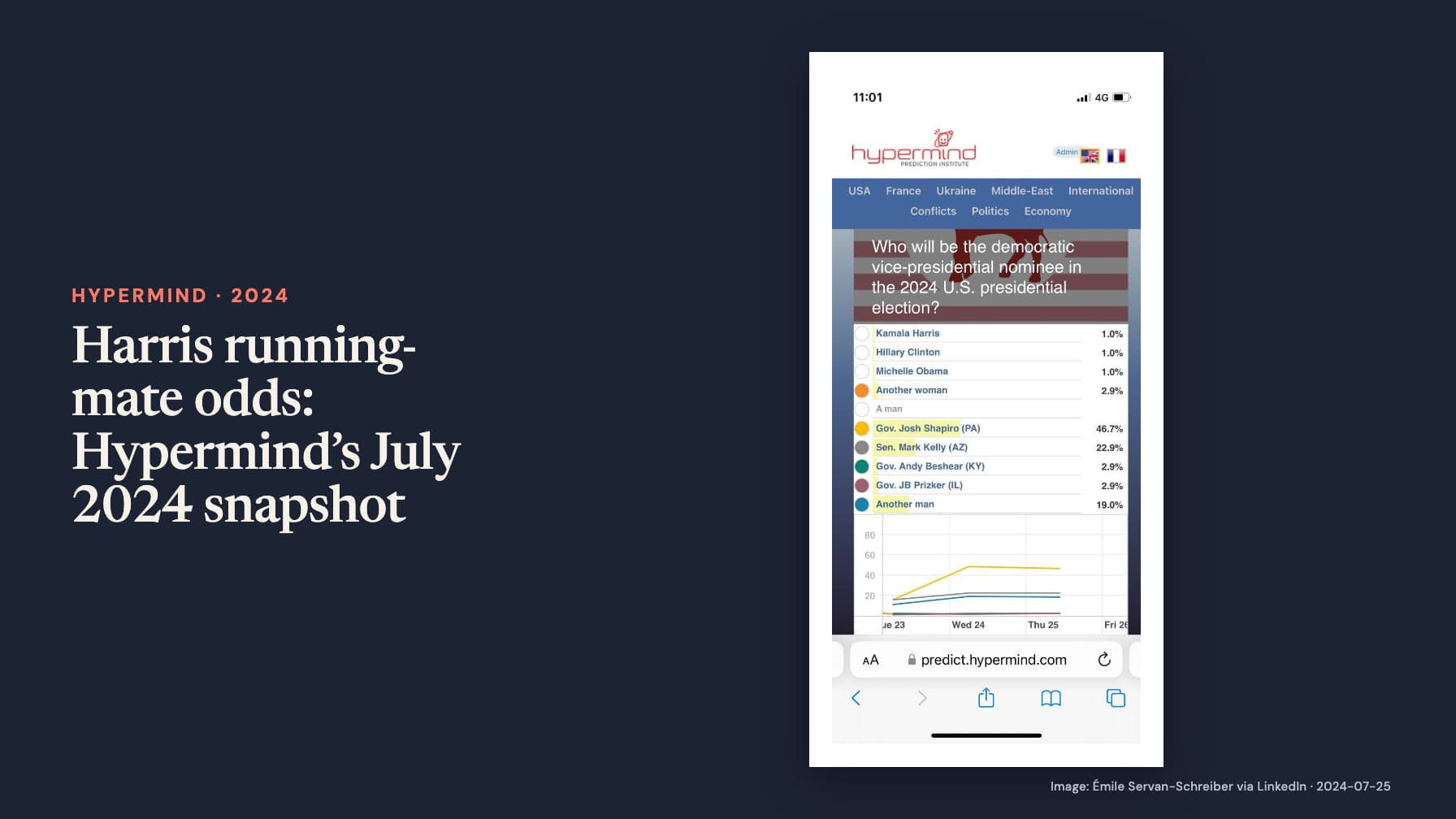
On 25 July 2024, Émile Servan-Schreiber wrote that Pennsylvania governor Josh Shapiro was the clear favourite to become Kamala Harris’s running mate. The accompanying Hypermind screenshot supplies the number behind that description: Shapiro had a 46.7% chance, the largest named probability but less than one in two.
The Hypermind question asked who would be the Democratic vice-presidential nominee in the 2024 US presidential election. A nomination forecast asks whom the party will select; a presidential-election forecast asks whether the eventual ticket will win. The July distribution captured the first decision while several candidates remained possible.
The distribution on 25 July
- Josh Shapiro: 46.7%.
- Mark Kelly: 22.9%.
- Andy Beshear and JB Pritzker: 2.9% each.
- Another man: 19.0%.
- Kamala Harris, Hillary Clinton and Michelle Obama: 1.0% each; another woman: 2.9%.
The labels matter. Tim Walz was not a separately priced name in the displayed distribution. As an unnamed male candidate, he belonged to the “another man” category. Its 19.0% cannot be reported as Walz’s individual probability: it covered every eligible man outside the named options. The displayed values also reflect rounding.
What happened afterwards
Harris selected Minnesota governor Tim Walz on 6 August 2024. The White House statement preserved in that day’s presidential pool reports confirms the selection and President Biden’s congratulatory call. Shapiro therefore did not become the nominee, despite leading this earlier market snapshot.
That is a miss for anyone who turned the leading name into a categorical prediction. It is not evidence that the market had declared Shapiro certain. The screenshot placed more than half of the total probability outside his option, spread across alternatives. A forecaster could regard him as the best individual bet while still expecting someone else, collectively, more often.
What this snapshot can tell us
The 25 July image records an intermediate distribution, with the later price history and full settlement rules unspecified. Keeping the observation date attached to the probability is essential: a forecast made while a choice is still open represents the information available at that point. The eventual announcement supplies the outcome against which that observation can be compared.
The useful lesson is narrower: preserve both the leading probability and the alternatives when reporting a forecast. Assessing whether probabilities deserve trust requires many resolved questions, as explained in our guide to scoring and calibration. This running-mate market provides one historical observation, with a clearly identifiable favourite and a different eventual outcome.