On 18 September 2024, Émile Servan-Schreiber announced what he called an election forecasting battle between artificial and collective intelligence. Hypermind, the prediction-market company he leads, would set its new AI Forecasting Machine against its long-running human market to see which better predicted the 2024 US presidential election, state by state and overall. The forecasts appeared on a public interactive map, updated daily, that Hypermind had unveiled on 9 September.
The experiment matters beyond one election. Language models were starting to produce probability forecasts, and the open question was whether they could match a well-run crowd. Servan-Schreiber framed it plainly in his post: whoever won, there was a lot to learn.
Two forecasters on one map
In one corner was Hypermind’s prediction market, which opened in 2014. It is a play-money market: traders do not stake their own cash, but buy and sell contracts with a virtual currency, and their standing depends on how accurate they turn out to be. Contract prices are read as probabilities. Servan-Schreiber described its secret sauce as an elite panel of champion forecasters.
In the other corner was the AI Forecasting Machine, which he described as retrieval-augmented. In plain terms, before the model answers, it is fed recent news retrieved from reputable sources, so its reasoning rests on current events rather than only on what it learned in training. According to the post, it prompts leading large language models to produce reasoned probability forecasts grounded in a model of the world.
The map did not simply run the two side by side. It combined them, and its sidebar explained the split:
A selection of battleground states are forecasted by Hypermind’s prediction market, while others are forecasted by our AI Forecasting Machine.
Hypermind election map, 2024
A legend marked crowd-forecast states with a dashed outline. Tabs let readers switch between the combined view, the crowd alone, the AI alone and the 2020 result. The headline Electoral College win probability was labelled as forecast by the crowd.
What the map said
The images Servan-Schreiber and Hypermind posted give three snapshots of the combined map. The electoral-vote figures count the states leaning to each side, not certainties.
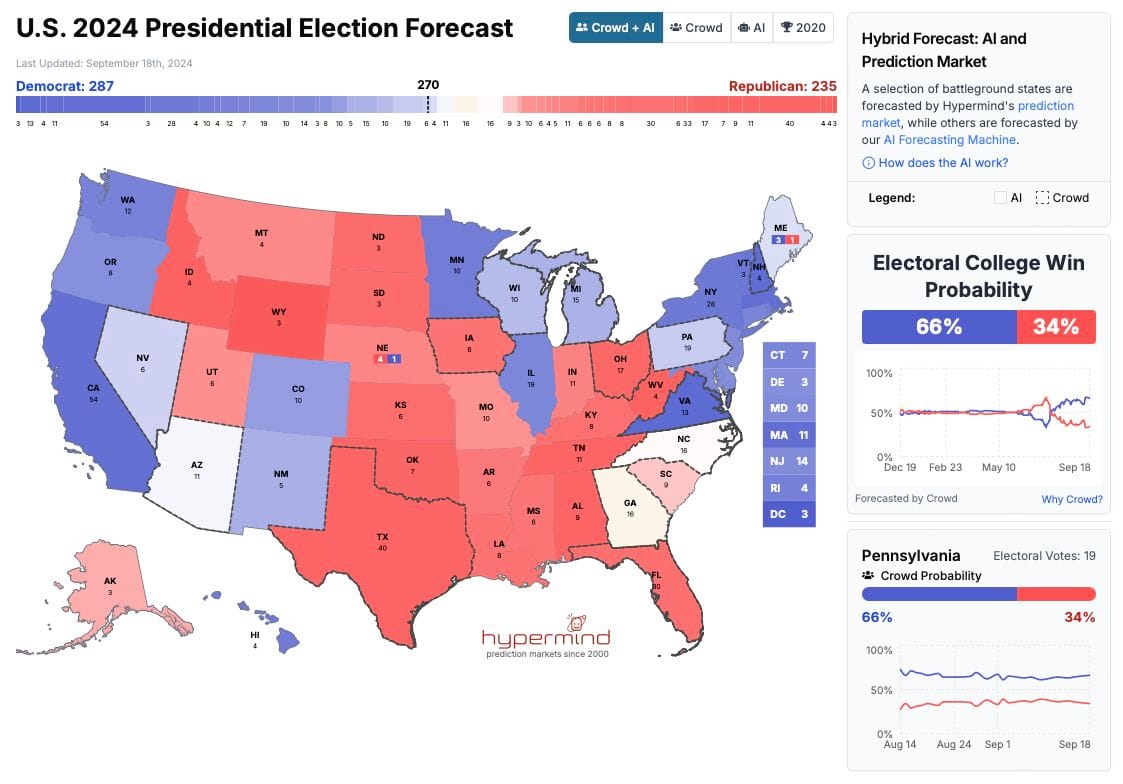
- 9 September: 287 electoral votes leaning Democratic and 219 leaning Republican, with a 60% chance of a Harris win in the Electoral College. Pennsylvania stood at 64% for the Democratic side.
- 18 September: 287 against 235, with Harris at 66%. Pennsylvania stood at 66%.
- 5 November, before the count: 276 against 262, with Harris at 60%.
In the comments, Servan-Schreiber added a timing claim about the human market. He wrote that after Joe Biden withdrew on 21 July, Harris became the favourite on Hypermind a couple of days later, “a full week before any other model catches on.” We could not check that comparison independently.
Where the AI and the crowd disagreed
Asked how the two compared, Servan-Schreiber wrote that the AI’s probabilities tended to be less confident than the crowd’s. His example was Florida, where the market gave Trump 92% and the AI only 58%.
AI is ironically more likely to succumb to the classic gambler’s bias of overestimating outsiders and underestimating favorites.
Émile Servan-Schreiber, LinkedIn comment, September 2024
That bias, known as the favourite-longshot bias, is familiar from betting markets: long shots tend to be priced too high and favourites too low. Servan-Schreiber added that the tests run by Hypermind and by others converged on the same finding, namely that the AI’s overall accuracy approaches crowd accuracy but does not surpass it.
How the election turned out
Donald Trump won 312 electoral votes to Kamala Harris’s 226 and carried all seven swing states, Axios reported from Associated Press results. The final map’s 276 Democratic-leaning votes equal Harris’s 226 plus Pennsylvania, Michigan, Wisconsin and Nevada. In other words, on election morning the map leaned the wrong way in those four battlegrounds. It leaned correctly in Arizona, Georgia and North Carolina, and its leans in the other states matched the result.
Those battlegrounds sit on the crowd side of the experiment, by our reading of the map legend. So the four misses belong mainly to the human market, not to the AI. The headline 60% for Harris was a forecast, not a call: a 60% favourite is expected to lose about four times in ten. But the misses all went the same way, which is common in elections because states tend to move together.
What the experiment did not settle
We found no published scorecard comparing the AI and the crowd state by state after the vote, and the map is no longer online. The archived copy keeps only the page shell, not the daily numbers. On the evidence available, the 2024 contest between the two forecasters remains unscored. What is on record is Servan-Schreiber’s summary of earlier tests: AI forecasts close in on the crowd without overtaking it.
The work continued. A year later, on 16 September 2025, Servan-Schreiber launched The Forecasting Machine, which he described as incubated at Hypermind after 18 months of research. It combines real-time news scraping with an ensemble of AI models.