
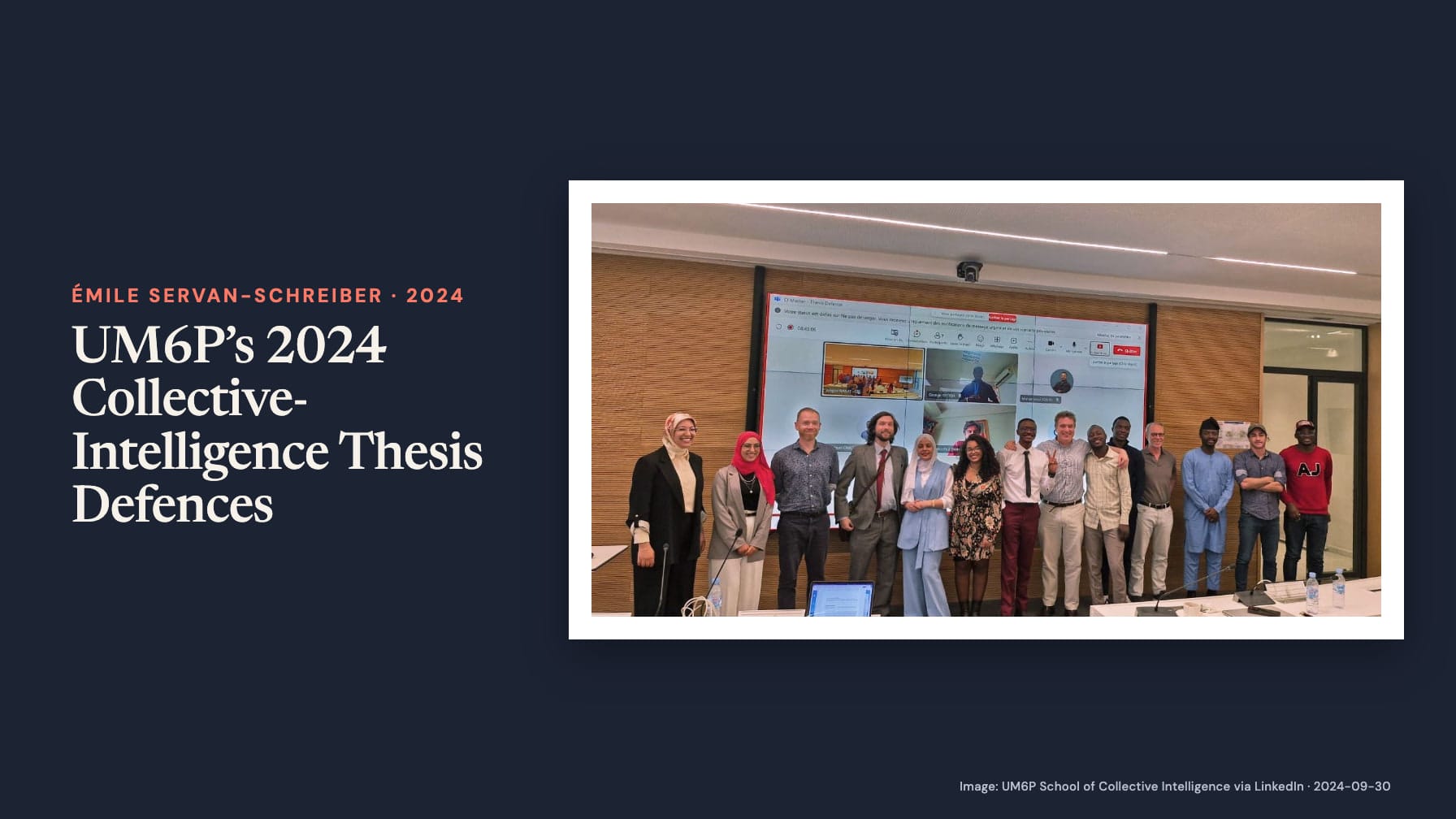
On 30 September 2024, Émile Servan-Schreiber shared the UM6P School of Collective Intelligence’s congratulations to students completing its two-year master’s programme. Their final thesis defences had taken place on the preceding Thursday, 26 September, as his own 27 September post also indicates. The subjects ranged from cryptocurrency communities to the origins of language.
The common question was how groups organise themselves to work more intelligently. Servan-Schreiber wrote that helping shape the students’ research year after year was rewarding. The school’s account celebrated the defences, but did not publish their findings.
Four routes into the study of groups
- Cryptocurrency governance: how communities built around cryptocurrencies should govern themselves.
- Moroccan nomads: whether settling in villages leaves nomadic people better off.
- Language origins: what gorilla songs might reveal about the development of human language.
- Deliberation: how traditional African practices could inform the design of a global citizens’ assembly.
The four subjects are research questions. They approach collaboration at different scales: governance within a digital community, changes in a way of life, communication among primates and deliberation across countries. Together they show that the school’s subject extends beyond forecasting into how groups communicate, coordinate and make decisions.
An education in measuring collaboration
The school’s current master’s programme description combines cognitive science, computer science, data science and collaborative leadership. Its objectives include learning experimental and statistical methods to test, measure and improve collaborative processes, then applying them in research or real-world settings. The description also confirms the two-year format. That curriculum gives a methodological context for the wide range of thesis topics.
Earlier posts show the educational argument taking shape. On 29 December 2022, Servan-Schreiber shared a master’s admissions invitation and argued that the century’s intelligence would not be artificial alone: organising many human minds well remained central. In November 2023, he described UM6P’s master’s and doctoral programmes as dedicated to the science of collective intelligence.
The journal’s account of forecasting classes at IE University and UM6P concerns a specific decision skill. These defences illustrate the wider research setting around it: asking how communities deliberate, communicate and coordinate, and developing methods to study their answers. The school’s announcement describes the topics without reporting the theses’ findings.