
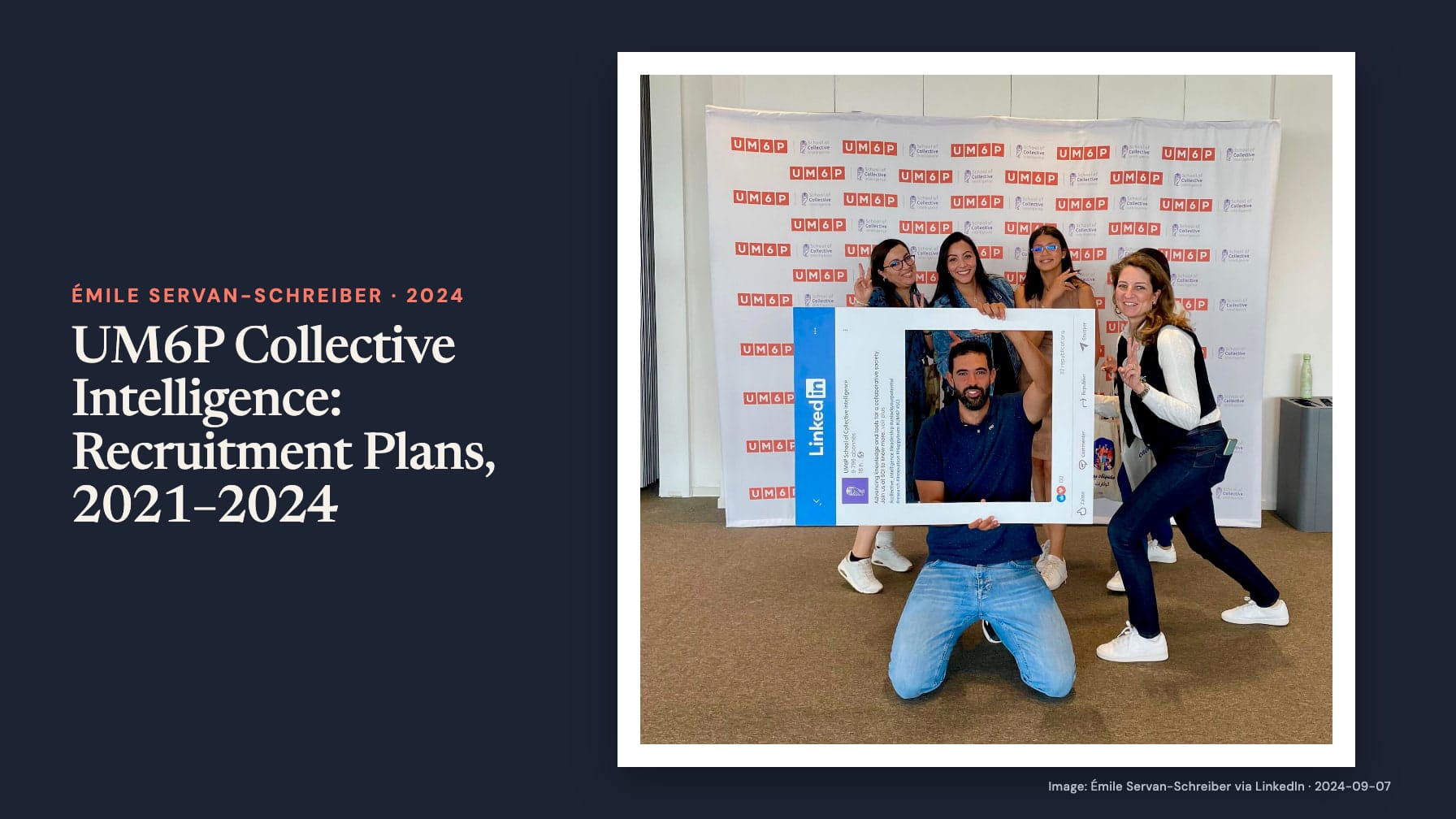
On 7 September 2024, Émile Servan-Schreiber shared a recruitment announcement for the Advisory Team at the UM6P School of Collective Intelligence. The full-time Junior Program Officer role was described in practical terms: helping teams reach their potential, running memorable workshops, building partnerships and supporting more open and creative organisations.
The announcement followed academic recruitment posts in April 2021 and February 2023. Together, the advertised roles cover research, teaching and work with organisations. The school sought people who could study collective judgement as well as help teams put it into practice.
Political science and social data
On 6 April 2021, Servan-Schreiber announced four positions, which he described as tenured: a professor in political science, a research and education fellow in political science, and two research and education fellows in social data or an open field. The post named the disciplines and supplied application links, presenting political science and social data as parts of the school’s research agenda.
On 17 February 2023, another announcement sought a professor in political science and/or collective intelligence. Servan-Schreiber described an international team of researchers and graduate students, a new campus in Morocco’s capital, and an ambition to improve society through the science of collective intelligence. His pitch connected academic work to an institutional ambition to improve how groups make decisions.
From research to organisational practice
The September 2024 advisory announcement asked for a master’s degree in business or a related subject, English and French proficiency, and curiosity. It linked the role to Morocco’s and Africa’s development. Its emphasis on workshops and partnerships made the applied side of the school visible alongside the earlier academic openings.
The school’s official institutional description confirms a broader remit in collaboration, collective decision-making and research. Its recruitment page is updated as opportunities change; it does not establish that these historical vacancies remain open.
For readers interested in forecasting, the connection is institutional rather than numerical. Research, teaching and facilitation provide different routes for making collective judgement usable. The journal’s account of teaching forecasting examines the educational side. The recruitment sequence shows how the school presented those different forms of work to prospective colleagues.