
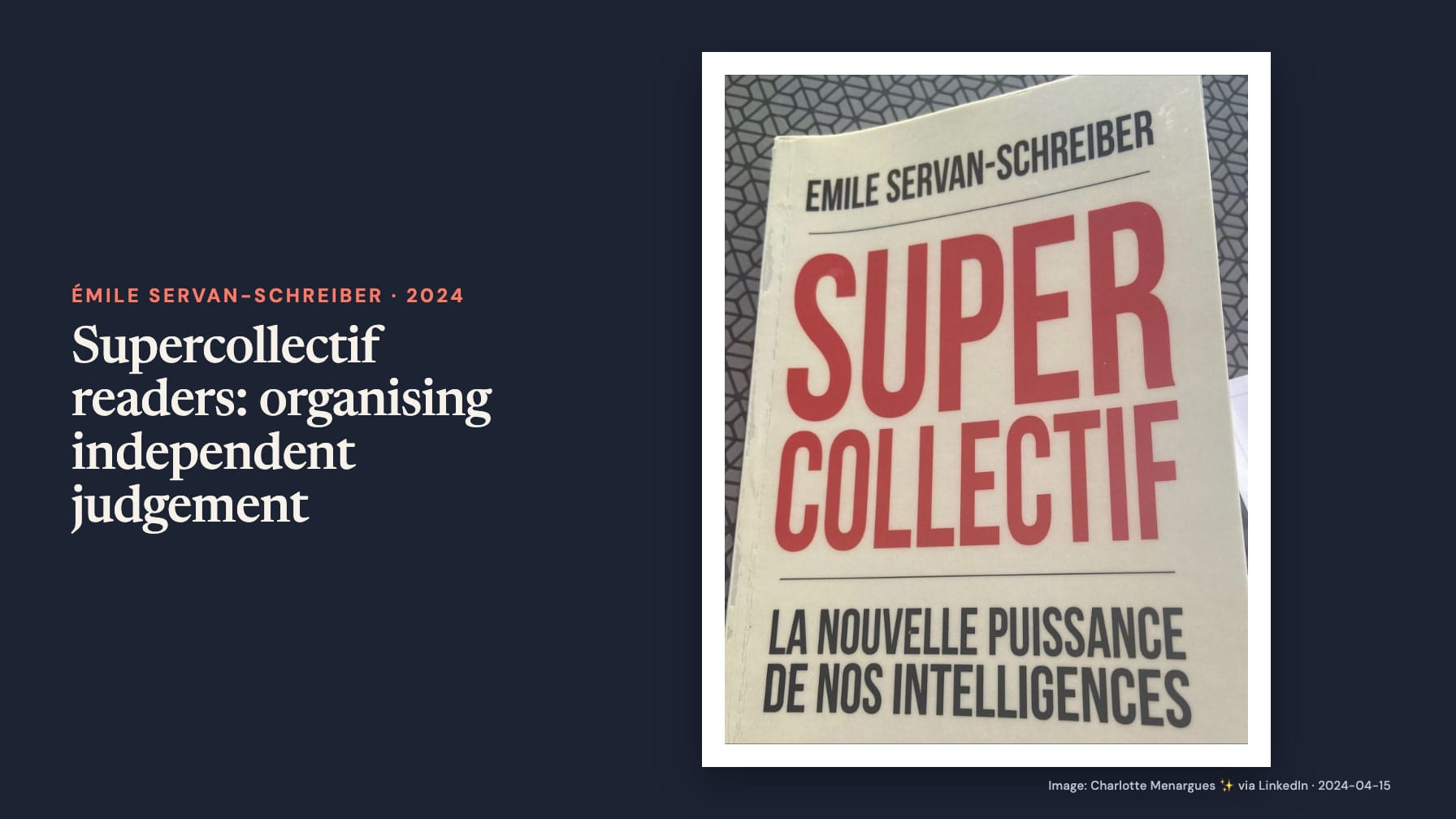
On 15 April 2024, Émile Servan-Schreiber thanked Charlotte Menargues for recommending Supercollectif. Her reading focused on a qualification that runs through the book’s reception: collective intelligence has to be organised. Adding people to a discussion is only a starting point.
Fayard published Supercollectif. La nouvelle puissance de nos intelligences on 24 October 2018. Its official description connects group intelligence, conformity, diversity, business performance and democracy. Reader responses between 2019 and 2024 show how people connected those themes to working habits: asking for independent judgements, seeking contradictors and creating room for different information.
Four conditions for a useful collective
A recommendation shared on 5 May 2023 identified four components of a useful collective: independent judgement, diversity of opinions, decentralised information sources and a method for extracting a collective answer. It offered voting, auctions, averaging and algorithms as examples of aggregation. The post framed the book’s principles around methods for gathering and combining information, suggesting different mechanisms for different kinds of questions.
That distinction matters to forecasting. Collecting different views and combining them are separate jobs. A crowd can contain valuable local information without having an effective way to turn it into a shared estimate. The post’s promises about anticipating markets, finding innovations and retaining talent describe hoped-for applications, rather than measured results.
A robotics leader and a workshop facilitator
In November 2019, Sophie Cahen described the book’s relevance to her team at Ganymed Robotics. She emphasised seeking contradictors, testing hypotheses and resisting attachment to a theory. Servan-Schreiber thanked her and praised the importance of the team’s work. Her reading focused on habits that encourage a team to test its own assumptions before settling on an answer.
A September 2019 reshare carried a different application. Pierre Alzingre reported workshops over fifteen days with 70 employees, 145 secondary-school pupils, 39 entrepreneurs and 77 students. He said the participants had experienced an advantage from working together. These are his reported counts and observations, describing how he applied the ideas in practice.
What the testimonials can establish
Thierry Fouquet’s January 2020 review connected the book to autonomy, diversity and freedom of expression in organisations and democracy. Menargues’s April 2024 recommendation similarly highlighted participation, acceptance of ideas and the need to organise human intelligence. Together, the posts document recurring reader interests across several years.
Woolley and colleagues’ 2010 study examined performance across tasks in small groups and reported a collective intelligence factor associated with social sensitivity and more equal conversational turn-taking. The findings give interaction a place alongside individual ability when thinking about group performance. They offer a research perspective on the reader recommendations’ recurring concern with listening and participation.
The reader responses turn an argument about collective intelligence into questions about disagreement, information and group process. The later English edition tells the publication story. These recommendations show a different aspect of the book’s reception: readers applying its ideas to how a team listens, evaluates proposals and decides what to do next.