
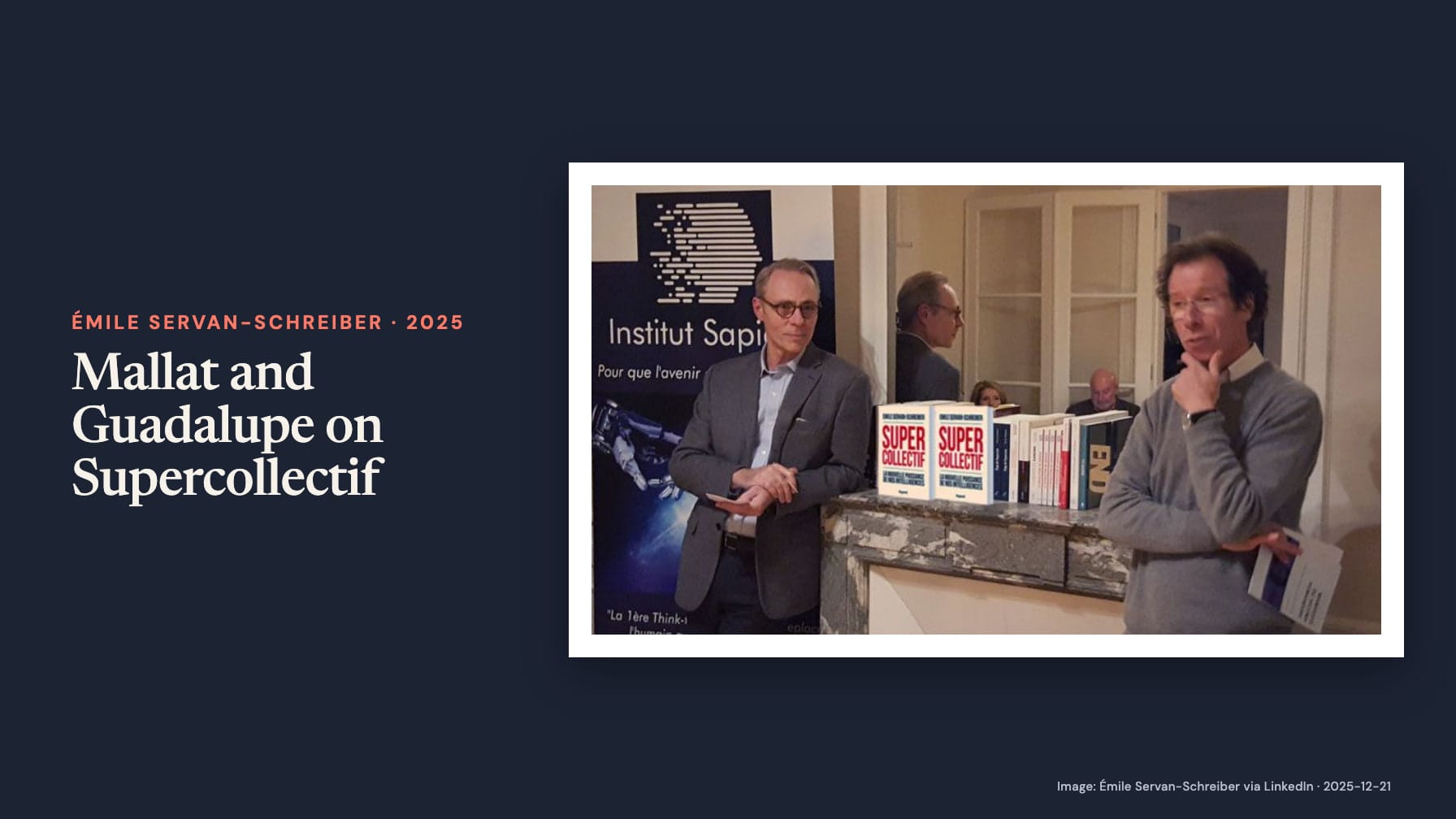
On 21 December 2025, Émile Servan-Schreiber returned to a response to his book Supercollectif that Stéphane Mallat had delivered seven years earlier. The occasion was Mallat’s 2025 CNRS Gold Medal. CNRS confirms the award, recognising his work across mathematics and computer science, including signal processing and artificial intelligence. Servan-Schreiber used the occasion to revisit Mallat’s connection between statistical learning and collective intelligence.
The original account, published on LinkedIn on 19 November 2018, dates Mallat’s remarks to a book presentation at Institut Sapiens on 13 November. A second article, published the next day, preserves Maria Guadalupe’s response at the same event. These are endorsements as recorded by the author, not independent experiments testing the book’s propositions.
Mallat: combining imperfect estimators
Mallat, identified in Servan-Schreiber’s account as the Collège de France professor holding the Data Sciences chair, began with his unease about collective intelligence. The remarkable organisation of social insects had previously suggested repetitive work to him rather than intellectual possibility. He found the book interesting because it challenged an opposition between individual and collective intelligence.
His central parallel was with statistical learning. In his account, effective strategies for answering complex questions can aggregate many unreliable estimators through a well-designed voting system. Diversity was therefore more than a desirable social slogan: it was part of an explanation of how an aggregate could exceed its components. He saw the book extending that argument from individuals to groups, companies and democratic processes.
Guadalupe: an argument for practical systems
Guadalupe, described in Servan-Schreiber’s account as an INSEAD professor of economics and political science, focused on what a reader might do with the argument. She linked the book to questions about AI, innovation in companies and the quality of democracy, while also asking how intelligence can arise in a complex system beyond any one individual.
Her response was explicitly personal: if she ran a company or government, she wrote, she would want help designing a system that drew on the collective to make better decisions. Her recommendation concerned the design of decision processes, rather than a reported consulting engagement.
The forecasting question underneath
The two responses identify complementary tasks. Mallat emphasised how estimates are combined; Guadalupe emphasised how the combined intelligence might change a decision. Neither response establishes that every crowd or ensemble will improve accuracy. It leaves a practical question for forecasting: which contributions add useful information, and how should they influence the answer?
Readers can follow the book’s later development in the journal’s account of Supercollective Intelligence’s English edition. The 2018 endorsements remain useful as a record of the argument’s early reception. Mallat’s later medal explains why Servan-Schreiber returned to the remarks in 2025, while the original remarks retain their original date and scope.