
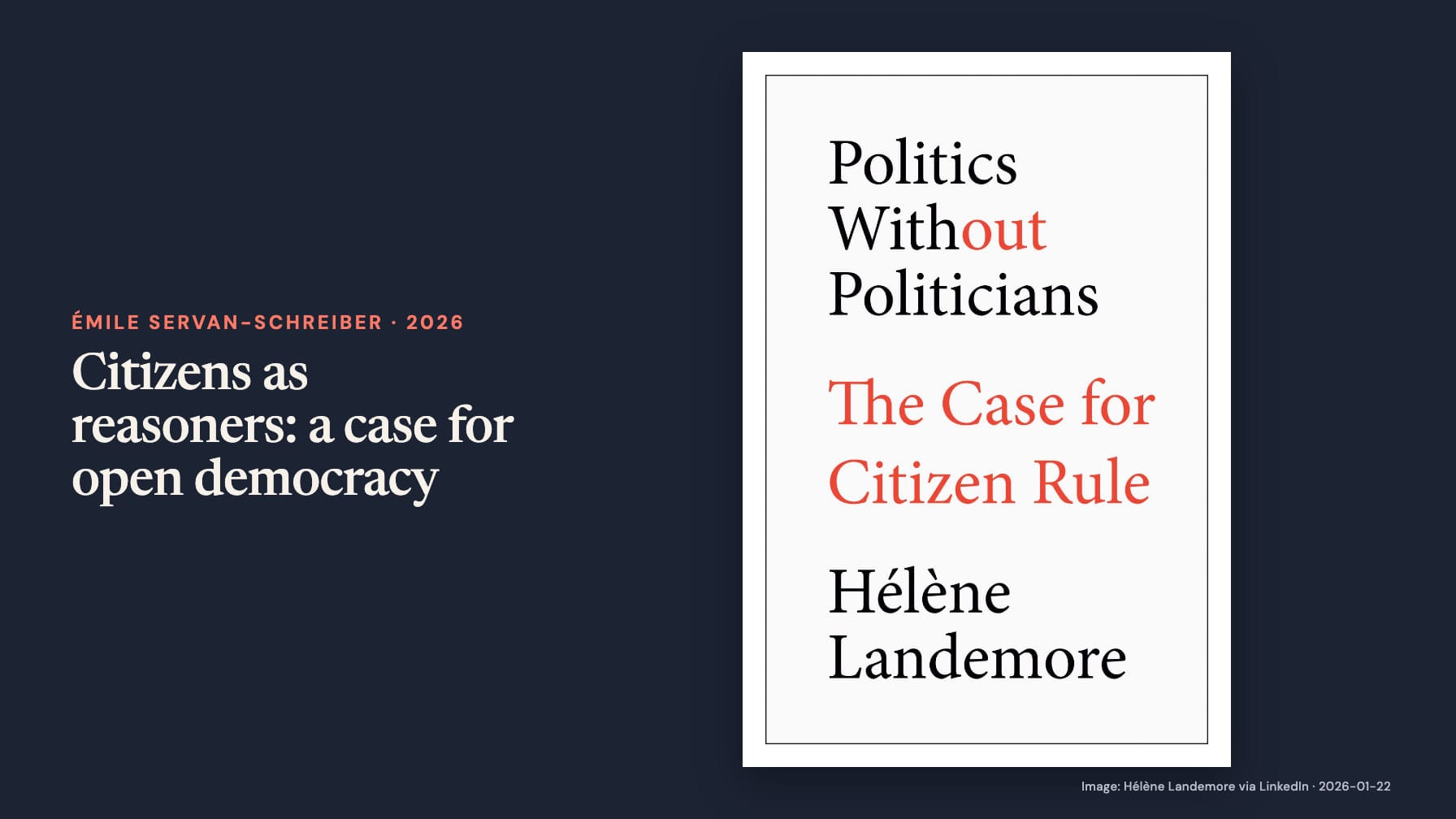
On 22 January 2026, Émile Servan-Schreiber reshared Hélène Landemore’s announcement of Politics Without Politicians. She described a book bringing ordinary citizens’ experiences into discussions of democracy; he welcomed its arrival. The publisher lists 10 February 2026 as the publication date. His brief endorsement was an anticipation of the book, rather than a review.
The endorsement continues a question running through his earlier advocacy and reading: what can citizens contribute beyond choosing professional politicians at election time? Candidate selection and public deliberation offer different answers, but both require institutions that give people a meaningful opportunity to contribute what they know.
An invitation to citizens in 2016
On 4 April 2016, Servan-Schreiber invited readers to support the first two candidates in La Vraie Primaire. He described them as ordinary citizens willing to help change France’s course and contrasted that option with the established contenders he named: Marine Le Pen, Alain Juppé and François Hollande. This was political advocacy for opening the candidate pool, not a prediction that the initiative would win.
Opening the candidate pool changes who can seek office. Organising public deliberation changes how people assess arguments. These are separate choices: a broader invitation to stand for election does not automatically create a better process for comparing policies or anticipating their consequences.
Why disagreement can help reasoning
A February 2020 reshare supplied a more specific research connection. Zelda Bas linked her reading of Supercollectif to a paper by Hugo Mercier and Hélène Landemore on group reasoning and democratic innovation.
Their 2012 paper, Reasoning Is for Arguing, proposes that reasoning works well when people produce and evaluate arguments in public deliberation. Its theory predicts an advantage for groups discussing diverse opinions, while warning that reasoning alone or among like-minded peers can reinforce initial beliefs. The distinction is about the conditions of discussion; it is not a claim that every crowd reaches a sound decision.
Participation remains a political proposal
In November 2018, Servan-Schreiber praised Yascha Mounk’s diagnosis of populism’s threat to democracy but considered the remedies insufficient. He presented his own concluding chapter on superdemocracy as going further. That comparison was his assessment of the two books, not an independently established ranking of their proposals.
Landemore’s later book announcement continues the citizen-centred theme without making the earlier primary and deliberative assemblies the same institutional design. The forecasting connection is narrower: useful collective judgement needs ways to bring different information into the decision. The journal’s account of citizen forecasting in public policy examines another form of that contribution, where beliefs about consequences can be expressed and checked. His advocacy asks who gets to contribute those beliefs in the first place.