
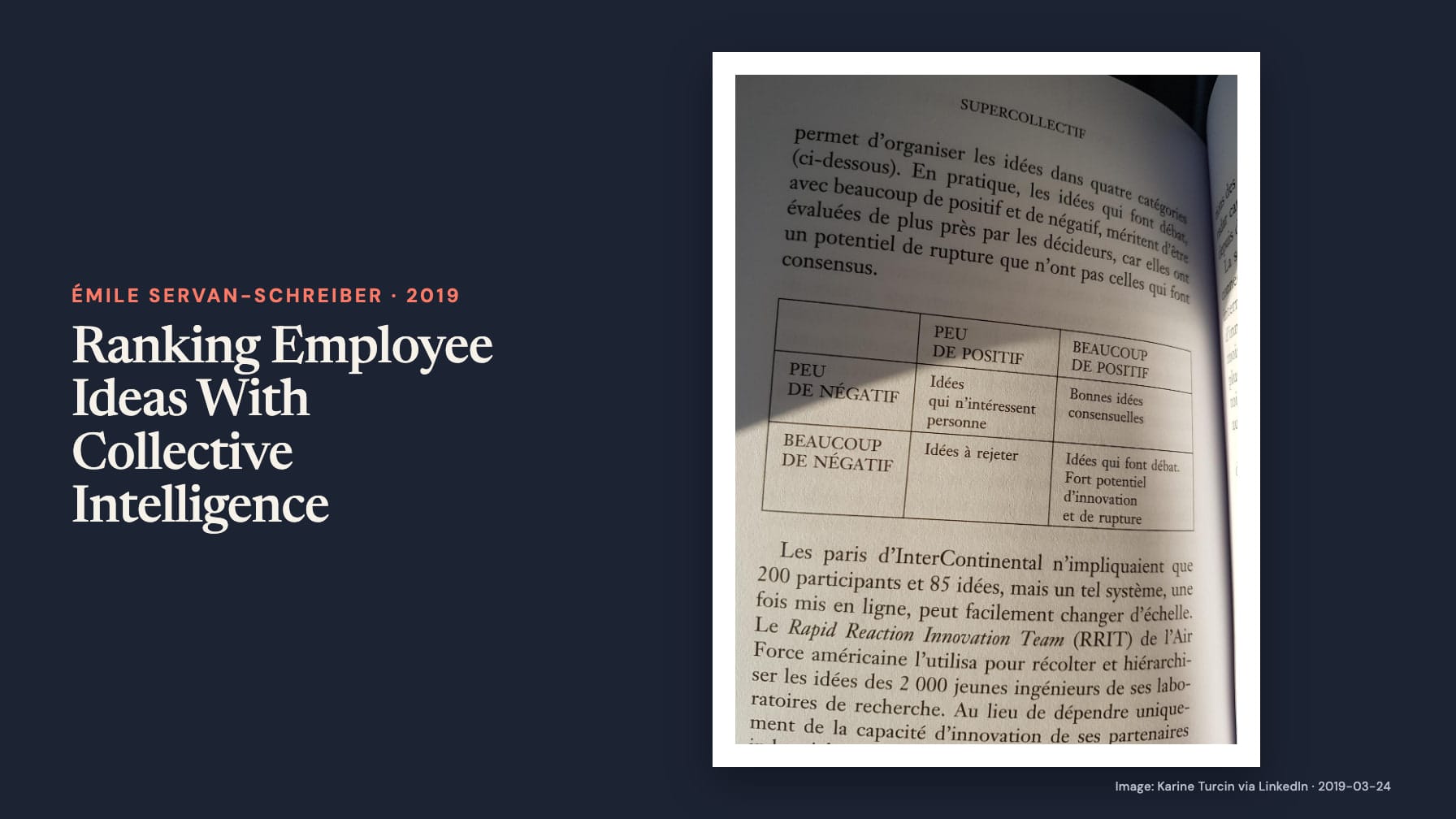
On 24 March 2019, Émile Servan-Schreiber reshared Karine Turcin’s question about ranking innovation ideas submitted by a team. Her answer was to invite willing employees to evaluate positive and negative impacts. The attached photograph of a page from Supercollectif makes the method more precise: keep the two dimensions visible instead of collapsing every idea into a single popularity score.
Four kinds of ideas
The photographed table crosses low or high positive assessments with low or high negative assessments. In the book’s framing, it produces four categories:
- Little positive and little negative: ideas that attract little interest.
- Much positive and little negative: good ideas with broad agreement.
- Little positive and much negative: ideas to reject.
- Much positive and much negative: disputed ideas with potential for innovation and disruption.
The paragraph above the table recommends closer evaluation of the disputed category by decision-makers. In the book’s argument, a contested proposal may offer possibilities that consensus ideas do not. Keeping positive and negative assessments separate preserves that disagreement as information: leaders can examine why some contributors see an opportunity while others see a risk.
Manutan’s Iday was a separate participation example
An earlier share, on 3 November 2018, carried Pierre-Olivier Brial’s account of Manutan’s Iday. He said 2,300 employees across Europe could propose and vote on ideas to improve customer, supplier and employee experiences. That wording describes the population offered participation; it does not establish that all 2,300 submitted ideas or voted.
Manutan’s 3 April 2019 press release corroborates an iDay held on 7 June 2018. It reports nearly 60% of group employees connected to the site and more than 4,300 ideas submitted and analysed. The company asked employees to propose ideas across six themes, including customer satisfaction, new products and services, cost savings, collaboration, supplier relationships and recruitment. These are company-reported activity measures, rather than innovation outcomes.
Brial said reading Supercollectif made him think the organisation could go further. The book’s matrix suggests a question to ask of any idea-ranking exercise: does the output preserve disagreement, or does it show only a combined score? A popular proposal and a divisive proposal may require different follow-up, even when both attract substantial attention.
For forecasting and decision-making, the useful distinction is between hearing many people and combining their judgements in a particular way. The journal’s discussion of minority rewards and prediction markets examines another mechanism for eliciting information. Here, the book excerpt shows how disagreement can remain an output worth examining, rather than disappear inside an average.