
On 2 August 2026, Émile Servan-Schreiber, co-founder and Chief Scientific Advisor of The Forecasting Machine and CEO of Hypermind, posted two bar charts one above the other. They showed the Hypermind prediction market’s estimates of each likely candidate’s chance of winning the 2027 French presidential election, in summer 2025 and in summer 2026. His question to readers was simple: what has changed in a year?
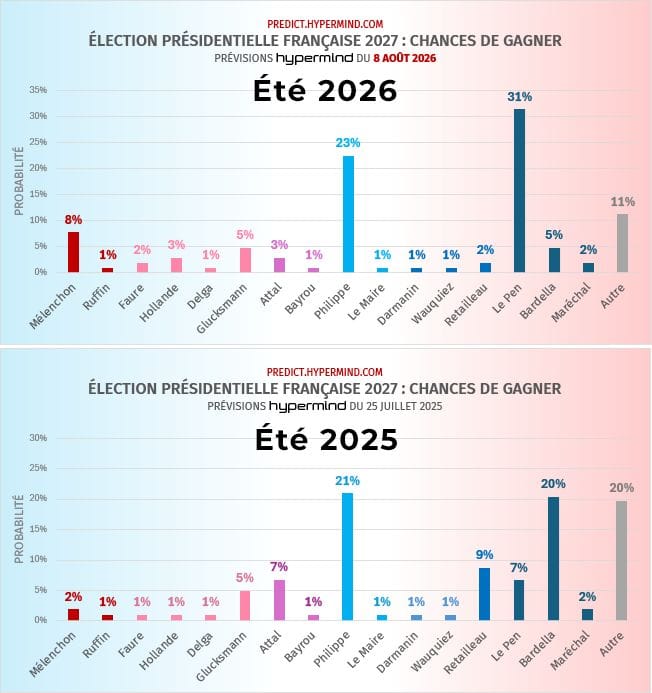
This article reads those numbers as a snapshot of collective expectations at a given moment, not as a forecast of who will win. Hypermind is a prediction market that uses no real money. Participants trade on the outcomes they expect, and the resulting prices are read as probabilities. A 31% chance is not a call that a candidate will win. It means that, in the crowd’s judgement, things play out that way in roughly three cases out of ten, and in seven out of ten they do not.
Summer 2025 against summer 2026
The list below compares the two charts for the main names. The 2025 figures are from the end of July 2025.
- Marine Le Pen: 7% → 31%
- Jordan Bardella: 20% → 5%
- Édouard Philippe: 21% → 23%
- Jean-Luc Mélenchon: 2% → 8%
- Bruno Retailleau: 9% → 2%
- Gabriel Attal: 7% → 3%
- Raphaël Glucksmann: 5% → 5%
- François Hollande: 1% → 3%
- Olivier Faure: 1% → 2%
- “Autre” (someone not on the list): 20% → 11%
Servan-Schreiber grouped the gains and losses in his post. Le Pen and Bardella together rose by 9 points, from 27% to 36%. Mélenchon gained 6 points, Philippe and Hollande 2 each, and Faure 1. The “unknown saviour”, as he called the “Autre” option, lost 9 points, Retailleau 7 and Attal 4.
How the picture formed
The series began earlier. On 15 June 2025, Servan-Schreiber noted that it was early for robust estimates. He grouped the market’s chances into political families: 28% for the far right (Le Pen, Bardella, Marion Maréchal), 35% for the right from Philippe to Retailleau, 9% for the centre (Attal, François Bayrou), 7% for the left from Faure to Glucksmann, 4% for the far left (Mélenchon, François Ruffin), and 18% for someone other than the usual suspects. That last share, he wrote, reflected how uncertain such a distant vote still was.
By 1 October 2025 he put the totals at 35% for the RN, 29% for the “socle commun” (the centre and centre-right parties that had backed recent governments), and 12% for the left. Within the RN, Bardella then led Le Pen by 24% to 8%.
By 5 February 2026, a separate Hypermind market put the probability that Le Pen would be eligible for the presidential election at 31.6%, against 68.4% that she would not. That forecast measured a legal condition for candidacy, not her chance of winning, but it helps explain why the market’s Le Pen and Bardella probabilities had to move together as the appeal developed.
The reversal between the two RN figures is the largest single movement over the year. Servan-Schreiber did not comment on its cause in his post. One relevant event, which we add as context, came on 7 July 2026. The Paris Court of Appeal ruled in the European Parliament assistants case. It sentenced Le Pen to 45 months of ineligibility, 30 of them suspended, and held that the period already served since 31 March 2025 was enough. Ignoring it, the court said, would infringe the freedom to stand for election. That made a Le Pen candidacy more plausible than it had been a year earlier, when Bardella was widely treated as her stand-in.
Servan-Schreiber’s reading
In his view, the contours of the election were becoming clearer. He described three:
- a duel between the RN and the candidate of the right and centre;
- Philippe as the only credible candidate of the right and centre;
- a fratricidal left dragged to the bottom by what he called “the millstone” Mélenchon.
These are his interpretation of the market, offered as a question to readers (“does this seem consistent to you?”), not a projection. The chart itself does not show a two-way race. In the 2026 numbers, nobody passes one chance in three. The left’s candidates together come to about a fifth, and “Autre” still holds 11%.
Reading probabilities, not verdicts
The comment thread showed why the distinction matters. When a reader brought up the 2024 US election, Servan-Schreiber replied that the market had given Kamala Harris “60% chances”, which was “far from a certainty”. He had made the same point in June 2025: Hypermind’s forecasters had not called Harris the winner, only the favourite, with three chances in five. A favourite at 60% should lose about four times in ten. A single result therefore says little about whether the probability was well judged. That can only be tested across many questions, which is what calibration measures.