
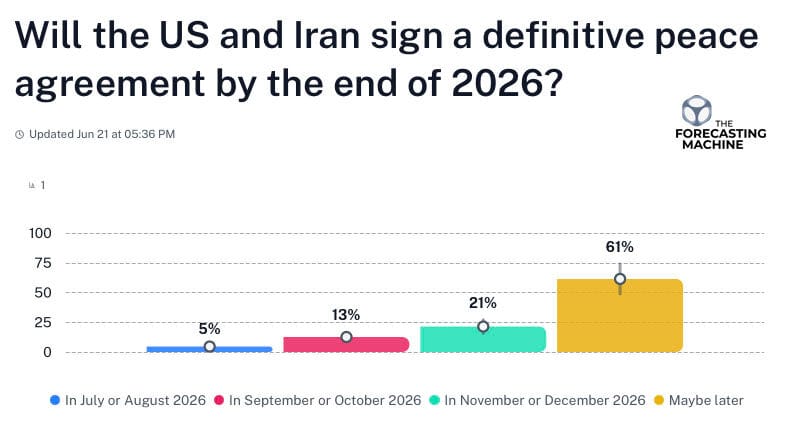
In mid-June 2026, the United States and Iran signed a memorandum of understanding that was meant to open a 60-day window for negotiating a lasting settlement. On 21 June, The Forecasting Machine published its forecast on whether that window would produce a definitive peace agreement by the end of 2026. Its answer was “maybe later”.
Émile Servan-Schreiber reshared the forecast with a one-line comment aimed at the US vice-president, JD Vance:
Good luck getting to a deal in 60 days, JD!
Émile Servan-Schreiber, on LinkedIn, 21 June 2026
This is a different question from our earlier write-ups on US strikes on Iran and the timing of a ceasefire. A ceasefire stops the fighting. A definitive agreement has to settle the issues behind it.
The forecast
The question asked when, if at all, the two governments would sign a definitive peace agreement. On 21 June the machine’s probabilities were:
- July or August 2026: 5%
- September or October 2026: 13%
- November or December 2026: 21%
- Maybe later (not in 2026): 61%
Put another way, it gave roughly a two-in-five chance of a treaty in 2026 and a three-in-five chance of slippage into 2027 or beyond. Even its most hopeful 2026 window, the last two months of the year, was less likely than slippage.
The reasoning
The machine’s summary made three arguments, which we paraphrase:
- History. Turning a framework memorandum into a final treaty within six months would be a historical anomaly.
- Deferred issues. The hardest questions, Iran’s uranium enrichment, its missile programme and its support for allied armed groups in the region, had been postponed, not resolved.
- Spoilers. Domestic opposition was fierce on both sides, and conflict involving third parties had already disrupted the talks.
The post pointed to a “fully-sourced analysis” in its comments. At the time of writing that shared report no longer loads, so the figures here are taken from the chart The Forecasting Machine published.
What has happened since
According to The National, the memorandum was signed on 17 June by Donald Trump and Iran’s president, Masoud Pezeshkian. It left enrichment, ballistic missiles and Iran’s network of allied groups out of scope, which matches the machine’s reading. The two sides then disagreed over the wording on the Strait of Hormuz and held only one round of indirect talks, in Doha. By mid-July the calm had broken down. The paper reported six consecutive days of US strikes, renewed Iranian attacks on tankers and the US revocation of a 60-day oil waiver. Iran said it had “no plans to resume negotiations”.
Talks did resume, indirectly. Al Jazeera reported on 29 September that Qatar was mediating between the delegations at the UN General Assembly in New York. It said Trump had rejected Iran’s latest proposal, the Strait of Hormuz was under blockade from both sides and no agreement was in sight. Trump said a deal would not come before the US midterm elections on 3 November.
Where the forecast stands
The July–August window passed without a treaty, and September ended without one, so only October is left of the September–October window. The question is still open: the forecast covered the whole of 2026, and three months remain. A last-minute agreement in November or December, the window the machine itself rated most plausible, would still be consistent with what it said. A one-in-five chance is not a ruling-out.