
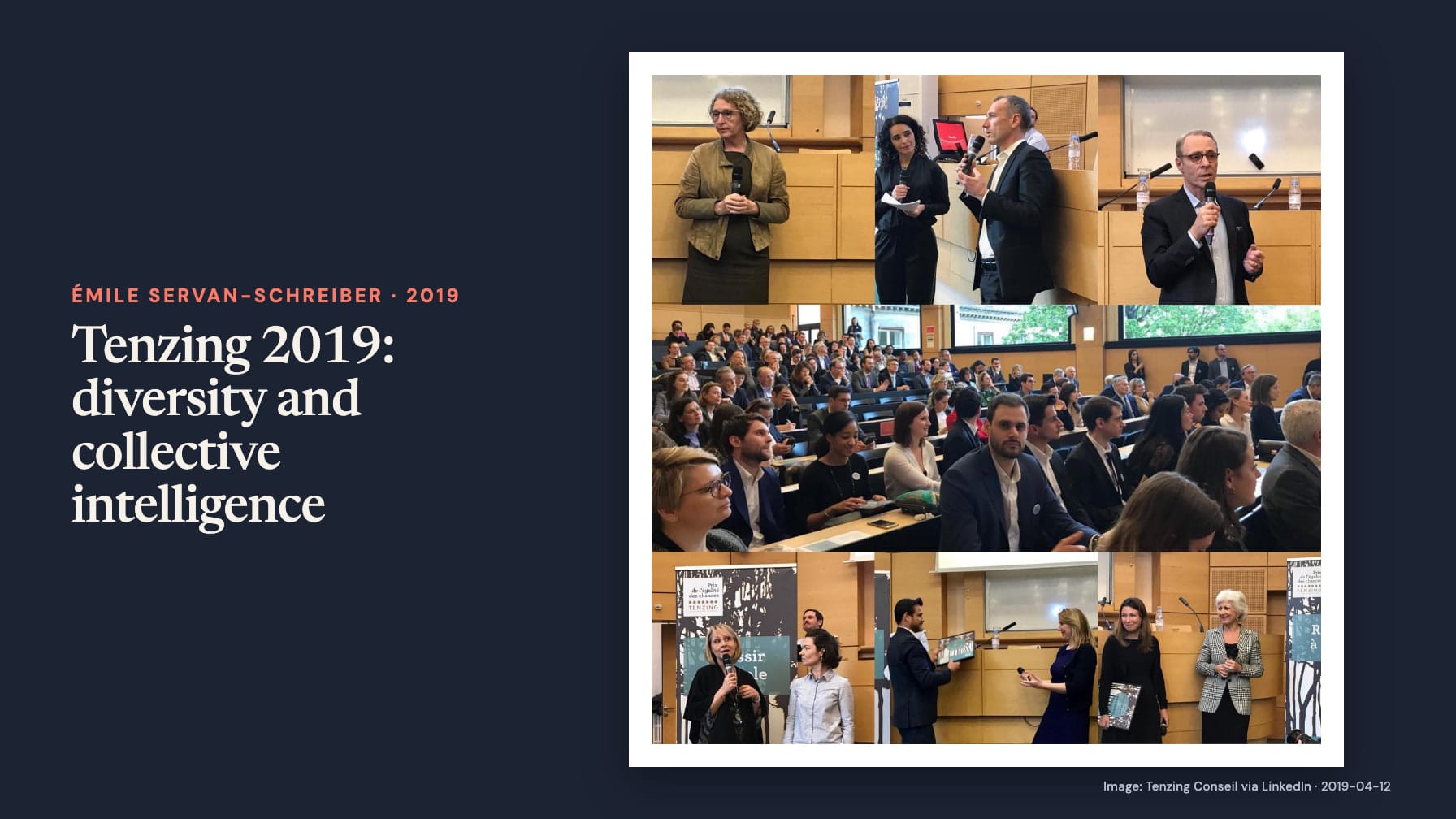
On 11 April 2019, Émile Servan-Schreiber spoke at Sciences Po during the second Prix Tenzing de l’Égalité des Chances. In his post that evening, he described appearing alongside Emmanuel Faber and Muriel Pénicaud and thanked Tenzing Conseil and Thibaut Guilluy for inviting him to discuss diversity’s role in collective intelligence.
The occasion concerned educational opportunity as well as organisations. A contemporaneous report by award recipient Réseau Môm’artre confirms the 11 April ceremony and its 2019 award for the Môm’Bondy project. Tenzing’s own recap, reshared by Servan-Schreiber, presented the prizes as a means of changing both attitudes toward opportunity and company practices.
The argument after the event
On 12 April, Servan-Schreiber extended his intervention in writing. He argued for recognising the value of people’s differences, citing Scott Page’s diversity theorem: collective performance depends on both the average quality of contributions and how different they are. His further claim was that even a weaker contribution could help if it brought enough difference to the group.
Tenzing subsequently circulated interview material that he reshared on 6 May and 29 June. The May post connected universities, professional training and public action with a wider mix of profiles in companies. Its excerpt captured his managerial prescription:
Si le but est d’augmenter le QI de votre entreprise, il faut maximiser la diversité des points de vue qui sont sollicités dans l’entreprise.
Émile Servan-Schreiber, excerpt circulated by Tenzing and reshared on 6 May 2019
In our translation: “If the aim is to increase your company’s IQ, you need to maximise the diversity of viewpoints sought within the company.”
What the theorem establishes
Page’s own account makes the forecasting mechanism precise. For numerical predictions combined by their arithmetic mean, the collective squared error equals the average individual squared error minus the variance of those predictions. Diversity here means differences in estimates. The identity does not guarantee that adding any particular person improves the result: average individual error can change too.
It also does not make demographic variety interchangeable with predictive diversity, or establish an automatic improvement in company performance. Servan-Schreiber’s broad organisational argument is an application of the idea. The distinction matters when turning an inclusion principle into a forecasting method.
This thread complements the IFTTD discussion of expertise and diversity. The practical question is how an organisation makes different judgments available for aggregation. In the Tenzing setting, his argument connected a managerial choice about whose views are sought with the forecasting question of what information those views add.