
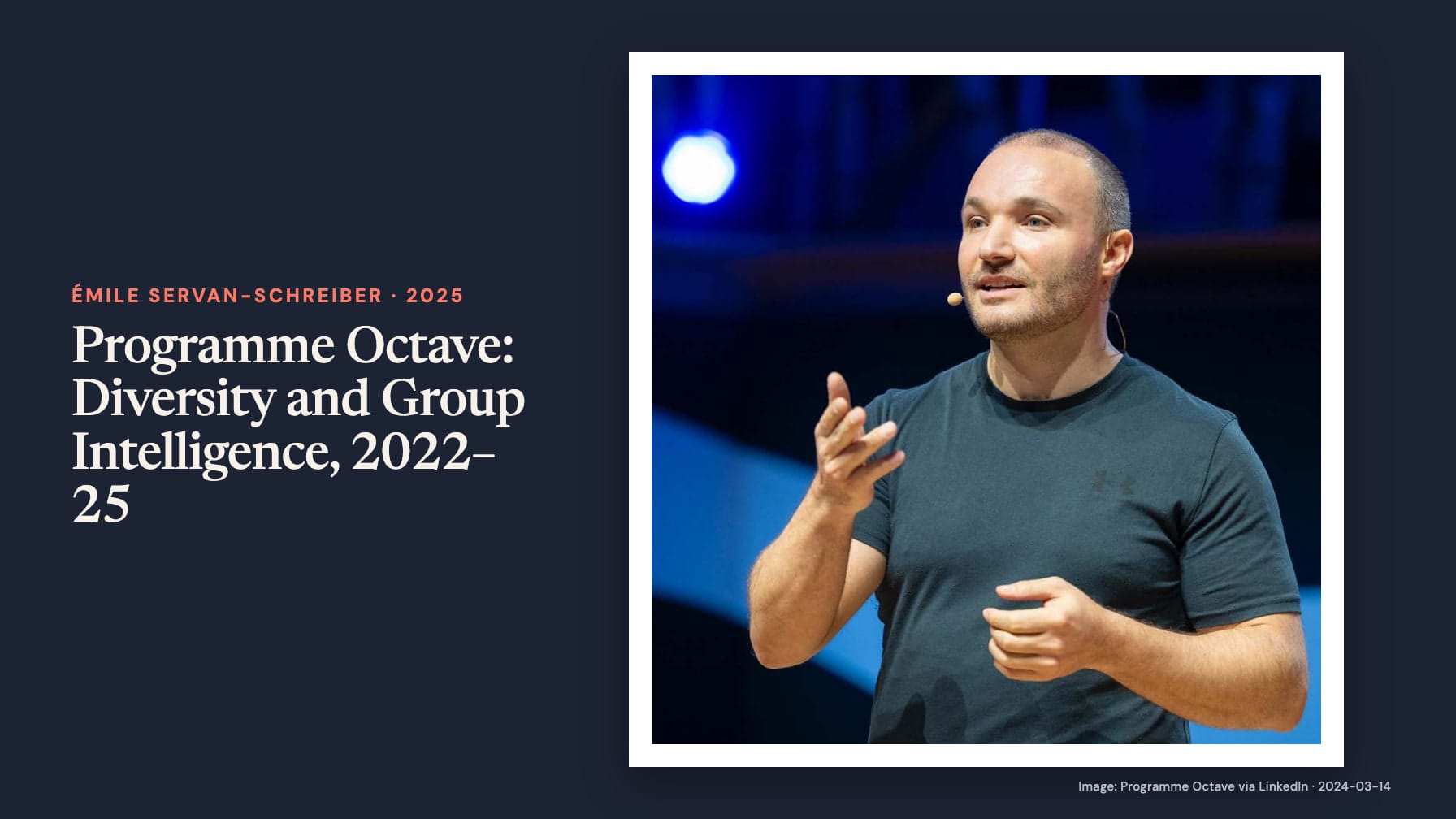
On 29 March 2025, Émile Servan-Schreiber announced another lecture on diversity and performance at Programme Octave in Évian-les-Bains. The next Tuesday, 1 April, fell at the start of the programme’s 1–3 April seminar. It continued a theme from his earlier Octave contributions: a group’s ability to think depends on how it brings different people into cooperation.
Octave describes its purpose through a musical analogy. A company that draws mainly on the generation in power resembles a piano played only in its middle octaves, neglecting the lower and higher registers. The programme was created to give different generations a fuller place in the enterprise. Its combination of personal development and understanding a changing world supplies the setting for the collective-intelligence talks.
From an invitation to documented talks
On 21 March 2022, Servan-Schreiber shared the organizer’s announcement that the seminar was returning in person. It listed him among the invited speakers, and the attached graphic gave the dates as 30 March–1 April in Évian. The invitation situated collective intelligence alongside talks and workshops about adapting to a changing world.
An organizer recap shared on 5 April 2023 described his contribution to the second day of plenaries. Its argument was that cooperation can extend human capabilities, provided the group is diverse and different skills and viewpoints can be expressed. The recap placed this beside Peter Hinssen’s discussion of technological change, connecting the organisation of people with the tools available to them.
The 2024 argument: get beyond familiar circles
A February 2024 invitation posed questions about group intelligence and diversity. On 14 March, an organizer recap identified Servan-Schreiber’s session as a discussion of how diversity makes people smarter together. Its reasoning was practical: cooperating mainly with people like ourselves can leave us with much the same limits as working alone. New ideas require encounters with different perspectives.
The same recap separately described Jérémy Lamri’s session on changing definitions of intelligence and competence. Lamri’s themes included critical thinking, cooperation and ease with technology. In December, another Octave post returned to Servan-Schreiber’s 2024 contribution, emphasizing the ability to do together what individuals cannot do alone. Both accounts treated cooperation as something to organise deliberately.
The April 2025 invitation
Official workshop material dates the 2025 seminar to 1–3 April in Évian, consistent with Servan-Schreiber’s announcement of a Tuesday lecture. His announcement presents diversity and performance as the intended subject. Across the earlier recaps and this invitation, the recurring argument concerns the organisation of contributions: different viewpoints must have room to be heard.
That lesson also connects to his teaching on crowd forecasting. A forecasting group needs ways to gather different information before combining it into a judgement. Octave provides a leadership setting for that question, asking participants to look beyond familiar circles and consider how the abilities of different generations can contribute to a shared task.