
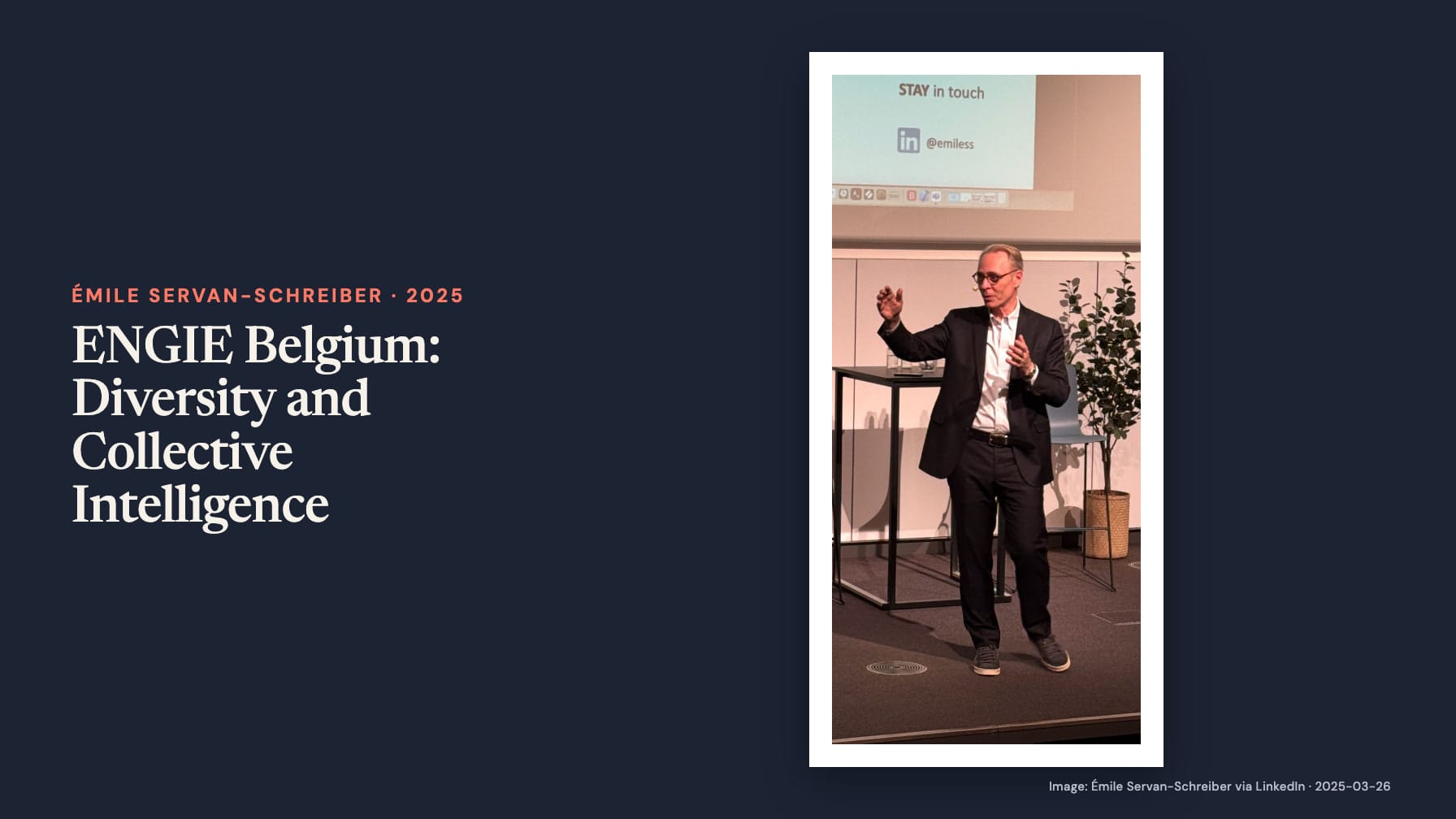
On 18 March 2025, Florence Muls reported introducing Émile Servan-Schreiber to ENGIE teams in Belgium and Europe for a discussion of collective intelligence. Her account described an interactive conference, held both on site and online, for hundreds of ENGIE Belgium employees. Servan-Schreiber reshared it that evening, stressing the importance he attached to diversity and inclusion.
A further LinkedIn reaction dated 26 March emphasised social sensitivity, equality of speaking time, listening to colleagues and testing ideas with a wider range of peers. The attendee’s name is unavailable. The emphasis gives a practical interpretation of the conference: inclusion involves what people can contribute during a discussion, as well as who has been invited into it.
What social sensitivity adds to a group
A 2010 Science paper by Anita Williams Woolley and colleagues studied 699 people in small groups. Group performance correlated with social sensitivity, more equally distributed speaking turns and the proportion of women. It did not test ENGIE’s conference or establish a guaranteed workplace effect.
The attendee also referred to reading minds through the eyes. A 2014 study by David Engel and colleagues examined social reasoning in face-to-face and online groups. The measure predicted group performance even when participants communicated through text and could not see one another. Its relevance was broader than recognising a facial expression: anticipating another person’s perspective can matter across different forms of collaboration.
From a conference to everyday practice
Muls said Supercollectif had helped her see the subject differently and presented inclusion as important for innovation. The later attendee response translated that argument into everyday behaviour: listen, invite more perspectives and let colleagues contribute. These are accounts of what participants valued in the discussion, rather than a measurement of its effect on ENGIE’s work.
The event belongs to the practical organisational side of Servan-Schreiber’s work, explored more fully in Supercollective Intelligence. For forecasting, its implication is that assembling diverse people is only part of the task. Their information needs a route into the shared judgement. A discussion dominated by a few voices can leave relevant knowledge unheard, even when the room contains it.