
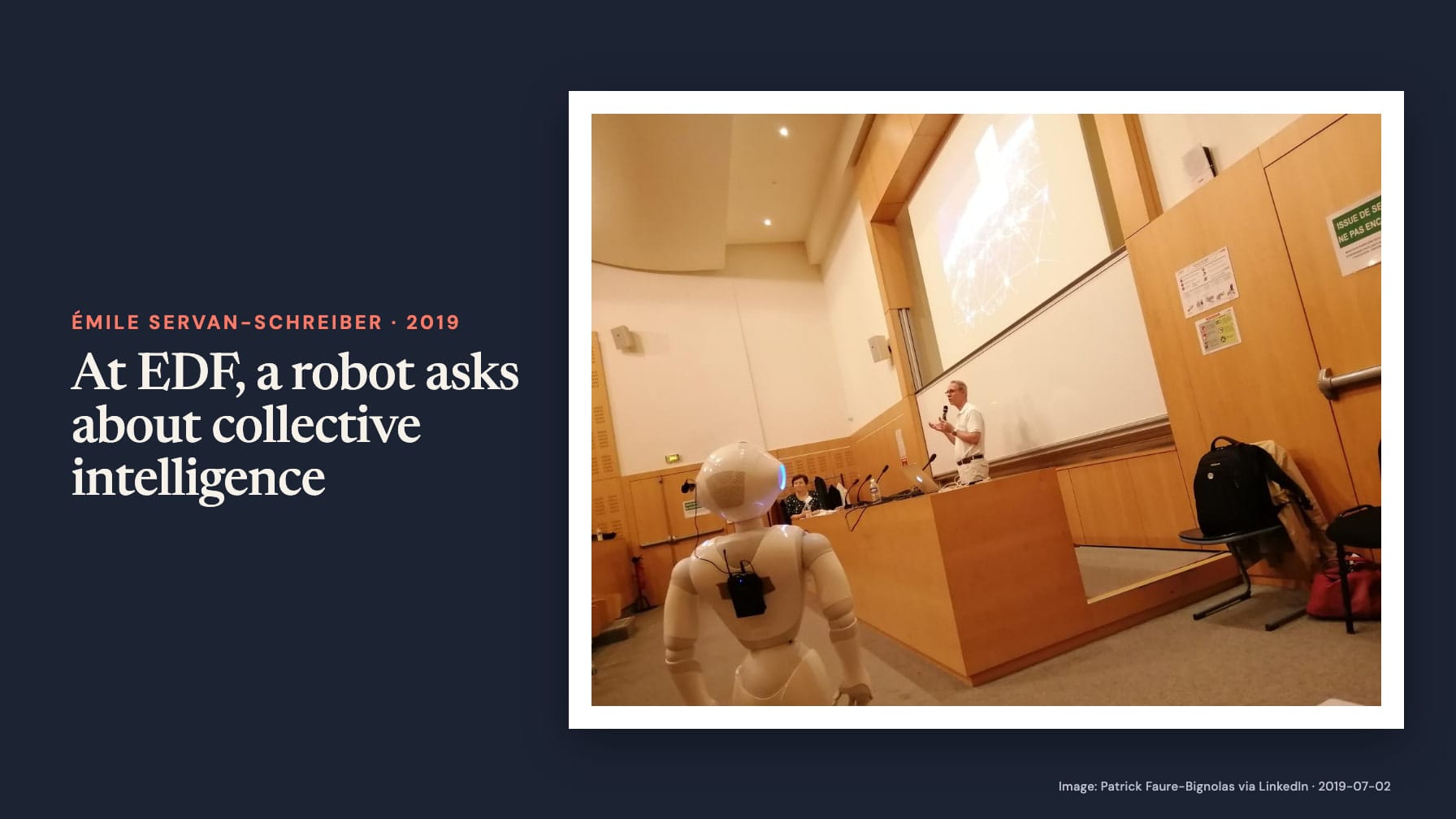
In July 2019, an EDF seminar prompted a question that Émile Servan-Schreiber considered worth recording: could a robot contribute to collective intelligence? His 2 July update described an exchange with a small robot he called Rocky and answered yes. In his view, artificial and collective intelligence could be combined.
A reshare the next day provided the organisational setting. Stéphanie Prisselkoff described an end-of-project seminar for the people responsible for collaborative tools within EDF’s Direction de la Production Nucléaire. Collective intelligence was the theme, Servan-Schreiber was a guest, and she identified ROCky as a new chatbot designed by Sopra Steria Consulting.
One question, two descriptions
The sources need careful reading. The post beneath Servan-Schreiber’s 2 July comment, by Patrick Faure-Bignolas, used the tag “pepper” and described a Sopra Steria robot attending the conference before EDF teams. The attached photograph shows a humanoid robot beside a speaker in a lecture room. The following day’s account instead calls ROCky a chatbot.
The relationship between the physical robot and ROCky is unconfirmed. Servan-Schreiber’s account supplies the substantive question: whether an artificial participant could contribute to collective intelligence. His answer shifts attention to the combination of abilities within a group, rather than treating human and machine intelligence as separate subjects.
A research question beyond the demonstration
Independent research had already made machine participation in groups a testable subject. In a 2017 Nature paper, Hirokazu Shirado and Nicholas Christakis studied a networked colour-coordination game involving people and software agents. Under particular conditions, centrally placed bots with a small amount of behavioural randomness improved group coordination. The result concerned a specific task and agent design, not the general intelligence of a robot.
The study provides independent research context for the question raised at the seminar. It illustrates why a machine’s contribution should be assessed through the group’s task and performance, rather than its appearance or ability to speak. A useful evaluation therefore asks what contribution a machine makes to the work people are doing together.
The journal’s account of the hybrid forecasting competition describes a separate effort to combine machine and human forecasts. The EDF exchange belongs to the wider discussion of mixed collectives in collaborative work. Its contribution is the question it put into a collaborative-work setting: what role could a machine play within the group?