
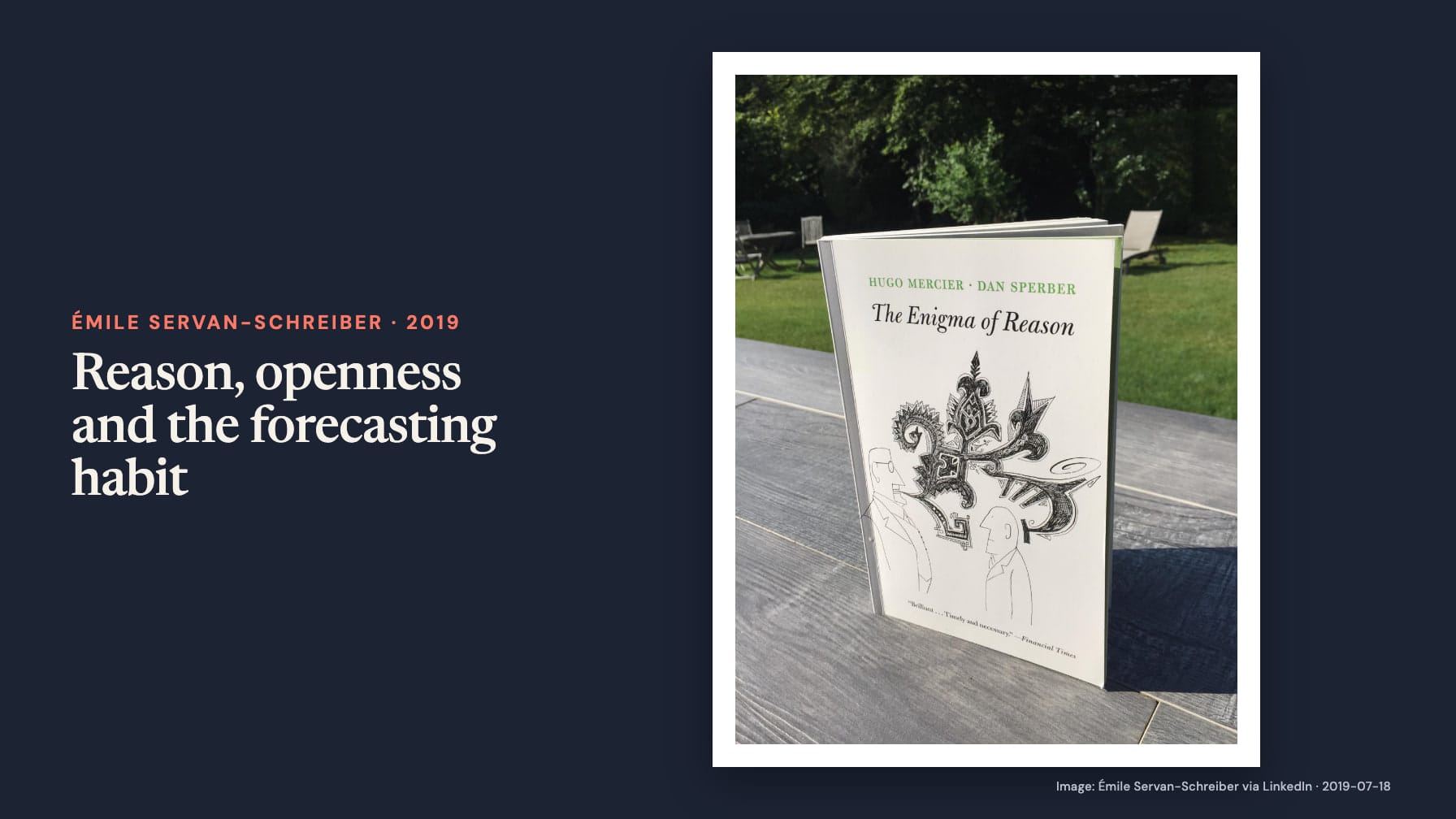
On 18 July 2019, Émile Servan-Schreiber recommended a book about reason at a moment he described as politically unsettling. His photograph identifies it as The Enigma of Reason, by Hugo Mercier and Dan Sperber. The recommendation followed a February post about a televised disagreement over climate change. Together, the two entries concern a habit central to forecasting: taking other people’s reasoning seriously, including when it challenges one’s own.
Reason as a social activity
Mercier and Sperber’s 2017 book proposes that reasoning is adapted to social interaction: people offer reasons for their positions and evaluate reasons offered by others. The Harvard University Press edition presents this as an explanation for both reason’s strengths and its characteristic biases. That is the authors’ account, rather than a finding established by Servan-Schreiber’s recommendation. It also distinguishes a group’s access to different arguments from any guarantee that discussion will produce the right answer.
On 5 February 2019, Servan-Schreiber had shared Xavier Alberti’s commentary on an old television exchange involving Haroun Tazieff. He praised the willingness to listen to other people and connected openness to the superforecasters discussed in his own book. He highlighted listening as a forecasting habit: an opposing argument can contain information that a confident speaker has missed.
The INA archive’s account identifies a debate on Les Dossiers de l’écran on 4 September 1979: Tazieff warned about warming associated with industrial emissions, while Jacques-Yves Cousteau argued that natural mechanisms would compensate. INA’s later account corroborates the historical disagreement. Servan-Schreiber read the disagreement as an example of why being willing to reconsider an argument matters.
Openness can be studied
There is more direct forecasting evidence in Barbara Mellers and colleagues’ 2015 study of geopolitical prediction. The researchers examined cognitive abilities, thinking styles, training, team participation and forecasting behaviour. They defined actively open-minded thinking in terms of evaluating evidence without undue attachment to prior beliefs and recognising that one’s judgment can be wrong. Their analysis treats openness as one contributor among several, rather than a complete explanation of forecasting skill.
The practical implication is a discipline, not simply a welcoming attitude: ask what evidence would change an estimate, consider a competing explanation, and revise when new information warrants it. Applied to forecasting, those habits turn discussion into a way of testing an estimate. Our history of proven NewsFutures forecasters provides the complementary perspective: openness becomes useful for forecasting when predictions are recorded and performance can be examined over time.