
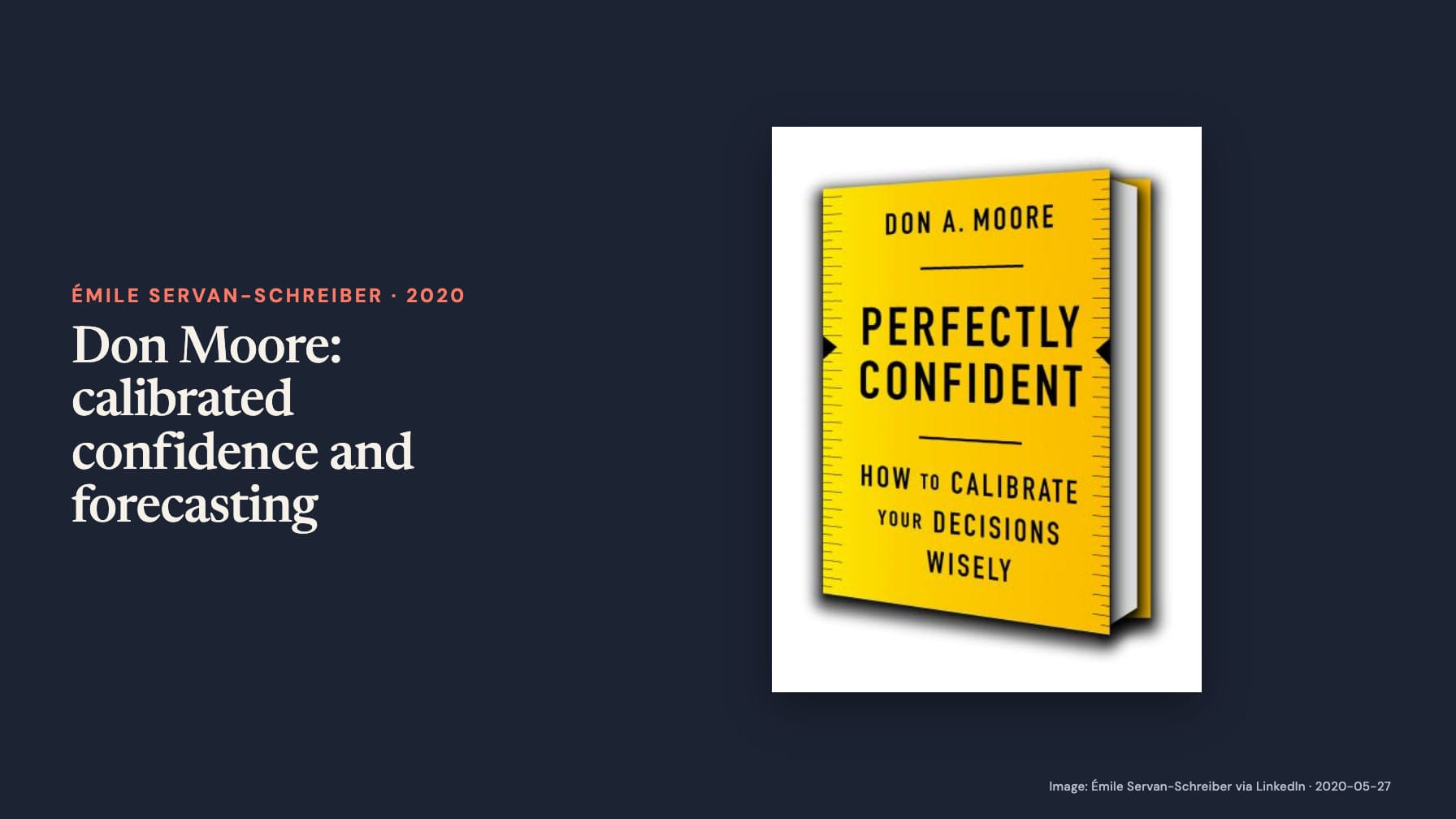
On 27 May 2020, Émile Servan-Schreiber recommended a new book by Don Moore, whom he described as a past collaborator on crowd-forecasting research. His playful endorsement put his confidence that he would enjoy it at 99%. That number described his expectation of reading pleasure, not the measured accuracy of Moore’s research or a Hypermind market.
The accompanying link points to Perfectly Confident: How to Calibrate Your Decisions Wisely. Berkeley Haas identified the title in its 5 May announcement and gave the release date as 26 May 2020. The book’s subject fits the language of the recommendation: matching confidence to what the evidence warrants.
Confidence that can be checked
The Haas account describes Moore’s aim as avoiding both inflated certainty and unnecessary self-doubt. Its practical advice includes writing down expectations and tracking results, considering ways one might be wrong, and using comparable cases to take an outside view. It also cautions against confusing a person’s confident manner with competence.
For a forecaster, keeping a record turns this advice into an observable discipline. A probability is a commitment about the frequency of an outcome across comparable judgements. The journal’s guide to calibration and the Brier score explains how those commitments can be checked after questions resolve.
The forecasting research behind the theme
Moore and colleagues’ paper Confidence Calibration in a Multiyear Geopolitical Forecasting Competition, published online in August 2016, examined thousands of forecasters predicting hundreds of events over three years. The authors reported that confidence and accuracy increased together as information arrived. They also found that training reduced overconfidence and team collaboration improved accuracy.
These results describe a particular tournament and its participants. They support studying how confidence develops with practice and feedback, rather than treating certainty as a fixed personality trait. They do not imply that every confident group forecasts well.
Servan-Schreiber’s recommendation connects a practitioner’s interest in crowd forecasting with Moore’s work on confidence. The tournament paper supplies a separate research example, with its own authors and findings. For a forecasting team, the shared practical question is how to match confidence to evidence: record a judgement, revisit it as information arrives and compare it with the eventual outcome.